Wenn Sie das Fenster schließen, wird Ihre Konfiguration nicht gespeichert, es sei denn, Sie haben Ihren Artikel in die Bestellung aufgenommen oder zu Ihren Favoriten hinzugefügt.
Klicken Sie auf OK, um das MILLIPLEX® MAP-Tool zu schließen oder auf Abbrechen, um zu Ihrer Auswahl zurückzukehren.
Wählen Sie konfigurierbare Panels & Premixed-Kits - ODER - Kits für die zelluläre Signaltransduktion & MAPmates™
Konfigurieren Sie Ihre MILLIPLEX® MAP-Kits und lassen sich den Preis anzeigen.
Konfigurierbare Panels & Premixed-Kits
Unser breites Angebot enthält Multiplex-Panels, für die Sie die Analyten auswählen können, die am besten für Ihre Anwendung geeignet sind. Unter einem separaten Register können Sie das Premixed-Cytokin-Format oder ein Singleplex-Kit wählen.
Kits für die zelluläre Signaltransduktion & MAPmates™
Wählen Sie gebrauchsfertige Kits zur Erforschung gesamter Signalwege oder Prozesse. Oder konfigurieren Sie Ihre eigenen Kits mit Singleplex MAPmates™.
Die folgenden MAPmates™ sollten nicht zusammen analysiert werden: -MAPmates™, die einen unterschiedlichen Assaypuffer erfordern. -Phosphospezifische und MAPmate™ Gesamtkombinationen wie Gesamt-GSK3β und Gesamt-GSK3β (Ser 9). -PanTyr und locusspezifische MAPmates™, z.B. Phospho-EGF-Rezeptor und Phospho-STAT1 (Tyr701). -Mehr als 1 Phospho-MAPmate™ für ein einziges Target (Akt, STAT3). -GAPDH und β-Tubulin können nicht mit Kits oder MAPmates™, die panTyr enthalten, analysiert werden.
.
Bestellnummer
Bestellinformationen
St./Pkg.
Liste
Dieser Artikel wurde zu Ihren Favoriten hinzugefügt.
Wählen Sie bitte Spezies, Panelart, Kit oder Probenart
Um Ihr MILLIPLEX® MAP-Kit zu konfigurieren, wählen Sie zunächst eine Spezies, eine Panelart und/oder ein Kit.
Custom Premix Selecting "Custom Premix" option means that all of the beads you have chosen will be premixed in manufacturing before the kit is sent to you.
Catalogue Number
Ordering Description
Qty/Pack
List
Dieser Artikel wurde zu Ihren Favoriten hinzugefügt.
Spezies
Panelart
Gewähltes Kit
Menge
Bestellnummer
Bestellinformationen
St./Pkg.
Listenpreis
96-Well Plate
Menge
Bestellnummer
Bestellinformationen
St./Pkg.
Listenpreis
Weitere Reagenzien hinzufügen (MAPmates erfordern die Verwendung eines Puffer- und Detektionskits)
Menge
Bestellnummer
Bestellinformationen
St./Pkg.
Listenpreis
48-602MAG
Buffer Detection Kit for Magnetic Beads
1 Kit
Platzsparende Option Kunden, die mehrere Kits kaufen, können ihre Multiplex-Assaykomponenten in Kunststoffbeuteln anstelle von Packungen erhalten, um eine kompaktere Lagerung zu ermöglichen.
Dieser Artikel wurde zu Ihren Favoriten hinzugefügt.
Das Produkt wurde in Ihre Bestellung aufgenommen
Sie können nun ein weiteres Kit konfigurieren, ein Premixed-Kit wählen, zur Kasse gehen oder das Bestell-Tool schließen.
LP02
Sigma-AldrichAnti-LDL Receptor Mouse mAb (15C8)
This Anti-LDL Receptor Mouse mAb (15C8) is validated for use in ELISA, Flow Cytometry, Frozen Sections, Immunoblotting, Immunocytochemistry, Immunoprecipitation for the detection of LDL Receptor.
More>>This Anti-LDL Receptor Mouse mAb (15C8) is validated for use in ELISA, Flow Cytometry, Frozen Sections, Immunoblotting, Immunocytochemistry, Immunoprecipitation for the detection of LDL Receptor. Less<<
Anti-LDL Receptor Mouse mAb (15C8): SDB (Sicherheitsdatenblätter), Analysenzertifikate und Qualitätszertifikate, Dossiers, Broschüren und andere verfügbare Dokumente.
Recognizes the ~160 kDa LDL receptor protein in HT1080 and HepG2 cells.
Catalogue Number
LP02
Brand Family
Calbiochem®
Application Data
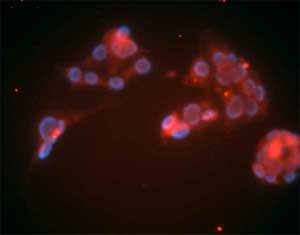
Detection of human LDL receptor by immunocytochemistry. Sample: HepG2 cells fixed in methanol. Primary antibody: Anti-LDL Receptor Mouse mAb (15C8) (Cat. No. LP02) (5 µg/ml). Detection: fluorescence.
References
References
van Driel, I.R., et al. 1987. J. Biol. Chem.262, 16127. van Driel, I.R., et al. 1987. J. Biol. Chem.262, 17443. Russell, D.W., et al. 1984. Cell37, 577. Achneider, W.J., et al. 1983. J. Cell Biol.97, 1635. Cummings, R.D., et al. 1983. J. Biol. Chem.258, 15261. Schneider, W.J., et al. 1982 J. Biol. Chem.257, 2664. Goldstein, J.L., et al. 1979. Nature279, 679.
Original Clone
Russell, D.W., et al. 1984. Cell37, 577.
Specificity
van Driel, I.R., et al. 1987. J. Biol. Chem.262, 16127.
Immunoblotting
van Driel, I.R., et al. 1987. J. Biol. Chem.262, 17443.
Flow Cytometry
Duvillard, L., et al. 2003. Diabetes Care26, 1540.
Will displace 50-70% of LDL binding to the receptor. For immunoblotting, include 2 mM Ca+2 with the antibody and avoid EDTA. This antibody has been reported to bind best to the unreduced LDL-R (see specificity application reference). Antibody should be titrated for optimal results in individual systems.
Biological Information
Immunogen
a trypic digest of bovine low density lipoprotein receptor
Immunogen
Bovine
Epitope
first cysteine-rich ligand binding domain
Clone
15C8
Host
Mouse
Isotype
IgG2a
Species Reactivity
Bovine
Human
Antibody Type
Monoclonal Antibody
Concentration Label
Please refer to vial label for lot-specific concentration
Physicochemical Information
Dimensions
Materials Information
Toxicological Information
Safety Information according to GHS
Safety Information
Product Usage Statements
Storage and Shipping Information
Ship Code
Blue Ice Only
Toxicity
Standard Handling
Storage
+2°C to +8°C
Do not freeze
Yes
Packaging Information
Transport Information
Supplemental Information
Specifications
Global Trade ITEM Number
Bestellnummer
GTIN
LP02
0
Documentation
Anti-LDL Receptor Mouse mAb (15C8) Analysenzertifikate
Titel
Chargennummer
LP02
Literatur
Übersicht
van Driel, I.R., et al. 1987. J. Biol. Chem.262, 16127. van Driel, I.R., et al. 1987. J. Biol. Chem.262, 17443. Russell, D.W., et al. 1984. Cell37, 577. Achneider, W.J., et al. 1983. J. Cell Biol.97, 1635. Cummings, R.D., et al. 1983. J. Biol. Chem.258, 15261. Schneider, W.J., et al. 1982 J. Biol. Chem.257, 2664. Goldstein, J.L., et al. 1979. Nature279, 679.
Datenblatt
Note that this data sheet is not lot-specific and is representative of the current specifications for this product. Please consult the vial label and the certificate of analysis for information on specific lots. Also note that shipping conditions may differ from storage conditions.
Detection of human LDL receptor by immunocytochemistry. Sample: HepG2 cells fixed in methanol. Primary antibody: Anti-LDL Receptor Mouse mAb (15C8) (Cat. No. LP02) (5 µg/ml). Detection: fluorescence.
Description
Purified mouse monoclonal antibody generated by immunizing BALB/c mice with the specified immunogen and fusing splenocytes with Sp2/0-Ag14 myeloma cells (see application references). Recognizes the ~160 kDa LDL Receptor protein.
Background
The low density lipoprotein receptor is responsible for mediating the uptake of LDL, a cholesterol carrying plasma lipoprotein. The receptor is a member of a class of cell surface proteins which are concentrated in clathrin coated pits and carry external ligands into cells by receptor-mediated endocytosis. The purified receptor is a glycoprotein with a molecular weight of 160,000. It is synthesized as a precursor of molecular weight 120,000 that is then glycosylated to the mature form by addition of N-linked and O-linked sugars in the Golgi apparatus. Unlike other hepatic lectins, the orientation of the LDL-R is such that the amino terminus is to the exterior of the cell. It has recently been determined that the LDL-R has sequence homology with the epidermal growth factor receptor precursor.
Host
Mouse
Immunogen species
Bovine
Immunogen
a trypic digest of bovine low density lipoprotein receptor
Epitope
first cysteine-rich ligand binding domain
Clone
15C8
Isotype
IgG2a
Species
bovine, human, not rabbit
Positive control
Liver sections, HT1080 cells, HepG2 cells
Form
Liquid
Formulation
In 0.05 M sodium phosphate buffer, 0.2% gelatin.
Concentration Label
Please refer to vial label for lot-specific concentration
Preservative
≤0.1% sodium azide
Comments
Will displace 50-70% of LDL binding to the receptor. For immunoblotting, include 2 mM Ca+2 with the antibody and avoid EDTA. This antibody has been reported to bind best to the unreduced LDL-R (see specificity application reference). Antibody should be titrated for optimal results in individual systems.
Storage
+2°C to +8°C
Do Not Freeze
Yes
Toxicity
Standard Handling
References
van Driel, I.R., et al. 1987. J. Biol. Chem.262, 16127. van Driel, I.R., et al. 1987. J. Biol. Chem.262, 17443. Russell, D.W., et al. 1984. Cell37, 577. Achneider, W.J., et al. 1983. J. Cell Biol.97, 1635. Cummings, R.D., et al. 1983. J. Biol. Chem.258, 15261. Schneider, W.J., et al. 1982 J. Biol. Chem.257, 2664. Goldstein, J.L., et al. 1979. Nature279, 679.
Application references
Original Clone
Russell, D.W., et al. 1984. Cell37, 577.
Specificity
van Driel, I.R., et al. 1987. J. Biol. Chem.262, 16127.
Immunoblotting
van Driel, I.R., et al. 1987. J. Biol. Chem.262, 17443.
Flow Cytometry
Duvillard, L., et al. 2003. Diabetes Care26, 1540.