Wenn Sie das Fenster schließen, wird Ihre Konfiguration nicht gespeichert, es sei denn, Sie haben Ihren Artikel in die Bestellung aufgenommen oder zu Ihren Favoriten hinzugefügt.
Klicken Sie auf OK, um das MILLIPLEX® MAP-Tool zu schließen oder auf Abbrechen, um zu Ihrer Auswahl zurückzukehren.
Wählen Sie konfigurierbare Panels & Premixed-Kits - ODER - Kits für die zelluläre Signaltransduktion & MAPmates™
Konfigurieren Sie Ihre MILLIPLEX® MAP-Kits und lassen sich den Preis anzeigen.
Konfigurierbare Panels & Premixed-Kits
Unser breites Angebot enthält Multiplex-Panels, für die Sie die Analyten auswählen können, die am besten für Ihre Anwendung geeignet sind. Unter einem separaten Register können Sie das Premixed-Cytokin-Format oder ein Singleplex-Kit wählen.
Kits für die zelluläre Signaltransduktion & MAPmates™
Wählen Sie gebrauchsfertige Kits zur Erforschung gesamter Signalwege oder Prozesse. Oder konfigurieren Sie Ihre eigenen Kits mit Singleplex MAPmates™.
Die folgenden MAPmates™ sollten nicht zusammen analysiert werden: -MAPmates™, die einen unterschiedlichen Assaypuffer erfordern. -Phosphospezifische und MAPmate™ Gesamtkombinationen wie Gesamt-GSK3β und Gesamt-GSK3β (Ser 9). -PanTyr und locusspezifische MAPmates™, z.B. Phospho-EGF-Rezeptor und Phospho-STAT1 (Tyr701). -Mehr als 1 Phospho-MAPmate™ für ein einziges Target (Akt, STAT3). -GAPDH und β-Tubulin können nicht mit Kits oder MAPmates™, die panTyr enthalten, analysiert werden.
.
Bestellnummer
Bestellinformationen
St./Pkg.
Liste
Dieser Artikel wurde zu Ihren Favoriten hinzugefügt.
Wählen Sie bitte Spezies, Panelart, Kit oder Probenart
Um Ihr MILLIPLEX® MAP-Kit zu konfigurieren, wählen Sie zunächst eine Spezies, eine Panelart und/oder ein Kit.
Custom Premix Selecting "Custom Premix" option means that all of the beads you have chosen will be premixed in manufacturing before the kit is sent to you.
Catalogue Number
Ordering Description
Qty/Pack
List
Dieser Artikel wurde zu Ihren Favoriten hinzugefügt.
Spezies
Panelart
Gewähltes Kit
Menge
Bestellnummer
Bestellinformationen
St./Pkg.
Listenpreis
96-Well Plate
Menge
Bestellnummer
Bestellinformationen
St./Pkg.
Listenpreis
Weitere Reagenzien hinzufügen (MAPmates erfordern die Verwendung eines Puffer- und Detektionskits)
Menge
Bestellnummer
Bestellinformationen
St./Pkg.
Listenpreis
48-602MAG
Buffer Detection Kit for Magnetic Beads
1 Kit
Platzsparende Option Kunden, die mehrere Kits kaufen, können ihre Multiplex-Assaykomponenten in Kunststoffbeuteln anstelle von Packungen erhalten, um eine kompaktere Lagerung zu ermöglichen.
Dieser Artikel wurde zu Ihren Favoriten hinzugefügt.
Das Produkt wurde in Ihre Bestellung aufgenommen
Sie können nun ein weiteres Kit konfigurieren, ein Premixed-Kit wählen, zur Kasse gehen oder das Bestell-Tool schließen.
MABS449
Sigma-AldrichAnti-Acylation Stimulating Protein Antibody, clone 4H3
This Anti-Acylation Stimulating Protein Antibody, clone 4H3 is validated for use in Western Blotting and ELISA for the detection of Acylation Stimulating Protein.
More>>This Anti-Acylation Stimulating Protein Antibody, clone 4H3 is validated for use in Western Blotting and ELISA for the detection of Acylation Stimulating Protein. Less<<
SDB (Sicherheitsdatenblätter), Analysenzertifikate und Qualitätszertifikate, Dossiers, Broschüren und andere verfügbare Dokumente.
Anti-Acylation Stimulating Protein Antibody, clone 4H3
Alternate Names
Complement C3
C3adesArg
C3
PZP-like alpha-2-macroglobulin domain-containing protein 1
Background Information
The protein called Acylation stimulating protein (ASP) is a cleavage fragment protein from the Complement C3 gene. C3 plays a central role in the activation of the complement system. C3’s processing by C3 convertase is the central reaction in both classical and alternative complement pathways. ASP acts as an adipogenic hormone that stimulates triglyceride synthesis and glucose transport in adipocytes, and thus it helps regulate fat storage and triglyceride synthesis. ASP stimulates triglyceride synthesis via PLC, MAPK and AKT signaling pathways and ASP promotes the phosphorylation and internalization and recycling of Complement factor C5AR2. ASP is expressed in adipocytes and released into the plasma during both the fasting and postprandial periods. Increased levels of C3 and its cleavage product ASP are associated with obesity, diabetes and coronary heart disease. Short-term endurance training reduces baseline ASP levels and subsequently fat storage.
References
Product Information
Format
Purified
Presentation
Purified mouse monoclonal IgG1κ in buffer containing 0.1 M Tris-Glycine (pH 7.4), 150 mM NaCl with 0.05% sodium azide.
This Anti-Acylation Stimulating Protein Antibody, clone 4H3 is validated for use in Western Blotting and ELISA for the detection of Acylation Stimulating Protein.
Key Applications
Western Blotting
ELISA
Application Notes
ELISA Analysis: 7 µg/mL of this antibody detected ASP (PEG precipitated) in a sandwich ELISA format (Saleh, J,. et al, J. Lipid Res. 1998. 39: 884–891)
Biological Information
Immunogen
linear peptide corresponding to Human Acylation Stimulating Protein.
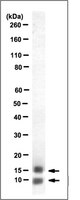
~ 16/10 kDa observed, 10 kDa indicates native ASP, 16 kDa indicates HIS-Tag ASP. HIS-Tag was added for purification purposes. We have found no difference in Activity (measured by TGS, Fatty Acid uptake, etc) between rASP with/without the tag. Further, the ELISA was successful in measuring both.
Physicochemical Information
Dimensions
Materials Information
Toxicological Information
Safety Information according to GHS
Safety Information
Product Usage Statements
Quality Assurance
Evaluated by Western Blotting on purified Acylation Stimulating Protein from transfected HEK293 cell lysate
Western Blotting Analysis: 0.1 µg/mL of this antibody detected purified Acylation Stimulating Protein from transfected HEK293 cell.
Usage Statement
Unless otherwise stated in our catalog or other company documentation accompanying the product(s), our products are intended for research use only and are not to be used for any other purpose, which includes but is not limited to, unauthorized commercial uses, in vitro diagnostic uses, ex vivo or in vivo therapeutic uses or any type of consumption or application to humans or animals.
Storage and Shipping Information
Storage Conditions
Stable for 1 year at 2-8°C from date of receipt.
Packaging Information
Material Size
100 µg
Transport Information
Supplemental Information
Specifications
Global Trade ITEM Number
Bestellnummer
GTIN
MABS449
04055977112733
Documentation
Anti-Acylation Stimulating Protein Antibody, clone 4H3 SDB
Coordinated release of acylation stimulating protein (ASP) and triacylglycerol clearance by human adipose tissue in vivo in the postprandial period. Saleh, J; Summers, LK; Cianflone, K; Fielding, BA; Sniderman, AD; Frayn, KN Journal of lipid research
39
884-91
1998
The objective of this study was to determine whether Acylation Stimulating Protein (ASP) is generated in vivo by human adipose tissue during the postprandial period. After a fat meal, samples from 12 subjects were obtained (up to 6 h) from an arterialized hand vein and an anterior abdominal wall vein that drains adipose tissue. Veno-arterial (V-A) gradients across the subcutaneous adipose tissue bed were calculated. The data demonstrate that ASP is produced in vivo (positive V-A gradient) With maximal production at 3-5 h postprandially. The plasma triacylglycerol (TAG) clearance was evidenced by a negative V-A gradient. It increased substantially after 3 h and remained prominent until the final time point. There was, therefore, a close temporal coordination between ASP generation and TAG clearance. In contrast, plasma insulin and non-esterified fatty acid (NEFA) had an early (1-2 h) postprandial change. Fatty acid incorporation into adipose tissue (FIAT) was calculated from V-A glycerol and non-esterified fatty acid (NEFA) differences postprandially. FIAT was negative during the first hour, implying net fat mobilization. FIAT then became increasingly positive, implying net fat deposition, and overall followed the same time course as ASP and TAG clearance. There was a direct positive correlation between total ASP production and total FIAT (r = 0.566, P < 0.05). These data demonstrate that ASP is generated in vivo by human adipocytes and that this process is accentuated postprandially, supporting the concept that ASP plays an important role in clearance of TAG from plasma and fatty acid storage in adipose tissue.