Chiudendo, la configurazione personalizzata non sarà salvata, a meno che l'articolo non sia stato aggiunto al carrello della spesa o ai prodotti preferiti.
Clicchi OK per chiudere MILLIPLEX® MAP, oppure Annulla per tornare alla selezione.
Scelga pannelli su misura e kit premiscelati, OPPURE le microsfere MAPmates™ per la trasduzione del segnale
Progetti e calcoli il prezzo dei Suoi kit MILLIPLEX® MAP.
Pannelli su misura e kit premiscelati
La nostra ampia gamma comprende pannelli multiplex che consentono di scegliere, nell'ambito del pannello, gli analiti più adatti per le Sue esigenze. Oppure Lei può scegliere le citochine premiscelate o i kit single plex.
Kit e MAPmates™ per studi di trasduzione del segnale
Scelga i kit premiscelati che permettono di esplorare interi processi e pathway. Oppure progetti kit su misura scegliendo le microsfere MAPmates™ single plex e seguendo le linee guida fornite.
Le seguenti MAPmates™ non possono essere dosate insieme: -MAPmates™ che richiedono tamponi differenti per l'analisi. -MAPmate™ fosfo-specifiche e totali, es GSK3β totale e GSK3β (Ser 9). -MAPmates™ PanTyr e sito-specifiche come fosfo-recettore EGF e fosfo-STAT1 (Tyr701). -Più di 1 fosfo-MAPmate™ per un solo bersaglio (Akt, STAT3). -GAPDH e β-Tubulina non possono essere miscelati con kit o MAPmates™ contenenti panTyr.
.
Numero di catalogo
Descrizione dell'ordine
Qtà/conf
Elenca
Questo articolo è stato aggiunto ai prodotti preferiti.
Selezioni una specie, un tipo di pannello, un kit o un tipo di campione
Per cominciare a progettare il Suo kit MILLIPLEX® MAP, selezioni una specie, un tipo di pannello o un kit di Suo interesse.
Custom Premix Selecting "Custom Premix" option means that all of the beads you have chosen will be premixed in manufacturing before the kit is sent to you.
Catalogue Number
Ordering Description
Qty/Pack
List
Questo articolo è stato aggiunto ai prodotti preferiti.
Specie
Tipo di pannello
Kit selezionato
Qtà
Numero di catalogo
Descrizione dell'ordine
Qtà/conf
Prezzo di listino
96-Well Plate
Qtà
Numero di catalogo
Descrizione dell'ordine
Qtà/conf
Prezzo di listino
Aggiungi altri reagenti (Le microsfere MAPmate devono essere utilizzate con un tampone ed un kit di rilevazione)
Qtà
Numero di catalogo
Descrizione dell'ordine
Qtà/conf
Prezzo di listino
48-602MAG
Buffer Detection Kit for Magnetic Beads
1 Kit
Opzione salva-spazio I Clienti che ordinano diversi kit possono scegliere di ridurre lo spazio necessario per lo stoccaggio, rinunciando al confezionamento del kit e ricevendo i vari reagenti per il saggio multiplex in buste di plastica.
Questo articolo è stato aggiunto ai prodotti preferiti.
Il prodotto è stato aggiunto al carrello.
Ora può disegnare un altro kit su misura, scegliere un kit premiscelato, procedere con il check out dell'ordine, oppure chiudere lo strumento per gli ordini on-line.
Anti-PABP 1, clone 10E10 is a Mouse Monoclonal Antibody for detection of PABP 1 also known as PABP 1, Poly(A)-binding protein 1, poly(A) binding protein cytoplasmic 1 & has been validated in WB, ICC & IP.
More>>Anti-PABP 1, clone 10E10 is a Mouse Monoclonal Antibody for detection of PABP 1 also known as PABP 1, Poly(A)-binding protein 1, poly(A) binding protein cytoplasmic 1 & has been validated in WB, ICC & IP. Less<<
Anti-PABP 1 Antibody, clone 10E10: MSDS (material safety data sheet) o SDS, certificato d’analisi (CoA) e certificato di qualità (CoQ), dossier, brochure e altri documenti disponibili.
Poly(A)-binding protein (PABP 1) is an abundant protein that interacts with the 3' poly(A) tail of most eukaryotic mRNAs. In vivo this protein is involved in many aspects of mRNA metabolism, including mRNA stability, translationally coupled mRNA turnover, protein biosynthesis, and ribosome biogenesis. PABP1 shuttles between the cytoplasm and the nucleus and may bind to cytoplasmic RNA sequences other than poly(A). PABP1 accumulates in the nucleus if transcription is inhibited, suggesting that nuclear export is coupled to active transcription.
References
Product Information
Format
Purified
Control
HeLa cell lysate
Presentation
Purified mouse monoclonal IgGκ in buffer containing 0.1 M Tris-Glycine (pH 7.4, 150 mM NaCl) with 0.05% sodium azide.
Anti-PABP 1, clone 10E10 is a Mouse Monoclonal Antibody for detection of PABP 1 also known as PABP 1, Poly(A)-binding protein 1, poly(A) binding protein cytoplasmic 1 & has been validated in WB, ICC & IP.
Key Applications
Western Blotting
Immunocytochemistry
Immunoprecipitation
Application Notes
Immunoprecipitation: Cited in Thoma, C., et al. (2008) RNA. 14:1579-1589, and Buchet-Poyau, K., et al.(2007) Nuc. Acids Res. 35:1289-1300 using a representative lot.
Immunocytochemistry: Cited in Afonina, E, et al. (1998) J. Biol. Chem., 273: 13015-21 (1998) using a representative lot.
Biological Information
Immunogen
Recombinant protein corresponding to human PABP 1.
Epitope
Unknown
Clone
10E10
Concentration
Please refer to the Certificate of Analysis for the lot-specific concentration.
The poly(A)-binding protein (PABP), which is found complexed to the 3-prime poly(A) tail of eukaryotic mRNA, is required for poly(A) shortening and translation initiation. In humans, the PABPs comprise a small nuclear isoform and a conserved gene family that displays at least 3 functional proteins: PABP1 (PABPC1), inducible PABP (iPABP, or PABPC4; MIM 603407), and PABP3 (PABPC3; MIM 604680). In addition, there are at least 4 pseudogenes, PABPCP1 to PABPCP4.[supplied by OMIM]
FUNCTION: Binds the poly(A) tail of mRNA. May be involved in cytoplasmic regulatory processes of mRNA metabolism such as pre- mRNA splicing. Its function in translational initiation regulation can either be enhanced by PAIP1 or repressed by PAIP2. Can probably bind to cytoplasmic RNA sequences other than poly(A) in vivo. May be involved in translationally coupled mRNA turnover. Implicated with other RNA-binding proteins in the cytoplasmic deadenylation/translational and decay interplay of the FOS mRNA mediated by the major coding-region determinant of instability (mCRD) domain.
SIZE: 636 amino acids; 70671 Da
SUBUNIT: Component of a multi subunit autoregulatory ribonucleoprotein complex (ARC), at least composed of IGF2BP1, PABPC1 and CSDE1. Interacts with IGF2BP1. Part of a complex associated with the FOS mCRD domain and consisting of HNRPD, SYNCRIP, PAIP1 and CSDE1/UNR. Interacts with the PABPC1- interacting motif-1 (PAM1) and -2 (PAM2) of PAIP1 and PAIP2. Interacts with PAIP1 with a 1:1 stoichiometry and with PAIP2 with a 1:2 stoichiometry. The interaction with CSDE1 is direct and RNA- independent. Found in a mRNP complex with YBX2. Identified in the spliceosome C complex, at least composed of AQR, ASCC3L1, C19orf29, CDC40, CDC5L, CRNKL1, DDX23, DDX41, DDX48, DDX5, DGCR14, DHX35, DHX38, DHX8, EFTUD2, FRG1, GPATC1, HNRPA1, HNRPA2B1, HNRPA3, HNRPC, HNRPF, HNRPH1, HNRPK, HNRPM, HNRPR, HNRPU, KIAA1160, KIAA1604, LSM2, LSM3, MAGOH, MORG1, PABPC1, PLRG1, PNN, PPIE, PPIL1, PPIL3, PPWD1, PRPF19, PRPF4B, PRPF6, PRPF8, RALY, RBM22, RBM8A, RBMX, SART1, SF3A1, SF3A2, SF3A3, SF3B1, SF3B2, SF3B3, SFRS1, SKIV2L2, SNRPA1, SNRPB, SNRPB2, SNRPD1, SNRPD2, SNRPD3, SNRPE, SNRPF, SNRPG, SNW1, SRRM1, SRRM2, SYF2, SYNCRIP, TFIP11, THOC4, U2AF1, WDR57, XAB2 and ZCCHC8 (By similarity).
SUBCELLULAR LOCATION: Cytoplasm. Nucleus. Note=Shuttles between the cytoplasm and the nucleus.
TISSUE SPECIFICITY: Ubiquitous.
DOMAIN: The RNA-binding domains RRM1 and RRM2 and the C-terminus (last 138 amino acids) regions interact with the PABPC1- interacting motif-1 (PAM1) and -2 (PAM2) of PAIP1, respectively. & The RNA-binding domains RRM2 and RRM3 and the C-terminus (last 138 amino acids) regions interact with the PABPC1- interacting motif-1 (PAM1) and -2 (PAM2) of PAIP2, respectively.
PTM: Methylated by CARM1. & Arg-493 is dimethylated, probably to asymmetric dimethylarginine.
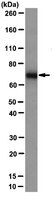
Western Blot Analysis: 0.5 µg/ml of this antibody detected PABP 1 in 10 µg of HeLa cell lysate.
Usage Statement
Unless otherwise stated in our catalog or other company documentation accompanying the product(s), our products are intended for research use only and are not to be used for any other purpose, which includes but is not limited to, unauthorized commercial uses, in vitro diagnostic uses, ex vivo or in vivo therapeutic uses or any type of consumption or application to humans or animals.