


Saggi cellulari
Risorse correlate

Prodotti consigliati
Panoramica
Specifiche tecniche
Informazioni per l’ordine
Documentation
Riferimenti bibliografici
| Panoramica dei riferimenti bibliografici | Applicazione |
|---|---|
| Extracellular HIV-1 Nef increases migration of monocytes Michael H. Lehmanna, Stefan Walterc, Loyda Ylisastiguid, Frank Striebelc, Vladimir Ovode, Matthias Geyerf, Jean Claude Gluckmand and Volker Erflea Experimental Cell Research, Volume 312, Issue 18 , 1 November 2006, Pages 3659-3668 2005 | |
| High throughput in vivo screening for bone anabolic compounds with zebrafish Angeleen Fleming, Masahiko Sato, Paul Goldsmith Journal of Biomolecular Screening 10(8); 2005, 823-831 2004 | |
| Screening Assay for the Identification of Deoxyhypusine Synthase Inhibitors Marc-Nicola Somner, Dorian Bevec, et al. Journal of Biomolecular Screening, 2004, 9(5):434-438 2004 | Cell Based Assays |
| A cell-based assay for screening the uridine 5'-diphosphate-glucuronosyltransferase 1A inhibitory potential of new chemical entities. Jaime Padros, Donald Chun, Liangfu Chen, Pierre Rigolli, Themis Flarakos and Malle Jurima-Romet; Analytical Biochemistry 320 (2): 310-312 Analytical Biochemistry 320 (2): 310-312 2003 | Cell Culture |
| Functional characterization of Glu298Asp mutant human endothelial nitric oxide synthase purified from a yeast expression system. Regina Golser, Antonius C. F. Gorren, Bernd Mayer and Kurt Schmidt Nitric Oxide 8 (1): 7-14 2003 | Cell Based Assays |
FAQ
| Domanda | Risposta | ||||||||||||||||||||||||||||||||||||||||||||||||||||
|---|---|---|---|---|---|---|---|---|---|---|---|---|---|---|---|---|---|---|---|---|---|---|---|---|---|---|---|---|---|---|---|---|---|---|---|---|---|---|---|---|---|---|---|---|---|---|---|---|---|---|---|---|---|
| What type of detection equipment do I need for detecting migrated or invaded cells in the MultiScreenTM-MIC plates? | There are many ways to detect cells that have migrated or invaded across the membrane. Fluorescence and staining are very commonly used techniques. For suspension cells, you can pre-label (Eg. Calcein AM, Cell Tracker green) or post-label your cells with fluorescence marker of choice (E.g. Calcein AM, Cell Tracker green to label cells or Alamar Blue to label cell medium) and assess the number of cells that migrated or invaded, using a fluorescent plate reader. A standard fluorescent plate reader is sufficient to detect fluorescently labeled cells, if fluorescence is your detection method. In our laboratory we read the receiver plate (housed in its single well tray) with fluorescently labeled cells on a Wallac Victor2 TM. The receiver plate fits inside this reader without any adapter. For adherent cells, you can stain your cells migrated or invaded to membrane (Hema-3 or Diff Quik) after scrubbing away cells from the top using a cotton swab. The stained cells can then be counted manually or by using imaging and counting software linked to a standard microscope with appropriate magnification to visualize the cells. We use a Zeiss Axioplan-2 microscope with an automated stage and a KS300 cell counting software. The filter plate with stained cells on membrane is placed inverted onto the stage, in a plate holder, for counting with this microscope as objectives are mounted above the stage. Place the filter plate with stained cells on a glass slide to protect membrane before placing on the stage if using a standard microscope with objectives mounted below the stage. |
||||||||||||||||||||||||||||||||||||||||||||||||||||
| Is there any product and protocol literature available for my reference when using the MultiScreenTM-MIC plates? | You can find the following literature pieces on our website: http://www.millipore.com/multiscreenMIC Poster, Literature piece number: PS1651EN00 Poster, Literature piece number: PS0912EN00 Poster, Literature piece number: PS0913EN00 Datasheet, Literature piece number: PF2627EN00 Applications Note, Literature piece number: AN1060EN00 These literature pieces can be ordered via our website or by calling 1-800-645-5476 or your local Millipore office. You can also call the Millipore Technical Support at 1-800-645-5476 for further assistance or your local Millipore office. |
||||||||||||||||||||||||||||||||||||||||||||||||||||
| What is the well depth and maximum volume capacity of a MultiScreen plate? | The well depth of a 96 well MultiScreen plate is 1.245 cm. The well depth for a 384 well MultiScreen plate is 1.2 cm. The maximum working volume of a 96 well plate is 300 ul. The maximum working volume for a 384 well plate is 100 ul. | ||||||||||||||||||||||||||||||||||||||||||||||||||||
| Assay Terminology commonly used with reference to MultiScreen-MIC plates | Chemotaxis: Directed movement of cells in response to a concentration gradient. Migration: Random movement of cells. Invasion: The movement of cells across a barrier (e.g. extracellular matrix) in response to a concentration gradient. Transmigration: The movement of cells across another cell barrier in response to a concentration gradient. Angiogenesis: Tubule formation exhibited by HUVEC (Human Umbilical Vein Endothelial Cells) in response to cell stimulating factors. Co-culture: When you have more than one cell type in your assay it is called co-culture. These assays are typically run to assess cell-cell interactions and factors secreted by one cell influencing the behavior of the other cell. |
||||||||||||||||||||||||||||||||||||||||||||||||||||
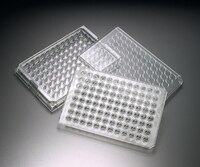
| What is the MultiScreenTM-MIC plate? | It is a 96 well sterile single use device that allows you to perform a variety of assays such as migration, invasion, chemotaxis, angiogenesis, transendothelial migration and co-culture type of assays. It has a filter plate* with 96 wells fitted with membrane. These wells serve as upper wells in your assay. It has a 96 well tear drop receiver plate. These wells serve as the lower wells in your assay. The membrane is the separation component between the two wells. These devices are available in a variety of pore sizes (3, 5 and 8 mm pore sizes available as cataloged products. 1, 2 and 12 mm pore sizes available by special order) in an uncoated format. The plates are available in packs of 10 with each device individually wrapped in a blister pack to ensure sterility. The plates are tissue culture treated (using a proprietary methodology) to support use with suspension and adherent cells. *There is no underdrain on these filter plates, as the application does not require use of vacuum. |
||||||||||||||||||||||||||||||||||||||||||||||||||||
| What type of assays can I perform on the MultiScreen-MIC plates? | he MultiScreenTM-MIC plates can be used for a variety of assays such as migration, invasion, chemotaxis, angiogenesis, transendothelial migration and co-culture type of assays. | ||||||||||||||||||||||||||||||||||||||||||||||||||||
| What type of screening can I perform with the MultiScreenTM-MIC plates? | Some examples of screening that can be done on MIC plates are compound library screening, protein library screening or antibody library screening. You can measure the effect of the compound, protein or antibodies on cell behavior in functional assays such as migration, invasion, chemotaxis, angiogenesis, transendothelial migration and co-culture type of assays. | ||||||||||||||||||||||||||||||||||||||||||||||||||||
| What pore size should I select when using the MultiScreenTM-MIC plate for my assay? | Pore size determination depends totally on your cell type. A quick literature search will enable you to decide the best pore size for the particular cells you are using. The following chart illustrates pore size choice for cell lines used in our laboratory and by some of our customers for these assays.
Prodotti e applicazioni correlateVisto recentemente |