Skip to Content
Merck

208752

Hexane

≥95%, Laboratory Reagent, suitable for EPA 1613

Synonym(s):

n-Hexane

Sign In to View Organizational & Contract Pricing.

Select a Size

Change View

About This Item

Linear Formula:
CH3(CH2)4CH3
CAS Number:
Molecular Weight:
86.18
NACRES:
NA.21
PubChem Substance ID:
UNSPSC Code:
12352001
EC Number:
203-777-6
MDL number:
Beilstein/REAXYS Number:
1730733
Assay:
≥95%
Grade:
Laboratory Reagent
Bp:
69 °C (lit.)
Vapor pressure:
256 mmHg ( 37.7 °C), 5.2 psi ( 37.7 °C), ~132 mmHg ( 20 °C)
Technical Service
Need help? Our team of experienced scientists is here for you.
Let Us Assist


Product Name

Hexane, Laboratory Reagent, ≥95%

grade

Laboratory Reagent

Quality Level

agency

suitable for EPA 1613

vapor density

~3 (vs air)

vapor pressure

256 mmHg ( 37.7 °C), 5.2 psi ( 37.7 °C), ~132 mmHg ( 20 °C)

assay

≥95%

form

liquid

autoignition temp.

453 °F

expl. lim.

7.7 %

dilution

(for analytical testing)

impurities

≤0.005% aromatics (as benzene), ≤0.015% (water)

evapn. residue

≤0.0015%

refractive index

n20/D 1.375 (lit.)

pH

7

bp

69 °C (lit.)

mp

−95 °C (lit.)

density

0.659 g/mL at 25 °C (lit.)

storage temp.

room temp

SMILES string

CCCCCC

InChI

1S/C6H14/c1-3-5-6-4-2/h3-6H2,1-2H3

InChI key

VLKZOEOYAKHREP-UHFFFAOYSA-N

General description

Hexane is an unbranched alkane that exists in five structural isomeric forms, i.e. hexane, isohexane, 3-methylpentane, neohexane, and 2,3-dimethylbutane. It can be obtained from petroleum by distillation.

Application

Hexane can be used:      
  • As a solvent for the extraction of oil, wax, and fat.     
  • As a non-polar solvent in chromatographic applications for product separation and purification.

It is also used in the preparation of organolithium reagents because it cannot be easily deprotonated.

Other Notes

The article number 208752-4X2.5L will be discontinued. Please order the single bottle 208752-2.5L which is physically identical with the same exact specifications.


Still not finding the right product?

Explore all of our products under Hexane


signalword

Danger

target_organs

Central nervous system, Nervous system

Storage Class

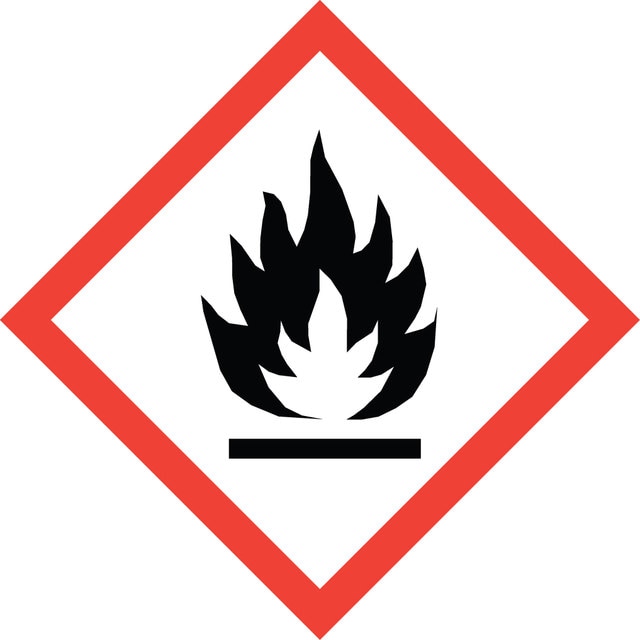
3 - Flammable liquids

flash_point_f

-7.6 °F - closed cup

flash_point_c

-22 °C - closed cup

Hazard Classifications

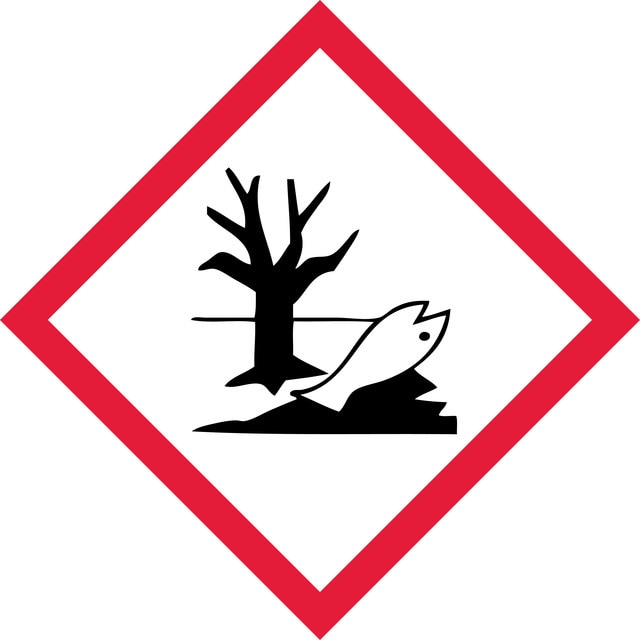
Aquatic Chronic 2 - Asp. Tox. 1 - Flam. Liq. 2 - Repr. 2 - Skin Irrit. 2 - STOT RE 1 Inhalation - STOT SE 3


Choose from one of the most recent versions:

Certificates of Analysis (COA)

Lot/Batch Number

It looks like we've run into a problem, but you can still download Certificates of Analysis from our Documents section.

If you need assistance, please contact Customer Support

Already Own This Product?

Find documentation for the products that you have recently purchased in the Document Library.

Visit the Document Library


Related Content

This page is intended to make it easier to find the consumables you need based on the analytical method you’re using. Methods included on this page come from the EPA, Standard Methods and ASTM.


Effects of pre-treatments on the lipid extraction and biodiesel production from municipal WWTP sludge.
Olkiewicz M, et al.
Fuel: The Science and Technology of Fuel and Energy, 141, 250-257 (2015)
Eagleson M.
Concise Encyclopedia Chemistry, 492-492 (1994)
Alexandre S Cristino et al.
Nature communications, 5, 5529-5529 (2014-11-21)
Increasing evidence suggests small non-coding RNAs (ncRNAs) such as microRNAs (miRNAs) control levels of mRNA expression during experience-related remodelling of the brain. Here we use an associative olfactory learning paradigm in the honeybee Apis mellifera to examine gene expression changes