Si cierra, no se guardará su personalización salvo que haya añadido el artículo a su carrito de la compra o a favoritos.
Pulse OK para cerrar la herramienta MILLIPLEX® MAP o Cancelar para volver a su selección.
Elija paneles personalizables y kits premezclos - O - MAPmates™ de señalización celular
Diseñe y calcule el precio de sus kits MILLIPLEX® MAP.
Paneles personalizados y kits premezclados
Nuestra amplia cartera de productos consta de paneles multiplex que le permiten elegir, dentro del panel, los analitos que mejor se ajustan a sus requisitos. En una pestaña distinta puede elegir el formato de citocina premezclada o un kit single plex.
Kits de señalización celular y MAPmates™
Elija los kits preparados para poder explorar las vías o los procesos enteros. O diseñe sus propios kits eligiendo single plex MAPmates™ según las directrices proporcionadas.
No deben combinarse los siguientes MAPmates™: -MAPmates™ que requieren un tampón de ensayo diferente. -Pares MAPmate™ fosfoespecíficos y totales, por ejemplo, GSK3β y GSK3β (Ser 9). -MAPmates™ con panTyr y específicos de sitio; por ejemplo, receptor del fosfo-EGF y fosfo-STAT1 (Tyr701). -Más de 1 fosfo-MAPmate™ para una sola diana (Akt, STAT3). -La GAPDH y la β-tubulina no pueden combinarse con kits o MAPmates™ que contengan panTyr.
.
Número de referencia
Descripción para pedidos
Cant./Env.
Lista
Este artículo se ha añadido a favoritos.
Seleccione una especie, un tipo de panel, un kit o un tipo de muestra
Para empezar a diseñar su kit MILLIPLEX® MAP, seleccione una especie, un tipo de panel o un kit de interés.
Custom Premix Selecting "Custom Premix" option means that all of the beads you have chosen will be premixed in manufacturing before the kit is sent to you.
Catalogue Number
Ordering Description
Qty/Pack
List
Este artículo se ha añadido a favoritos.
Especie
Tipo de panel
Kit seleccionado
Cant.
Número de referencia
Descripción para pedidos
Cant./Env.
Precio de catálogo
96-Well Plate
Cant.
Número de referencia
Descripción para pedidos
Cant./Env.
Precio de catálogo
Añadir más reactivos (Se necesita tampón y un kit de detección para usar con MAPmates)
Cant.
Número de referencia
Descripción para pedidos
Cant./Env.
Precio de catálogo
48-602MAG
Buffer Detection Kit for Magnetic Beads
1 Kit
Opción para ahorrar espacio Los clientes que adquieran múltiples kits pueden optar por ahorrar espacio de almacenamiento retirando el embalaje del kit y recibiendo los componentes de sus ensayos multiplex en bolsas de plástico para un almacenamiento más compacto.
Este artículo se ha añadido a favoritos.
El producto se ha añadido a su carrito
Ahora puede personalizar otro kit, elegir un kit premezclado, tramitarlo o cerrar la herramienta de pedidos.
This Anti-Src Antibody, clone N6L is validated for use in WB for the detection of Src.
More>>This Anti-Src Antibody, clone N6L is validated for use in WB for the detection of Src. Less<<
Anti-Src Antibody, clone N6L, rabbit monoclonal: Ficha de datos de seguridad (MSDS o SDS), certificado de análisis y de calidad (CoA y CoQ), expedientes, folletos y otros documentos disponibles.
pp60c-Src is the prototype non-receptor tyrosine kinase. Homology to Src in three regions is shared by a number of proteins: SH1 being the catalytic domain, SH2 being a phospho-tyrosine binding domain, and SH3 being a proline-binding domain. The Src SH2 domain binds to phospho-Tyr527 (phosphorylated by Csk) within the Src molecule, causing Src to adopt an inactive conformation. Mutation of Tyr527 to phenylalanine removes the SH2-binding target and results in a constitutively active kinase. A second mutation at the conserved lysine residue at the ATP-binding site abolishes kinase activity, but without Tyr527, the conformation of the protein is open, allowing interaction with endogenous activators. Consequently, this double-mutant exhibits a dominant-negative phenotype
References
Product Information
Format
Culture Supernatant
Control
Included positive antigen control of non-stimulated A431 lysate (Cat. No. 12-301). Add 2.5 μL of 2-mercaptoethanol/100 μL of lysate and boil for 5 minutes to reduce the preparation. Load 20 μg of reduced lysate per lane for minigels.
This gene is highly similar to the v-src gene of Rous sarcoma virus. This proto-oncogene may play a role in the regulation of embryonic development and cell growth. The protein encoded by this gene is a tyrosine-protein kinase whose activity can be inhibited by phosphorylation by c-SRC kinase. Mutations in this gene could be involved in the malignant progression of colon cancer. Two transcript variants encoding the same protein have been found for this gene.
CATALYTIC ACTIVITY:ATP + a [protein]-L-tyrosine = ADP + a [protein]-L-tyrosine phosphate. SUBUNIT STRUCTURE: Interacts with DDEF1/ASAP1; via the SH3 domain. Interacts with CCPG1 By similarity. Interacts with CDCP1, PELP1, TGFB1I1 and TOM1L2. Interacts with the cytoplasmic domain of MUC1, phosphorylates it and increases binding of MUC1 with beta-catenin. Interacts with RALGPS1; via the SH3 domain. Interacts with HEV ORF3 protein; via the SH3 domain. Interacts with CAV2 (tyrosine phosphorylated form). PTM: Phosphorylated on Tyr-530 by c-Src kinase (CSK). The phosphorylated form is termed pp60c-src. The phosphorylated tail interacts with the SH2 domain thereby repressing kinase activity. SEQUENCE SIMILARITIES: Belongs to the protein kinase superfamily. Tyr protein kinase family. SRC subfamily. Contains 1 protein kinase domain. Contains 1 SH2 domain. Contains 1 SH3 domain.
Molecular Weight
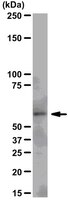
~ 60 kDa
Physicochemical Information
Dimensions
Materials Information
Toxicological Information
Safety Information according to GHS
Safety Information
Product Usage Statements
Quality Assurance
Western Blot Analysis: A 1:500 to 1:1000 dilution of this antibody detected Src in RIPA lysates from A431 cells.
Usage Statement
Unless otherwise stated in our catalog or other company documentation accompanying the product(s), our products are intended for research use only and are not to be used for any other purpose, which includes but is not limited to, unauthorized commercial uses, in vitro diagnostic uses, ex vivo or in vivo therapeutic uses or any type of consumption or application to humans or animals.
Storage and Shipping Information
Storage Conditions
Stable for 1 year at -20ºC from date of receipt. Handling Recommendations: Upon receipt, and prior to removing the cap, centrifuge the vial and gently mix the solution. Aliquot into microcentrifuge tubes and store at -20°C. Avoid repeated freeze/thaw cycles, which may damage IgG and affect product performance.