Skip to Content
Merck

455180

Hydrogen chloride solution

2.0 M in diethyl ether

Sign In to View Organizational & Contract Pricing.

Select a Size

Change View

About This Item

Empirical Formula (Hill Notation):
HCl
CAS Number:
Molecular Weight:
36.46
NACRES:
NA.21
PubChem Substance ID:
UNSPSC Code:
12352301
MDL number:
Concentration:
1.90-2.20 M (with NaOH, titration), 2.0 M in diethyl ether
Form:
liquid
Technical Service
Need help? Our team of experienced scientists is here for you.
Let Us Assist


form

liquid

Quality Level

concentration

1.90-2.20 M (with NaOH, titration), 2.0 M in diethyl ether

bp

34.6 °C

density

0.747 g/mL at 25 °C

storage temp.

2-8°C

SMILES string

Cl

InChI

1S/ClH/h1H

InChI key

VEXZGXHMUGYJMC-UHFFFAOYSA-N

General description

Hydrogen chloride solution contains 2M hydrogen chloride in diethyl ether as the solvent. It is a strong acid and highly corrosive in nature and is commonly used in the selective cleavage of the protecting groups 2,4,6-trimethoxyphenyl from the respective (2,4,6-trimethoxyphenyl)silane to produce chlorosilanes.

Application

Hydrogen chloride solution can be used as a reagent to synthesize:
  • Cyanohydrin alkyl ethers via chiral Bronsted acid-mediated hydrocyanation of vinyl ethers with silyl cyanides.
  • N, N-Dimethylaniline hydrochloride salts via Pd-catalyzed Buchwald-Hartwig amination of aryl triflates with dimethylamines.
It can also be used as a catalyst for the amidation of carboxylic acids with amines to synthesize amides.


Still not finding the right product?

Explore all of our products under Hydrogen chloride solution

signalword

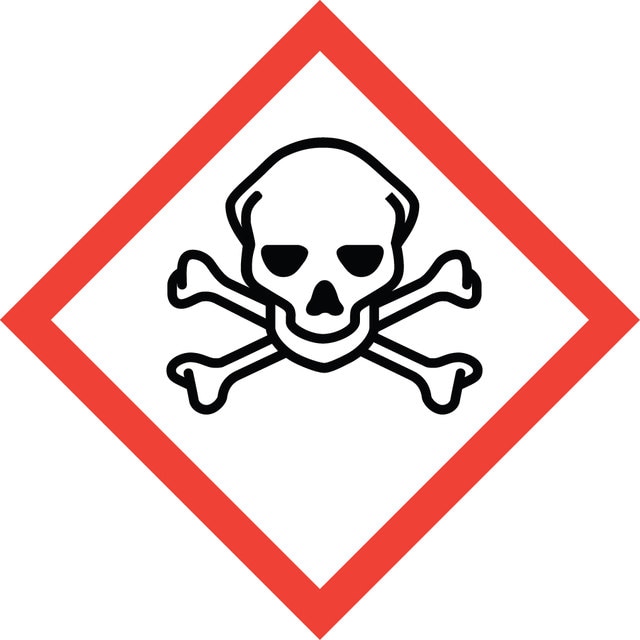
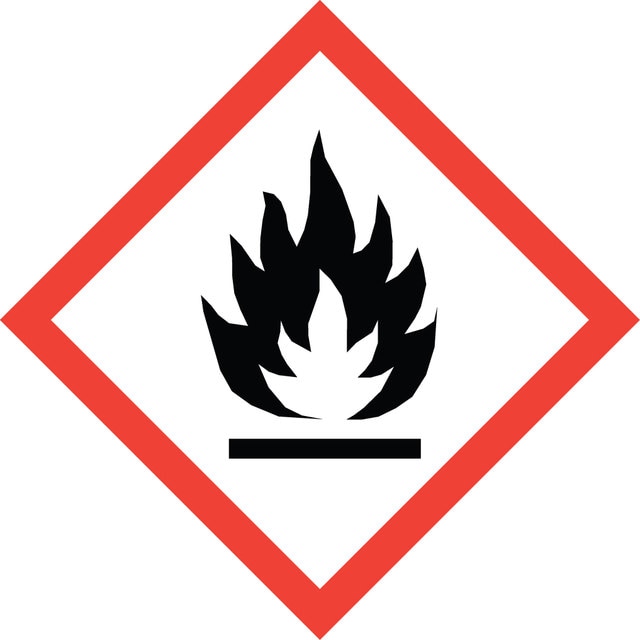
Danger

Hazard Classifications

Acute Tox. 3 Inhalation - Acute Tox. 4 Oral - Aquatic Chronic 3 - Flam. Liq. 1 - Met. Corr. 1 - STOT SE 3

target_organs

Central nervous system

supp_hazards

Storage Class

3 - Flammable liquids

wgk

WGK 1

flash_point_f

-29.2 °F - closed cup

flash_point_c

-34 °C - closed cup


Regulatory Listings

Regulatory Listings are mainly provided for chemical products. Only limited information can be provided here for non-chemical products. No entry means none of the components are listed. It is the user’s obligation to ensure the safe and legal use of the product.

Class I Designated Chemical Substances

prtr

Group 4: Flammable liquids + Special flammables + Hazardous rank I

fsl

Substances Subject to be Indicated Names

ishl_indicated

Substances Subject to be Notified Names

ishl_notified

455180-100ML:4.548173153742E12 + 455180-800ML:4.548173153759E12

jan


Choose from one of the most recent versions:

Certificates of Analysis (COA)

Lot/Batch Number

It looks like we've run into a problem, but you can still download Certificates of Analysis from our Documents section.

If you need assistance, please contact Customer Support

Already Own This Product?

Find documentation for the products that you have recently purchased in the Document Library.

Visit the Document Library


An automated SPE-based high-yield synthesis of [11C] acetate and [11C] palmitate: no liquid-liquid extraction, solvent evaporation or distillation required.
Mock BH, et al.
Nuclear Medicine and Biology, 38(8), 1135-1142 (2011)
Xuan Zhang et al.
Nanomedicine : nanotechnology, biology, and medicine, 11(6), 1365-1375 (2015-04-19)
Intratumoral injection of ultra-small gold nanoparticles (AuNPs) conjugated to doxorubicin (Au-Dox) is effective against both murine B16 and human SK-MEL-28 tumors in mice. Au-Dox suppresses growth of B16 tumors in immunocompetent mice by >70% for at least 19 days. In
Thomas Krohn et al.
European journal of nuclear medicine and molecular imaging, 42(2), 210-214 (2014-09-25)
To determine the frequency of seemingly pathological retroperitoneal uptake in the location of the coeliac ganglia in patients undergoing [(68)Ga]PSMA-HBED PET/CT. The study included 85 men with prostate cancer referred for [(68)Ga]PSMA-HBED PET/CT. The PET/CT scans were evaluated for the