
68279

Sulfuric acid concentrate
0.1 M H2SO4 in water (0.2N), eluent concentrate for IC
Synonym(s):
Sulfuric acid solution
Sign In to View Organizational & Contract Pricing.
Select a Size
Change View
About This Item
Linear Formula:
H2SO4
CAS Number:
Molecular Weight:
98.08
UNSPSC Code:
12161700
NACRES:
NB.21
PubChem Substance ID:
MDL number:
Beilstein/REAXYS Number:
2037554
Concentration:
0.1 M H2SO4 in water (0.2N)
Form:
liquid
Quality Segment
form
liquid
concentration
0.1 M H2SO4 in water (0.2N)
technique(s)
ion chromatography: suitable
SMILES string
OS(O)(=O)=O
InChI
1S/H2O4S/c1-5(2,3)4/h(H2,1,2,3,4)
InChI key
QAOWNCQODCNURD-UHFFFAOYSA-N
General description
Sulfuric acid (hydrogen sulfate, sulphine acid,battery acid) is a clear, colorless, oily liquid and is very corrosive in nature towards both metal and tissues. It is soluble in water.
This eluent concentrate for ion chromatography is determined by potentiometric titration. Content and expiry date can be found on the certificate.
Application
Metrohm IC application note AN-S-344:Anions in "Electronic grade" nitric acid on a high-capacity column.
Metrohm IC application note AN-S-341:4-Hydroxybutyratein addition to standard anions and organic acids.
Metrohm IC application note AN-S-336:Anion traces on the Metrosep A Supp 16 - 250/2.0 after Inline Preconcentration and Matrix Elimination
Metrohm IC application note AN-S-341:4-Hydroxybutyratein addition to standard anions and organic acids.
Metrohm IC application note AN-S-336:Anion traces on the Metrosep A Supp 16 - 250/2.0 after Inline Preconcentration and Matrix Elimination
Biochem/physiol Actions
Sulfuric acid is prepared by dry distillation of minerals like copper sulfate pentahydrate (blue vitriol), and iron sulfate heptahydrate (green vitriol). On application of heat these compounds decompose to form iron and copper oxides thereby eliminating water and sulphur trioxide, which then combine to give, dilute solution of sulphuric acid.
It finds application in the manufacture of explosives, fertilizers, glue and other acids. It is also used in the pickling of metal, purification of petroleum, and in lead-acid batteries. It is widely used as dehydrating agent, catalyst, and as an active reactant in chemical industry. It is also suitable to control pH, ranging from saline solutions to strong fuming acids.
Preparation Note
Prepared with sulfuric acid and high purity water (18.2 MΩ, 0.2 μm filtered)
Other Notes
Visit the IC Portal to learn more
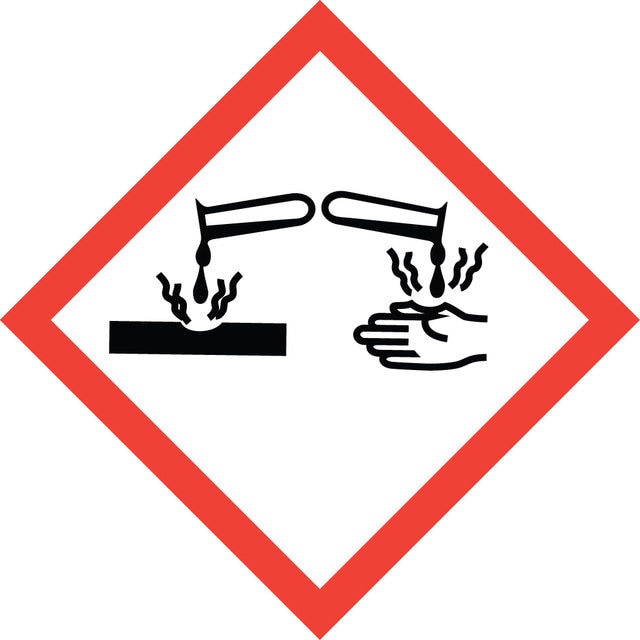
signalword
Warning
hcodes
Hazard Classifications
Met. Corr. 1
flash_point_f
Not applicable
flash_point_c
Not applicable
ppe
Faceshields, Gloves, Goggles, type ABEK (EN14387) respirator filter
pcodes
Storage Class
12 - Non Combustible Liquids
Choose from one of the most recent versions:
Already Own This Product?
Find documentation for the products that you have recently purchased in the Document Library.