コンテンツへスキップ
Merck

G7651

グルタルアルデヒド 溶液

Grade I, 50% in H2O, specially purified for use as an electron microscopy fixative or other sophisticated use

別名:

グルタル酸ジアルデヒド 溶液, ペンタン-1,5-ジオール

ログインで組織・契約価格をご覧ください。

サイズを選択してください


この商品について

化学式:
OHC(CH2)3CHO
CAS番号:
分子量:
100.12
UNSPSC Code:
12352114
NACRES:
NA.21
PubChem Substance ID:
MDL number:
Beilstein/REAXYS Number:
605390
テクニカルサービス
お困りのことがあれば、経験豊富なテクニカルサービスチームがお客様をサポートします。
お手伝いします
テクニカルサービス
お困りのことがあれば、経験豊富なテクニカルサービスチームがお客様をサポートします。
お手伝いします

製品名

グルタルアルデヒド 溶液, Grade I, 50% in H2O, specially purified for use as an electron microscopy fixative or other sophisticated use

InChI

1S/C5H8O2/c6-4-2-1-3-5-7/h4-5H,1-3H2

SMILES string

[H]C(CCCC([H])=O)=O

InChI key

SXRSQZLOMIGNAQ-UHFFFAOYSA-N

type

Grade I

form

liquid

concentration

50% in H2O

technique(s)

electron microscopy: suitable (fixative)

color

colorless

mp

-21  °C ((-6 °F))

solubility

water: soluble

shipped in

dry ice

storage temp.

2-8°C

Quality Level

類似した製品をお探しですか? 訪問 製品比較ガイド

関連するカテゴリー

Application

グルタルアルデヒド溶液は、次の用途で使用されています:
  • 4-(2-ヒドロキシエチル)-1-ピペラジンエタンスルホン酸(HEPES)バッファーと共に、走査電子顕微鏡(SEM)用にコンカナバリンA上に濃縮細胞外小胞(EV)を固定するため
  • 細胞を形態観察のために固定するための溶液中の成分として
  • 細菌性細胞の表面形態を保存するために水溶液中に大腸菌細胞を固定するため

Biochem/physiol Actions

グルタルアルデヒドは、細胞固定のために生物医学研究で使用でき、また健康な赤血球や病的な赤血球の分析にも使用できます。

Disclaimer

本製品は、グローバルな殺生物剤規制、例えばUS EPAのFederal Insecticide Fungicide and Rodenticide Act、European Biocidal Products Regulation、カナダのPest Management Regulatory Agency、トルコのBiocidal Products Regulation、韓国のConsumer Chemical Products and Biocide Safety Management Act(K-BPR)などの規制の下での殺生物剤としての使用を意図していません。

Features and Benefits

  • レンズが付いたゴム製またはプラスチック製の機器と高効率かつ安全に使用できます
  • 金属腐食性なし
  • 最短保存可能期間は14日

General description

グルタルアルデヒドは飽和ジアルデヒドで、不妊化剤として広く知られています。グルタルアルデヒド溶液は、結合効率が異なるモノマーとポリマーで構成されています。 

Other Notes

お客様の研究に適したメルクの広範な単糖類を包括的に理解していただくために、ぜひメルクの炭水化物カテゴリーページをご覧ください。

signalword

Danger

Hazard Classifications

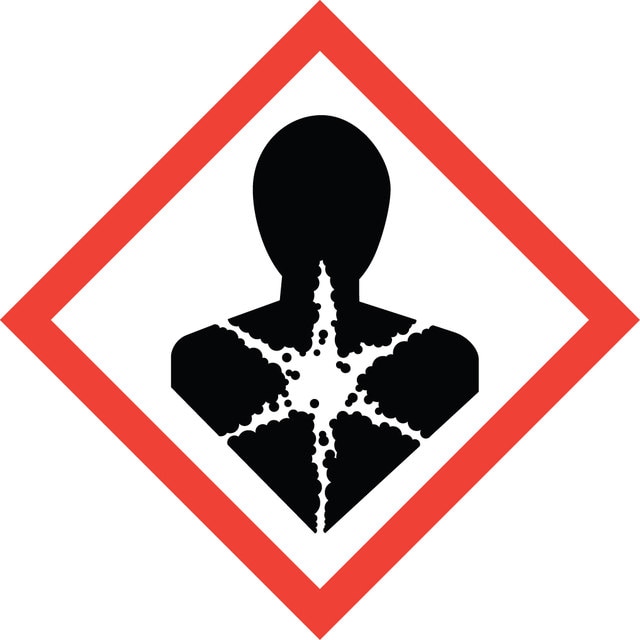
Acute Tox. 3 Inhalation - Acute Tox. 4 Oral - Aquatic Acute 1 - Aquatic Chronic 2 - Eye Dam. 1 - Resp. Sens. 1 - Skin Corr. 1B - Skin Sens. 1 - STOT SE 3

target_organs

Respiratory system

supp_hazards

保管分類

6.1A - Combustible acute toxic Cat. 1 and 2 / very toxic hazardous materials

wgk

WGK 3

flash_point_f

Not applicable

flash_point_c

Not applicable


最新バージョンのいずれかを選択してください:

試験成績書(COA)

Lot/Batch Number

適切なバージョンが見つかりませんか。

特定のバージョンが必要な場合は、ロット番号またはバッチ番号で特定の証明書を検索できます。

以前この製品を購入いただいたことがある場合

文書ライブラリで、最近購入した製品の文書を検索できます。

文書ライブラリにアクセスする

Irene Costantini et al.
Scientific reports, 5, 9808-9808 (2015-05-08)
Extensive mapping of neuronal connections in the central nervous system requires high-throughput µm-scale imaging of large volumes. In recent years, different approaches have been developed to overcome the limitations due to tissue light scattering. These methods are generally developed to
Stéphane Jauréguiberry et al.
Blood, 124(2), 167-175 (2014-05-27)
Patients with severe malaria treated with artesunate sometimes experience a delayed hemolytic episode. Artesunate (AS) induces pitting, a splenic process whereby dead parasites are expelled from their host erythrocytes. These once-infected erythrocytes then return to the circulation. We analyzed hematologic
Andri K Riau et al.
Investigative ophthalmology & visual science, 55(5), 3186-3194 (2014-04-26)
To compare flap adhesion strength, stromal bed quality, and tissue responses after flap preparation using nJ- and μJ-energy level femtosecond lasers. All corneal flaps were created by either VisuMax laser (μJ-energy level) or femto-LDV (nJ-energy level). Flap adhesion strength in
Stephanie J Bissel et al.
Journal of neuropathology and experimental neurology, 74(8), 767-777 (2015-06-27)
Human parechovirus 3 (HPeV3) is a picornavirus associated with neurologic disease in neonates. Human parechovirus 3 infection of preterm and term infants is associated with seizures and destructive periventricular white matter lesions. Despite unremarkable cerebrospinal fluid (CSF), HPeV3 RNA can
Jamie Hinks et al.
Applied and environmental microbiology, 81(6), 1949-1958 (2015-01-13)
The modification of microbial membranes to achieve biotechnological strain improvement with exogenous small molecules, such as oligopolyphenylenevinylene-conjugated oligoelectrolyte (OPV-COE) membrane insertion molecules (MIMs), is an emerging biotechnological field. Little is known about the interactions of OPV-COEs with their target, the

関連コンテンツ

Three-dimensional (3D) printing of biological tissue is rapidly becoming an integral part of tissue engineering.

ライフサイエンス、有機合成、材料科学、クロマトグラフィー、分析など、あらゆる分野の研究に経験のあるメンバーがおります。.

製品に関するお問い合わせはこちら(テクニカルサービス)