
534064

Acetone
histological grade, ≥99.5%
Sign In to View Organizational & Contract Pricing.
Select a Size
Change View
About This Item
Linear Formula:
CH3COCH3
CAS Number:
Molecular Weight:
58.08
UNSPSC Code:
12352115
NACRES:
NA.21
PubChem Substance ID:
EC Number:
200-662-2
Beilstein/REAXYS Number:
635680
MDL number:
eCl@ss:
39021201
Assay:
≥99.5%
Bp:
56 °C/760 mmHg (lit.)
Vapor pressure:
184 mmHg ( 20 °C)
Quality Segment
vapor density
2 (vs air)
vapor pressure
184 mmHg ( 20 °C)
assay
≥99.5%
expl. lim.
13.2 %
impurities
<0.5% water
evapn. residue
<0.001%
refractive index
n20/D 1.359 (lit.)
pH
5-6 (20 °C, 395 g/L)
bp
56 °C/760 mmHg (lit.)
mp
−94 °C (lit.)
solubility
water: miscible
density
0.791 g/mL at 25 °C (lit.)
application(s)
histology
format
neat
SMILES string
CC(C)=O
InChI
1S/C3H6O/c1-3(2)4/h1-2H3
InChI key
CSCPPACGZOOCGX-UHFFFAOYSA-N
General description
Acetone is an organic solvent widely used in the polymer and pharmaceutical industry. It is found in mammalian tissues as a by-product of metalbolism. It shows potent anticonvulsant property. Acetone in combination with tetraalkylammonium chloride forms an efficient solvent system for dissolving cellulose. The dehydration of acetone can be accomplised by pervaporation using P84 (polyimide membrane)/TAEA (tripodal amine (tris(2-aminoethyl)amine) cross-linked asymmetric flat sheet membranes. The acetone vapors can undergo photolysis in a titanium dioxide (TiO2) photocatalyst immobilized UV irradiated reactor.
Application
Acetone′s luminesence intensity is dependent upon the solution components . The absorption of UV light by acetone, results in its photolysis and the production of radials .
Acetone may be employed in the following studies:
- As a precursor for the synthesis of methyl isobutyl ketone (MIBK) in the presence of sulfonated graphene oxide-Pd/cordierite catalyst.
- Synthesis of (4-hydroxymethyl-2,2-dimethyl-1,3-dioxolane), a solketal from glycerol using supercritical fluids (SCF) technology.
- As a starting material to synthesize methyl methacrylate.
- 1-isopropylidene-2-methylhydrazine
- 1-isopropylidene-2-hydroxyethylhydrazine
- 1-isopropylidene-2-formylhydrazine
Still not finding the right product?
Explore all of our products under Acetone
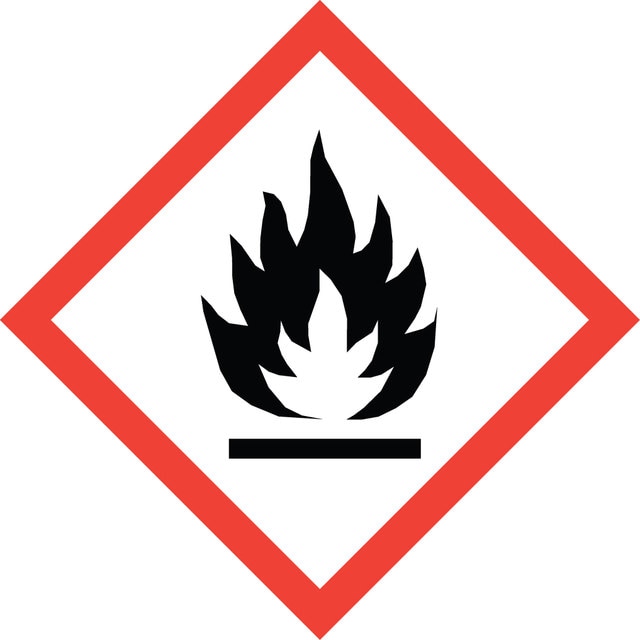

signalword
Danger
hcodes
Hazard Classifications
Eye Irrit. 2 - Flam. Liq. 2 - STOT SE 3
target_organs
Central nervous system
supp_hazards
Storage Class
3 - Flammable liquids
wgk
WGK 1
flash_point_f
1.4 °F - closed cup
flash_point_c
-17.0 °C - closed cup
Choose from one of the most recent versions:
Already Own This Product?
Find documentation for the products that you have recently purchased in the Document Library.