Skip to Content
Merck

506788

Acetaldehyde

PESTANAL®, analytical standard

Synonym(s):

Ethanal

Sign In to View Organizational & Contract Pricing.

Select a Size


About This Item

Linear Formula:
CH3CHO
CAS Number:
Molecular Weight:
44.05
UNSPSC Code:
12352200
PubChem Substance ID:
eCl@ss:
39021102
EC Number:
200-836-8
Beilstein/REAXYS Number:
505984
MDL number:
Technical Service
Need help? Our team of experienced scientists is here for you.
Let Us Assist
Technical Service
Need help? Our team of experienced scientists is here for you.
Let Us Assist

InChI key

IKHGUXGNUITLKF-UHFFFAOYSA-N

InChI

1S/C2H4O/c1-2-3/h2H,1H3

SMILES string

CC=O

grade

analytical standard

vapor density

1.52 (vs air)

vapor pressure

14.63 psi ( 20 °C)

product line

PESTANAL®

CofA

current certificate can be downloaded

autoignition temp.

365 °F

expl. lim.

60 %

packaging

ampule of 1000 mg

technique(s)

HPLC: suitable, gas chromatography (GC): suitable

refractive index

n20/D 1.332 (lit.)

bp

21 °C (lit.)

mp

−125 °C (lit.)

density

0.785 g/mL at 25 °C (lit.)

application(s)

agriculture
cleaning products
cosmetics
environmental
flavors and fragrances
food and beverages
personal care

format

neat

storage temp.

2-8°C

Quality Level

Looking for similar products? Visit Product Comparison Guide

Application

Refer to the product′s Certificate of Analysis for more information on a suitable instrument technique. Contact Technical Service for further support.

General description

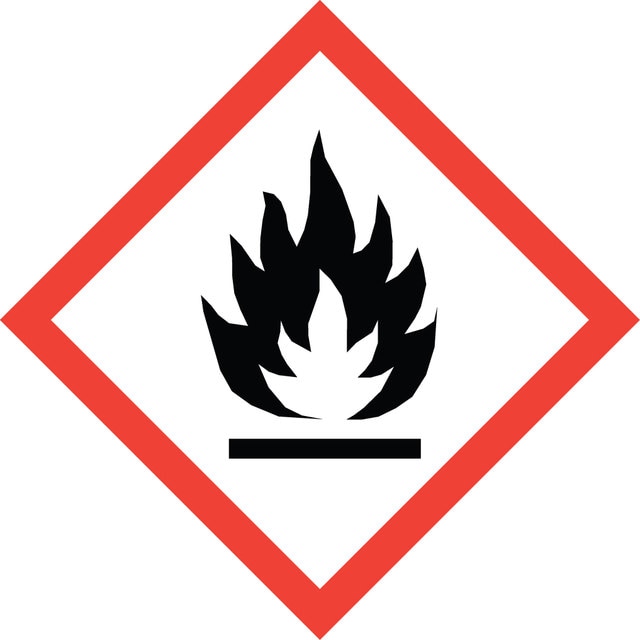
Acetaldehyde is a highly inflammable liquid, which can be commercially produced from liquid-phase oxidation of ethylene. It can also be obtained as a co-product from the oxidation of saturated hydrocarbons like propane or butane. It can find applications as a chemical intermediate in the production of acetic acid.

Legal Information

PESTANAL is a registered trademark of Merck KGaA, Darmstadt, Germany

signalword

Danger

Hazard Classifications

Carc. 1B - Eye Irrit. 2 - Flam. Liq. 1 - Muta. 2 - STOT SE 3

target_organs

Respiratory system

Storage Class

3 - Flammable liquids

wgk

WGK 3

flash_point_f

-38.0 °F - closed cup

flash_point_c

-38.89 °C - closed cup

ppe

Eyeshields, Faceshields, Gloves


Regulatory Listings

Regulatory Listings are mainly provided for chemical products. Only limited information can be provided here for non-chemical products. No entry means none of the components are listed. It is the user’s obligation to ensure the safe and legal use of the product.

75-07-0

CAS No.

Choose from one of the most recent versions:

Certificates of Analysis (COA)

Lot/Batch Number

Don't see the Right Version?

If you require a particular version, you can look up a specific certificate by the Lot or Batch number.

Already Own This Product?

Find documentation for the products that you have recently purchased in the Document Library.

Visit the Document Library

Acetaldehyde Production from Ethylene - Cost Analysis - Acetaldehyde E11A (2017)
M Becker et al.
Journal of chromatography. A, 1281, 115-126 (2013-02-13)
Gas chromatographic analysis of complex carbohydrate mixtures requires highly effective and reliable derivatisation strategies for successful separation, identification, and quantitation of all constituents. Different single-step (per-trimethylsilylation, isopropylidenation) and two-step approaches (ethoximation-trimethylsilylation, ethoximation-trifluoroacetylation, benzoximation-trimethylsilylation, benzoximation-trifluoroacetylation) have been comprehensively studied with regard
Marjie L Hard et al.
Placenta, 24(2-3), 149-154 (2003-02-05)
Significant interindividual variability exists following maternal alcohol consumption; not all children born to alcoholic women manifest the symptoms associated with foetal alcohol spectrum disorder (FASD). To investigate the potential role of the placenta as a source of variability by determining
Tetsuji Yokoyama et al.
Alcoholism, clinical and experimental research, 29(4), 622-630 (2005-04-19)
Elevated mean corpuscular volume (MCV) is a traditional biological marker for alcohol abuse and alcoholism, but the underlying mechanism is unclear. Three recent epidemiologic studies consistently showed that MCV was elevated by alcohol drinking more markedly among individuals with genetically
Dirk W Lachenmeier et al.
Addiction (Abingdon, England), 104(4), 533-550 (2009-04-02)
In addition to being produced in ethanol metabolism, acetaldehyde occurs naturally in alcoholic beverages. Limited epidemiological evidence points to acetaldehyde as an independent risk factor for cancer during alcohol consumption, in addition to the effects of ethanol. This study aims

Our team of scientists has experience in all areas of research including Life Science, Material Science, Chemical Synthesis, Chromatography, Analytical and many others.

Contact Technical Service