
34850

Acetone
suitable for HPLC, ≥99.8%
Sign In to View Organizational & Contract Pricing.
Select a Size
Change View
About This Item
Linear Formula:
CH3COCH3
CAS Number:
Molecular Weight:
58.08
UNSPSC Code:
41116105
PubChem Substance ID:
eCl@ss:
39021201
EC Number:
200-662-2
Beilstein/REAXYS Number:
635680
MDL number:
NACRES:
NA.21
Assay:
≥99.8%
Grade:
HPLC grade
Technique(s):
HPLC: suitable
Bp:
56 °C/760 mmHg (lit.)
Vapor pressure:
184 mmHg ( 20 °C)
grade
HPLC grade
Quality Segment
vapor density
2 (vs air)
vapor pressure
184 mmHg ( 20 °C)
assay
≥99.8%
form
liquid
expl. lim.
13.2 %
technique(s)
HPLC: suitable
impurities
≤0.0005% non-volatile matter, ≤0.002% free acid (as CH3COOH), ≤0.1% water (Karl Fischer)
transmittance
330 nm, ≥15%, 335 nm, ≥50%, 340 nm, ≥80%, 350 nm, ≥98%
refractive index
n20/D 1.359 (lit.)
pH
5-6 (20 °C, 395 g/L)
bp
56 °C/760 mmHg (lit.)
mp
−94 °C (lit.)
density
0.791 g/mL at 25 °C (lit.)
format
neat
SMILES string
CC(C)=O
InChI
1S/C3H6O/c1-3(2)4/h1-2H3
InChI key
CSCPPACGZOOCGX-UHFFFAOYSA-N
General description
Mixtures of TiO2 (P25) with rare earth oxides (La2O3 or Y2O3) calcined at 700°C or 650°C efficiently causes oxidation of acetone. Its Aldol condensation in vapor-phase has been investigated over MgO promoted with alkali (Li, Na, K and Cs) or alkaline earth (Ca, Sr and Ba) metal ions. It undergoes Aldol condensation in the presence of Mg-Al layered double hydroxides (LDH) as catalysts and Cl- and/or CO32- as compensating anions to afford diacetone alcohol and mesityl oxide. Enantioselective Aldol condensation of acetone with various isatins in the presence of dipeptides (catalyst) has been described.
Application
Acetone′s luminesence intensity is dependent upon the solution components . The absorption of UV light by acetone, results in its photolysis and the production of radials .
Acetone has been used in the preparation of 13wt% amorphous poly (lactic acid) (PLA) solution, which was required for the preparation of electrospun PLA membranes.
Packaging
Other Notes
Important notice
- The article number 34850-4X2.5L will be discontinued. Please order the single bottle 34850-2.5L which is physically identical with the same exact specifications.
- The article number 34850-6X1L will be discontinued. Please order the single bottle 34850-1L which is physically identical with the same exact specifications.
Still not finding the right product?
Explore all of our products under Acetone

signalword
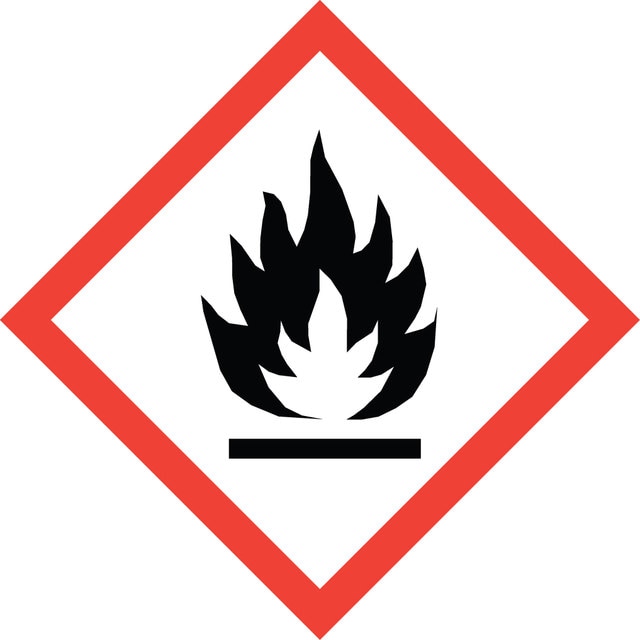
Danger
hcodes
Hazard Classifications
Eye Irrit. 2 - Flam. Liq. 2 - STOT SE 3
target_organs
Central nervous system
supp_hazards
Storage Class
3 - Flammable liquids
wgk
WGK 1
flash_point_f
1.4 °F - closed cup
flash_point_c
-17.0 °C - closed cup
Choose from one of the most recent versions:
Already Own This Product?
Find documentation for the products that you have recently purchased in the Document Library.