
Saltar al contenido
Merck

24-1520

Fenol solution

100 mg/dL, standard

Sinónimos:

Phenol solution

Iniciar sesión para ver los precios por organización y contrato.

Seleccione un Tamaño

Cambiar Vistas

Acerca de este artículo

Fórmula empírica (notación de Hill):
C6H6O
Número CAS:
Peso molecular:
94.11
EC Number:
203-632-7
UNSPSC Code:
12352002
PubChem Substance ID:
Beilstein/REAXYS Number:
6428463
MDL number:
Grade:
standard
Servicio técnico
¿Necesita ayuda? Nuestro equipo de científicos experimentados está aquí para ayudarle.
Permítanos ayudarle


grade

standard

availability

available only in Japan

concentration

100 mg/dL

dilution

(for analytical testing)

SMILES string

Oc1ccccc1

InChI

1S/C6H6O/c7-6-4-2-1-3-5-6/h1-5,7H

InChI key

ISWSIDIOOBJBQZ-UHFFFAOYSA-N
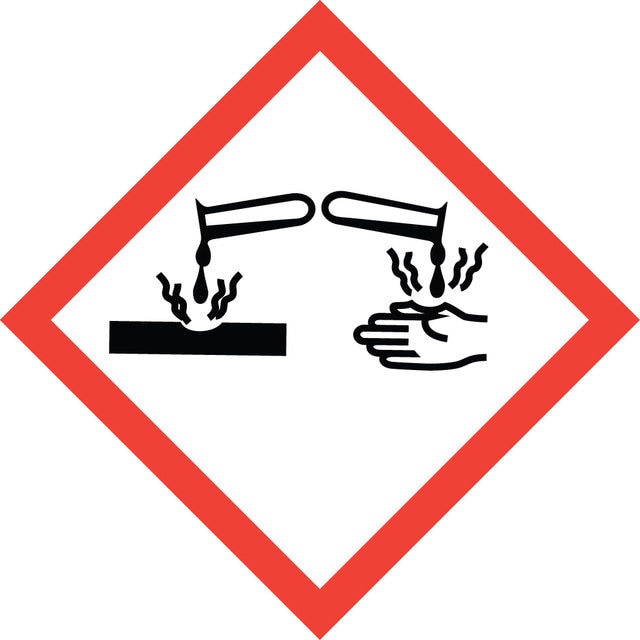


pictograms

Corrosion

signalword

Warning

hcodes

Hazard Classifications

Met. Corr. 1

flash_point_f

Not applicable

flash_point_c

Not applicable

ppe

Faceshields, Gloves, Goggles, type ABEK (EN14387) respirator filter

Clase de almacenamiento

12 - Non Combustible Liquids


Elija entre una de las versiones más recientes:

Certificados de análisis (COA)

Lot/Batch Number

¿No ve la versión correcta?

Si necesita una versión concreta, puede buscar un certificado específico por el número de lote.

¿Ya tiene este producto?

Encuentre la documentación para los productos que ha comprado recientemente en la Biblioteca de documentos.

Visite la Librería de documentos


B K Shormanov et al.
Sudebno-meditsinskaia ekspertiza, 56(2), 33-37 (2013-06-27)
The present work was designed to study the specific features of 2-methyl hydroxybezene and 3-methyl hydroxybenzene distribution after intragastric administration of these toxicants to warm-blooded animals (rats). They were detected in the unmetabolized form in the internal organs and blood
Cintia E Paisio et al.
Environmental technology, 34(1-4), 485-493 (2013-03-28)
The use of native microorganisms is a useful strategy for phenol bioremediation. In the present work, a bacterial strain, named RTE1.4, was isolated from effluents of a chemical industry. The strain was able to grow at high concentrations of phenol
Nina Sanina et al.
FEBS letters, 587(14), 2260-2265 (2013-06-08)
The present work aimed to compare the effects of different lysophosphatidylethanolamine (LPE) content in lipids derived from Yersinia pseudotuberculosis cells exposed and not exposed to phenol on the conformation of OmpF-like porin of these bacteria. Differential scanning calorimetry and intrinsic