Sign In to View Organizational & Contract Pricing.
Select a Size
Change View
About This Item
Empirical Formula (Hill Notation):
Br2
CAS Number:
Molecular Weight:
159.81
PubChem Substance ID:
UNSPSC Code:
41116105
MDL number:
grade
CP
form
liquid
availability
available only in Japan
density
1.307 g/mL at 25 °C (lit.)
storage temp.
15-25°C
InChI
1S/Br2/c1-2
InChI key
GDTBXPJZTBHREO-UHFFFAOYSA-N
signalword
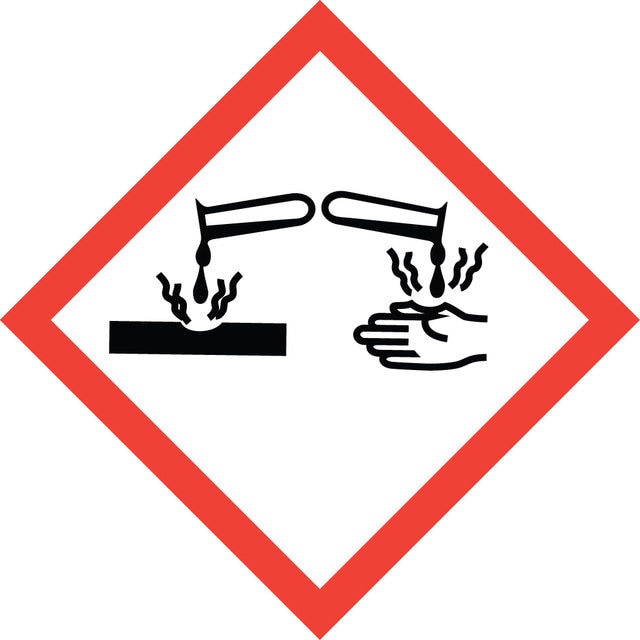
Danger
hcodes
Hazard Classifications
Acute Tox. 4 Inhalation - Aquatic Acute 1 - Eye Dam. 1 - Skin Irrit. 2
Storage Class
6.1A - Combustible acute toxic Cat. 1 and 2 / very toxic hazardous materials
wgk
WGK 2
flash_point_f
Not applicable
flash_point_c
Not applicable
Choose from one of the most recent versions:
Already Own This Product?
Find documentation for the products that you have recently purchased in the Document Library.
Vitalij V Levin et al.
Organic letters, 15(4), 917-919 (2013-02-02)
Reactions of difluorocarbene with benzyl and alkylzinc halides leading to fluorinated organozinc species have been described. The generated α-difluorinated organozinc reagents are reasonably stable in solution and can be quenched with external electrophiles (iodine, bromine, proton), affording compounds containing the
Kimberly T Barrett et al.
Journal of the American Chemical Society, 135(8), 2963-2966 (2013-02-16)
We report the enantioselective synthesis of atropisomeric benzamides employing catalytic electrophilic aromatic substitution reactions involving bromination. The catalyst is a simple tetrapeptide bearing a tertiary amine that may function as a Brønsted base. A series of tri- and dibrominations were
Mohammad Navid Soltani Rad et al.
Molecular diversity, 17(1), 9-18 (2012-11-08)
A facile and highly convenient base-free protocol for the chemoselective preparation of 1,2-diol mono-esters is described. In this method, the regioselective ring opening of epoxides with carboxylic acids in the presence of [bmim]Br furnishes the corresponding 1,2-diol mono-esters in excellent