
440140

(3-Aminopropyl)triethoxysilane
99%
Synonym(s):
3-Triethoxysilylpropylamine, APTES, APTS
Sign In to View Organizational & Contract Pricing.
Select a Size
Change View
About This Item
Linear Formula:
H2N(CH2)3Si(OC2H5)3
CAS Number:
Molecular Weight:
221.37
UNSPSC Code:
12352103
NACRES:
NA.23
PubChem Substance ID:
EC Number:
213-048-4
Beilstein/REAXYS Number:
1754988
MDL number:
Quality Segment
assay
99%
form
liquid
bp
217 °C/760 mmHg (lit.)
density
0.946 g/mL at 25 °C (lit.)
SMILES string
CCO[Si](CCCN)(OCC)OCC
InChI
1S/C9H23NO3Si/c1-4-11-14(12-5-2,13-6-3)9-7-8-10/h4-10H2,1-3H3
InChI key
WYTZZXDRDKSJID-UHFFFAOYSA-N
General description
(3-Aminopropyl)triethoxysilane (APTES) is a premium, high-purity aminosilane used to deposit stable Self-Assembled Monolayers (SAMs) on silica, metal oxides, and graphene. Its triethoxy structure allows for slower, more controlled hydrolysis compared to methoxysilanes, facilitating the formation of uniform, reproducible molecular layers. Critically for life science research, APTES releases ethanol rather than methanol during silanization, making it the preferred reagent for functionalizing surfaces intended for live-cell interfaces and clinical diagnostics. This 99% high-purity grade is engineered to provide a high density of reactive ethoxy groups for robust covalent anchoring while eliminating the trace impurities that act as charge traps or non-specific binding sites, thereby preventing the critical performance failures in OFETs and nanosensors that standard-grade silanes often cause.
Application
As a biocompatible molecular bridge, APTES is essential for engineering intelligent interfaces and stimuli-responsive systems that enable precise interactions at the intersection of nanotechnology, biology, and electronics.
• Biocompatible Drug Delivery: Preferred for coating Mesoporous Silica Nanoparticles (MSNs) and magnetic nanocarriers intended for in vivo use, ensuring minimal cytotoxicity during the functionalization process.
• Advanced Histology & Imaging: Used to prepare positively charged microscope slides that enhance the adhesion of tissue sections and cells for complex immunohistochemical (IHC) and in situ hybridization (ISH) procedures.
• Nano-Biosensors: Facilitates the immobilization of DNA and proteins onto graphene-based field-effect transistors (GFETs) and fiber-optic sensors for ultra-sensitive pathogen and biomarker detection.
• Regenerative Medicine: Surface-modifies hollow microcarriers (HMCs) and 3D-scaffolds to promote cell attachment and proliferation in tissue engineering and biopharmaceutical production.
• Organic Electronics (OFETs): Serves as an interfacial modifier to improve the electrical contact between graphene flakes and metal electrodes, as well as passivating gate dielectrics in flexible electronic devices.
• Gene Vector Engineering: Enables the synthesis of monodispersed, soluble DNA-nanodiamond conjugates and other cationic vectors for non-viral gene transfection.
• Biocompatible Drug Delivery: Preferred for coating Mesoporous Silica Nanoparticles (MSNs) and magnetic nanocarriers intended for in vivo use, ensuring minimal cytotoxicity during the functionalization process.
• Advanced Histology & Imaging: Used to prepare positively charged microscope slides that enhance the adhesion of tissue sections and cells for complex immunohistochemical (IHC) and in situ hybridization (ISH) procedures.
• Nano-Biosensors: Facilitates the immobilization of DNA and proteins onto graphene-based field-effect transistors (GFETs) and fiber-optic sensors for ultra-sensitive pathogen and biomarker detection.
• Regenerative Medicine: Surface-modifies hollow microcarriers (HMCs) and 3D-scaffolds to promote cell attachment and proliferation in tissue engineering and biopharmaceutical production.
• Organic Electronics (OFETs): Serves as an interfacial modifier to improve the electrical contact between graphene flakes and metal electrodes, as well as passivating gate dielectrics in flexible electronic devices.
• Gene Vector Engineering: Enables the synthesis of monodispersed, soluble DNA-nanodiamond conjugates and other cationic vectors for non-viral gene transfection.
Still not finding the right product?
Explore all of our products under (3-Aminopropyl)triethoxysilane
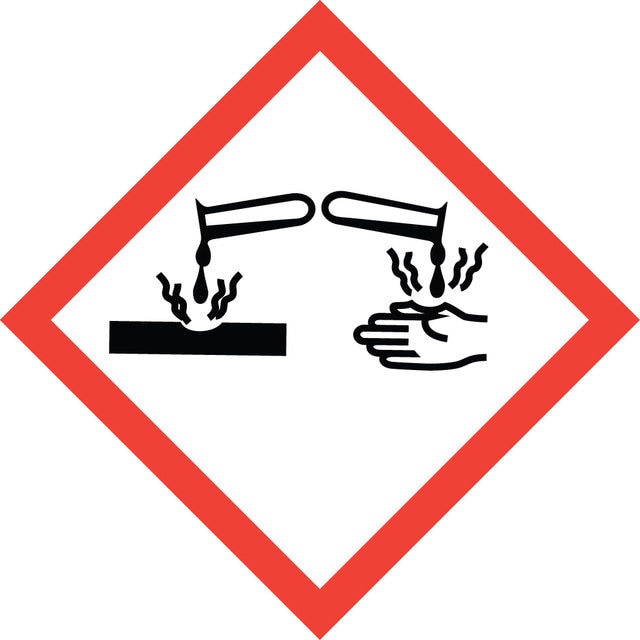

signalword
Danger
hcodes
Hazard Classifications
Acute Tox. 4 Oral - Eye Dam. 1 - Skin Corr. 1B - Skin Sens. 1
Storage Class
8A - Combustible corrosive hazardous materials
wgk
WGK 1
flash_point_f
199.4 °F - closed cup
flash_point_c
93 °C - closed cup
ppe
Faceshields, Gloves, Goggles, type ABEK (EN14387) respirator filter
Choose from one of the most recent versions:
Already Own This Product?
Find documentation for the products that you have recently purchased in the Document Library.