Skip to Content
Merck

OP115

Anti-MDM2 (Ab-2) Mouse mAb (2A10)

liquid, clone 2A10, Calbiochem®

Synonym(s):

Anti-Murine Double Minute Chromosome-2, Anti-Ubiquitin Protein Ligase, Anti-p53 Binding Protein, Anti-Ubiquitin Protein Ligase, Anti-p53 Binding Protein, Anti-Murine Double Minute Chromosome-2

Sign In to View Organizational & Contract Pricing.

Select a Size

Change View

About This Item

NACRES:
NA.41
UNSPSC Code:
12352203
Clone:
2A10, monoclonal
Species reactivity:
human
Application:
Citations:
14
Technical Service
Need help? Our team of experienced scientists is here for you.
Let Us Assist


biological source

mouse

Quality Level

antibody form

purified antibody

antibody product type

primary antibodies

clone

2A10, monoclonal

form

liquid

contains

≤0.1% sodium azide as preservative

species reactivity

human

manufacturer/tradename

Calbiochem®

storage condition

do not freeze

dilution

(Immunoblotting (2 µg/mL)
Immunofluorescence (1 µg/mL)
Immunoprecipitation (1 µg/reaction,
Paraffin Sections (2.5 µg/mL, heat pre-treatment required))

isotype

IgG2a

shipped in

wet ice

storage temp.

2-8°C

target post-translational modification

unmodified

Gene Information

human ... MDM2(4193)

General description

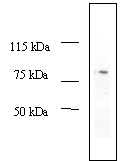
Purified mouse monoclonal antibody (see application references). Recognizes the ~90 kDa (apparent MW) MDM2 protein.
Recognizes the ~90 kDa (apparent MW) MDM2 protein in A549 cells.
This Anti-MDM2 (Ab-2) Mouse mAb (2A10) is validated for use in Immunoblotting, Immunofluorescence, Immunoprecipitation, Paraffin Sections for the detection of MDM2 (Ab-2).

Immunogen

Epitope: within amino acids 294-339
Human
human MDM2 protein

Application


Immunoblotting (2 g/ml)
Immunofluorescence (1 g/ml)
Immunoprecipitation (1 g/reaction, see application references)
Paraffin Sections (2.5 g/ml, heat pre-treatment required)

Packaging

Please refer to vial label for lot-specific concentration.

Physical form

In 50 mM sodium phosphate buffer, 0.2% gelatin, pH 7.5.

Analysis Note

Positive Control
A549 cells or most tissues

Other Notes

Antibody should be titrated for optimal results in individual systems.
Marchetti, A., et al. 1995. J. Pathol.175, 31.
Barak, Y., et al. 1993. EMBO. J.12, 461.
Chen, J., et al. 1993. Mol. Cell Biol.13, 4107.
Ladanyi, M., et al. 1993. Cancer Res.53, 16.
Leach, F.S., et al. 1993. Cancer Res.53, 2231.
Oliner, J.D., et al. 1993. Nature362, 857.
Momand, J., et al. 1992. Cell69, 1237.
Oliner, J.D., et al. 1992. Nature358, 80.
Fakharzadeh, S.S., et al. 1991. EMBO. J.10, 1565.

Legal Information

CALBIOCHEM is a registered trademark of Merck KGaA, Darmstadt, Germany

Disclaimer

Toxicity: Standard Handling (A)


Still not finding the right product?

Try our Product Selector Tool to narrow your options


Storage Class

12 - Non Combustible Liquids

wgk

nwg

flash_point_f

Not applicable

flash_point_c

Not applicable


Certificates of Analysis (COA)

Search for Certificates of Analysis (COA) by entering the products Lot/Batch Number. Lot and Batch Numbers can be found on a product’s label following the words ‘Lot’ or ‘Batch’.

Already Own This Product?

Find documentation for the products that you have recently purchased in the Document Library.

Visit the Document Library


Tomohiro Matsumoto et al.
The journal of physiological sciences : JPS, 69(2), 317-326 (2018-11-28)
The purpose of the present study was to determine the effects of transcutaneous CO2 application on the blood flow and capillary architecture of the soleus muscle in rats with streptozotocin (STZ)-induced hyperglycemia. Wistar rats were randomly divided into four groups:
Alexander P Miceli et al.
Molecular and cellular biology, 32(2), 348-364 (2011-11-09)
The ARF tumor suppressor is a potent sensor of hyperproliferative cues emanating from oncogenic signaling. ARF responds to these cues by eliciting a cell cycle arrest, effectively abating the tumorigenic potential of these stimuli. Prior reports have demonstrated that oncogenic
Avijeet Chopra et al.
PloS one, 11(4), e0153818-e0153818 (2016-04-21)
Mitotic inhibitors are widely utilized chemotherapeutic agents that take advantage of mitotic defects in cancer cells. We have identified a novel class of piperazine-based mitotic inhibitors, of which AK301 is the most potent derivative identified to date (EC50 < 200


Global Trade Item Number

SKUGTIN
OP115-100UGCN04055977224955