
P7875

Periodic acid
ReagentPlus®, ≥99.0%
Sign In to View Organizational & Contract Pricing.
Select a Size
Change View
About This Item
Empirical Formula (Hill Notation):
H5IO6
CAS Number:
Molecular Weight:
227.94
NACRES:
NA.21
PubChem Substance ID:
UNSPSC Code:
12352106
EC Number:
233-937-0
MDL number:
Assay:
≥99.0%
Form:
powder or crystals
Quality Level
product line
ReagentPlus®
assay
≥99.0%
form
powder or crystals
reaction suitability
reagent type: oxidant
technique(s)
toxicology assay: suitable
mp
122 °C (lit.)
solubility
water: 100 mg/mL, clear, colorless
SMILES string
OI(O)(O)(O)(O)=O
InChI
1S/H5IO6/c2-1(3,4,5,6)7/h(H5,2,3,4,5,6,7)
InChI key
TWLXDPFBEPBAQB-UHFFFAOYSA-N
General description
Periodic acid, an oxoacid of iodine, is commonly used as a strong oxidizing agent. This inorganic acid is soluble in most solvents including water and ether.
Application
Periodic acid can be used in the following reactions:
It can also be used:
- Oxidation of alcohols to ketones and aldehydes.
- Oxidation hydroxylamine derivatives.
- Oxidation of arenes to quinones.
It can also be used:
- As a stoichiometric oxidant with chromium (IV) acetate for the oxidation of tertiary C−H bonds to tertiary alcohols.
- In combination with chromium oxide to oxidize primary alcohols to carboxylic acids; alkylbenzenes to benzoic acids; and cyclic benzyl ethers to the corresponding lactones.
- In the selective oxidation of sulfides to sulfoxides using FeCl3 as a catalyst.
Legal Information
ReagentPlus is a registered trademark of Merck KGaA, Darmstadt, Germany
Still not finding the right product?
Explore all of our products under Periodic acid
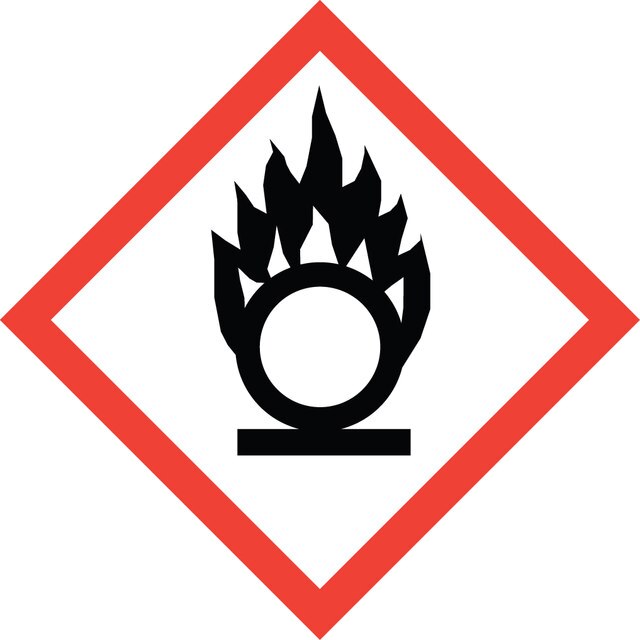



signalword
Danger
hcodes
Hazard Classifications
Aquatic Acute 1 - Aquatic Chronic 1 - Eye Dam. 1 - Ox. Sol. 1 - Skin Corr. 1B - STOT RE 1 Oral
target_organs
Thyroid
Storage Class
5.1A - Strongly oxidizing hazardous materials
wgk
WGK 3
flash_point_f
Not applicable
flash_point_c
Not applicable
Choose from one of the most recent versions:
Already Own This Product?
Find documentation for the products that you have recently purchased in the Document Library.
Murad Alturkustani et al.
Journal of neuropathology and experimental neurology, 74(3), 233-240 (2015-02-11)
The pathologic features of adult-onset leukoencephalopathy/leukodystrophy with axonal spheroids (ALAS) are variable, and this has led to different hypotheses as to whether primarily demyelination or axonopathy may underlie this disorder. Typical ALAS pathology is rarely accompanied by focal multiple sclerosis
Zollie A Yavarow et al.
Human molecular genetics, 29(2), 286-294 (2019-12-10)
Glycogen storage disease type Ia (GSD Ia) is caused by autosomal mutations in glucose-6-phosphatase α catalytic subunit (G6PC) and can present with severe hypoglycemia, lactic acidosis and hypertriglyceridemia. In both children and adults with GSD Ia, there is over-accumulation of
H Abdolmohammad-Zadeh et al.
Talanta, 94, 201-208 (2012-05-23)
A simple solid phase extraction system based on the applying the nickel-aluminum layered double hydroxide (Ni-Al LDH) as a nano-sorbent was developed for the speciation analysis of chromium and manganese by flame atomic absorption spectrometry (FAAS). The method is based