Skip to Content
Merck

110205

(±)-Propylene oxide

ReagentPlus®, ≥99%

Synonym(s):

(±)-Methyloxirane, 1,2-Epoxypropane

Sign In to View Organizational & Contract Pricing.

Select a Size


About This Item

Empirical Formula (Hill Notation):
C3H6O
CAS Number:
Molecular Weight:
58.08
UNSPSC Code:
12162002
NACRES:
NA.23
PubChem Substance ID:
EC Number:
200-879-2
Beilstein/REAXYS Number:
79763
MDL number:
Technical Service
Need help? Our team of experienced scientists is here for you.
Let Us Assist
Technical Service
Need help? Our team of experienced scientists is here for you.
Let Us Assist

Product Name

(±)-Propylene oxide, ReagentPlus®, ≥99%

InChI key

GOOHAUXETOMSMM-UHFFFAOYSA-N

InChI

1S/C3H6O/c1-3-2-4-3/h3H,2H2,1H3

SMILES string

CC1CO1

vapor density

2 (vs air)

vapor pressure

29.43 psi ( 55 °C)
8.59 psi ( 20 °C)

product line

ReagentPlus®

assay

≥99%

autoignition temp.

1378 °F

expl. lim.

37 %

refractive index

n20/D 1.366 (lit.)

bp

34 °C (lit.)

mp

−112 °C (lit.)

density

0.83 g/mL at 25 °C (lit.)

shipped in

wet ice

storage temp.

2-8°C

Quality Level

Looking for similar products? Visit Product Comparison Guide

Related Categories

Application

Used in the production of polyether polyols, propylene glycols, propylene glycol ethers.Used as an intermediate to produce ammonium type complex to remove thin films of petroleum from water surfaces.

General description

(±)-Propylene oxide is an organic compound used as an intermediate in several chemical reactions. It readily reacts with active hydrogen atoms.

Other Notes

The article number 110205-4X1L will be discontinued. Please order the single bottle 110205-1L which is physically identical with the same exact specifications.

Legal Information

ReagentPlus is a registered trademark of Merck KGaA, Darmstadt, Germany

signalword

Danger

Hazard Classifications

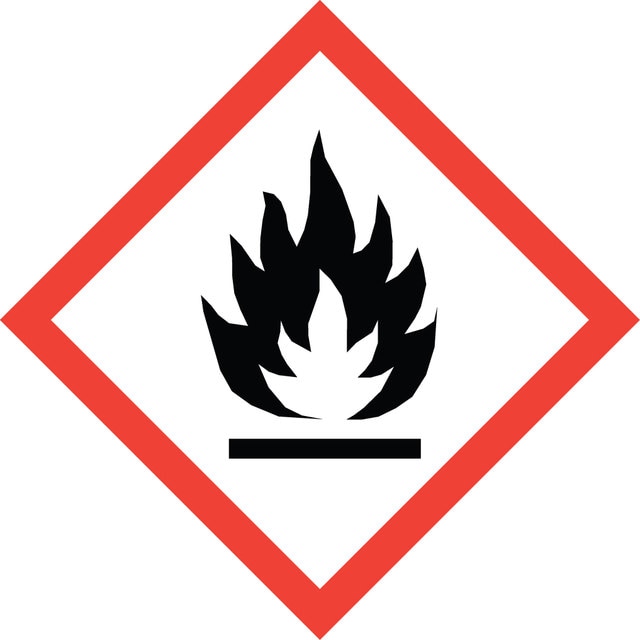
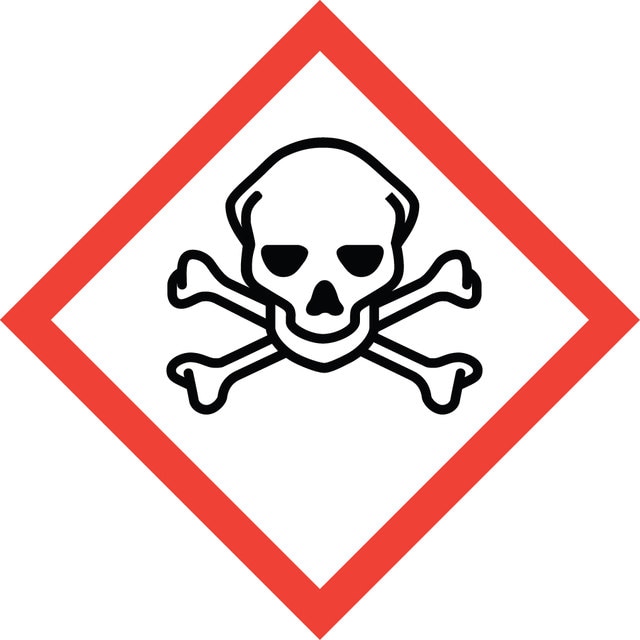
Acute Tox. 3 Dermal - Acute Tox. 3 Inhalation - Acute Tox. 4 Oral - Carc. 1B - Eye Irrit. 2 - Flam. Liq. 1 - Muta. 1B - STOT SE 3

target_organs

Respiratory system

Storage Class

3 - Flammable liquids

wgk

WGK 3

flash_point_f

-36.4 °F - Equilibrium method

flash_point_c

-38 °C - Equilibrium method

ppe

Faceshields, Gloves, Goggles


Choose from one of the most recent versions:

Certificates of Analysis (COA)

Lot/Batch Number

Don't see the Right Version?

If you require a particular version, you can look up a specific certificate by the Lot or Batch number.

Already Own This Product?

Find documentation for the products that you have recently purchased in the Document Library.

Visit the Document Library

Josep Casamada Ribot et al.
Chemical communications (Cambridge, England), 46(37), 6971-6973 (2010-08-24)
The aqueous gelation of a quaternary ammonium oligo(propylene oxide)-based ionic liquid yields ion gels with a reverse thermoresponsive behavior (i.e., mechanical moduli and viscosity increase with temperature) and enhanced ionic conductivities.
Aude Bouchet et al.
The Journal of organic chemistry, 76(10), 4178-4181 (2011-04-08)
ECD and NMR experiments show that the complexation of propylene oxide (PrO) within the cavity of an enantiopure water-soluble cryptophane 1 in NaOH solution is enantioselective and that the (R)-PrO@PP-1 diastereomer is more stable than the (S)-PrO@PP-1 diastereomer with a
Denis Merlet et al.
Journal of magnetic resonance (San Diego, Calif. : 1997), 209(2), 315-322 (2011-02-25)
The application of the G-SERFph pulse sequence is presented on enantiomeric mixtures dissolved in a chiral liquid crystal. It aims at editing, within one single 2D spectrum, every proton coupling which is experienced by a given proton site in the
Javix Thomas et al.
Chemistry (Weinheim an der Bergstrasse, Germany), 17(16), 4582-4587 (2011-03-25)
Chirality recognition in the hydrogen-bonded glycidol···propylene oxide complex has been studied by using rotational spectroscopy and ab initio calculations. An extensive conformational search has been performed for this binary adduct at the MP2/6-311++G(d,p) level of theory and a total of
Sascha Brunke et al.
PLoS pathogens, 10(10), e1004478-e1004478 (2014-10-31)
Candida glabrata is one of the most common causes of candidemia, a life-threatening, systemic fungal infection, and is surpassed in frequency only by Candida albicans. Major factors contributing to the success of this opportunistic pathogen include its ability to readily

Our team of scientists has experience in all areas of research including Life Science, Material Science, Chemical Synthesis, Chromatography, Analytical and many others.

Contact Technical Service