
11590

4,4′-Azobis(4-cyanovaleric acid)
≥98.0% (T)
Synonym(s):
4,4′-Azobis(4-cyanopentanoic acid), ABCVA, ACVA
Select a Size
About This Item
Quality Level
assay
≥98.0% (T)
form
solid
impurities
≤1% water
mp
118-125 °C (dec.) (lit.)
functional group
azo, carboxylic acid, nitrile
storage temp.
2-8°C
SMILES string
CC(CCC(O)=O)(\N=N\C(C)(CCC(O)=O)C#N)C#N
InChI
1S/C12H16N4O4/c1-11(7-13,5-3-9(17)18)15-16-12(2,8-14)6-4-10(19)20/h3-6H2,1-2H3,(H,17,18)(H,19,20)/b16-15+
InChI key
VFXXTYGQYWRHJP-FOCLMDBBSA-N
Application
Biochem/physiol Actions
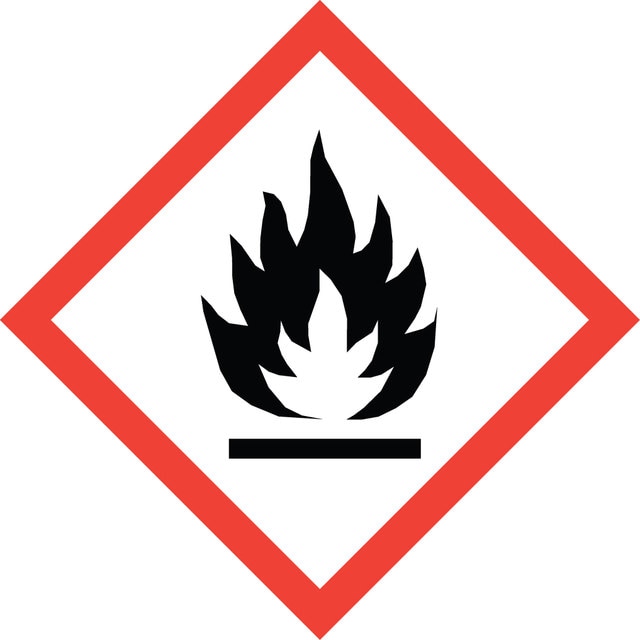
signalword
Danger
hcodes
Hazard Classifications
Self-react. D
Storage Class
5.2 - Organic peroxides and self-reacting hazardous materials
wgk
WGK 2
flash_point_f
Not applicable
flash_point_c
Not applicable
ppe
Eyeshields, Gloves, type P3 (EN 143) respirator cartridges
Regulatory Listings
Regulatory Listings are mainly provided for chemical products. Only limited information can be provided here for non-chemical products. No entry means none of the components are listed. It is the user’s obligation to ensure the safe and legal use of the product.
Group 5: Self-reactive substances + Azo compounds + Hazardous rank I + 1st self-reactive materials
fsl
Choose from one of the most recent versions:
Already Own This Product?
Find documentation for the products that you have recently purchased in the Document Library.
Protocols
We present an article about RAFT, or Reversible Addition/Fragmentation Chain Transfer, which is a form of living radical polymerization.
Polymerization via ATRP procedures demonstrated by Prof. Dave Haddleton's research group at the University of Warwick.
We presents an article featuring procedures that describe polymerization of methyl methacrylate and vinyl acetate homopolymers and a block copolymer as performed by researchers at CSIRO.
Articles
開始剤の選択方法や安定剤除去など、一般的なFAQをまとめました。
Micro Review:RAFT(可逆的付加/開裂連鎖移動)重合
An article regarding common FAQs for initiators and stabilizers.
Related Content
精巧な機能を持つ薬物送達システムを構築するのに非常に有用なポリマーキャリアをRAFT重合法にて調製した事例をご紹介します。