Skip to Content
Merck

139181

Bromodichloromethane

≥97%

Synonym(s):

Dichlorobromomethane

Sign In to View Organizational & Contract Pricing.

Select a Size


About This Item

Linear Formula:
BrCHCl2
CAS Number:
Molecular Weight:
163.83
UNSPSC Code:
12352100
NACRES:
NA.22
PubChem Substance ID:
EC Number:
200-856-7
Beilstein/REAXYS Number:
1697005
MDL number:
Technical Service
Need help? Our team of experienced scientists is here for you.
Let Us Assist
Technical Service
Need help? Our team of experienced scientists is here for you.
Let Us Assist

Product Name

Bromodichloromethane, ≥97%

InChI key

FMWLUWPQPKEARP-UHFFFAOYSA-N

InChI

1S/CHBrCl2/c2-1(3)4/h1H

SMILES string

ClC(Cl)Br

assay

≥97%

form

liquid

contains

potassium carbonate as stabilizer

refractive index

n20/D 1.497 (lit.)

bp

87 °C (lit.)

mp

−55 °C (lit.)

solubility

water: insoluble

density

1.98 g/mL at 25 °C (lit.)

functional group

bromo
chloro

Quality Level

Looking for similar products? Visit Product Comparison Guide

Related Categories

Application

Bromodichloromethane was used to investigate the in vivo genotoxicity of chlorodibromomethane, bromodichloromethane and bromoform in mice.

Biochem/physiol Actions

Bromodichloromethane (BDCM) induces steatohepatitic injury in human liver. BDCM induces the cell proliferation in different tissues and kidney damage by renal tuble cell proliferation in male F344 rats.

signalword

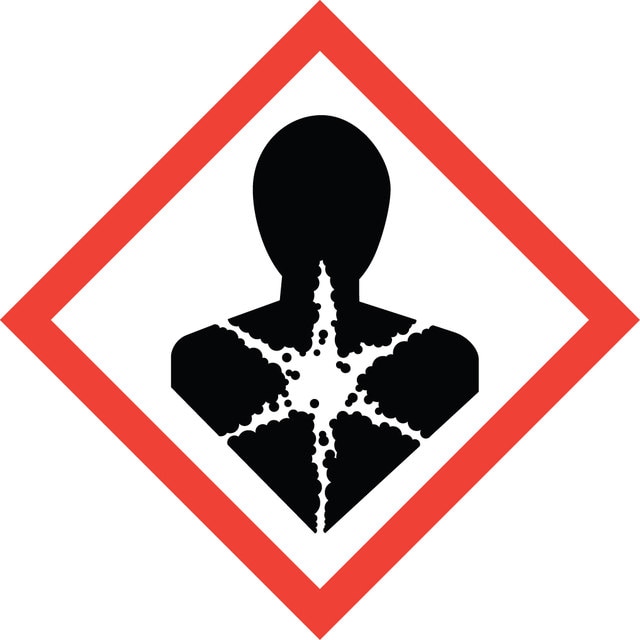
Danger

Hazard Classifications

Acute Tox. 4 Oral - Carc. 2 - Eye Dam. 1 - Skin Irrit. 2 - STOT SE 3

target_organs

Respiratory system

Storage Class

10 - Combustible liquids

wgk

WGK 3

flash_point_f

Not applicable

flash_point_c

Not applicable

ppe

Eyeshields, Faceshields, Gloves, type ABEK (EN14387) respirator filter


Choose from one of the most recent versions:

Certificates of Analysis (COA)

Lot/Batch Number

Don't see the Right Version?

If you require a particular version, you can look up a specific certificate by the Lot or Batch number.

Already Own This Product?

Find documentation for the products that you have recently purchased in the Document Library.

Visit the Document Library

K J Stocker et al.
Mutagenesis, 12(3), 169-173 (1997-05-01)
Chlorination of drinking water results in the formation of chlorodibromomethane, bromodichloromethane and bromoform. These trihalomethanes have all shown evidence of genotoxicity in bacterial and mammalian cell systems in vitro and some evidence of carcinogenicity in rodents. Chlorodibromomethane and bromodichloromethane have
Suvarthi Das et al.
American journal of physiology. Gastrointestinal and liver physiology, 305(12), G950-G963 (2013-10-26)
Recent studies indicate that metabolic oxidative stress, autophagy, and inflammation are hallmarks of nonalcoholic steatohepatitis (NASH) progression. However, the molecular mechanisms that link these important events in NASH remain unclear. In this study, we investigated the mechanistic role of purinergic
Ted Lock et al.
Archives of toxicology, 78(7), 410-417 (2004-05-14)
Male F344 rats exposed to bromodichloromethane (BDCM) by gavage at 50 or 100 mg/kg/day for 5 days a week for 28 days excreted large amounts of formic acid in their urine, which was accompanied by a change in urinary pH.
Regina Grazuleviciene et al.
Occupational and environmental medicine, 70(4), 274-282 (2013-02-14)
Congenital anomalies have been inconsistently associated with maternal crude estimated exposure to drinking water trihalomethane (THM). We investigated the relationship between individual THM uptake during the first trimester of pregnancy and congenital anomalies. We estimated maternal THM uptake for 3074
Teresa L Leavens et al.
Toxicological sciences : an official journal of the Society of Toxicology, 99(2), 432-445 (2007-07-28)
Exposure to bromodichloromethane (BDCM), one of the most prevalent disinfection byproducts in drinking water, can occur via ingestion of water and by dermal absorption and inhalation during activities such as bathing and showering. The objectives of this research were to

Our team of scientists has experience in all areas of research including Life Science, Material Science, Chemical Synthesis, Chromatography, Analytical and many others.

Contact Technical Service