Skip to Content
Merck

167185

Methyl 2-bromopropionate

98%

Synonym(s):

(±)-2-Bromopropionic acid methyl ester, (±)-Methyl 2-bromopropionate, 2-Bromopropanoic acid methyl ester, 2-Bromopropionic acid methyl ester, Methyl (±)-α-bromopropionate

Sign In to View Organizational & Contract Pricing.

Select a Size


About This Item

Linear Formula:
CH3CHBrCO2CH3
CAS Number:
Molecular Weight:
167.00
UNSPSC Code:
12352100
NACRES:
NA.22
PubChem Substance ID:
EC Number:
226-642-3
Beilstein/REAXYS Number:
1720592
MDL number:
Assay:
98%
Form:
liquid
Technical Service
Need help? Our team of experienced scientists is here for you.
Let Us Assist
Technical Service
Need help? Our team of experienced scientists is here for you.
Let Us Assist

Quality Level

assay

98%

form

liquid

refractive index

n20/D 1.451 (lit.)

bp

51 °C/19 mmHg (lit.)

solubility

water: insoluble

density

1.497 g/mL at 25 °C (lit.)

functional group

bromo, ester

SMILES string

COC(=O)C(C)Br

InChI

1S/C4H7BrO2/c1-3(5)4(6)7-2/h3H,1-2H3

InChI key

ACEONLNNWKIPTM-UHFFFAOYSA-N

Related Categories

Application
Methyl 2-bromopropionate was used as initiator during the synthesis of polymer brushes with single-walled carbon nanotubes as backbones. It was used as starting reagent for the synthesis of 2-18F-fluoropropionic acid, positron emission tomography imaging agent for prostate cancer.

signalword

Danger

Hazard Classifications

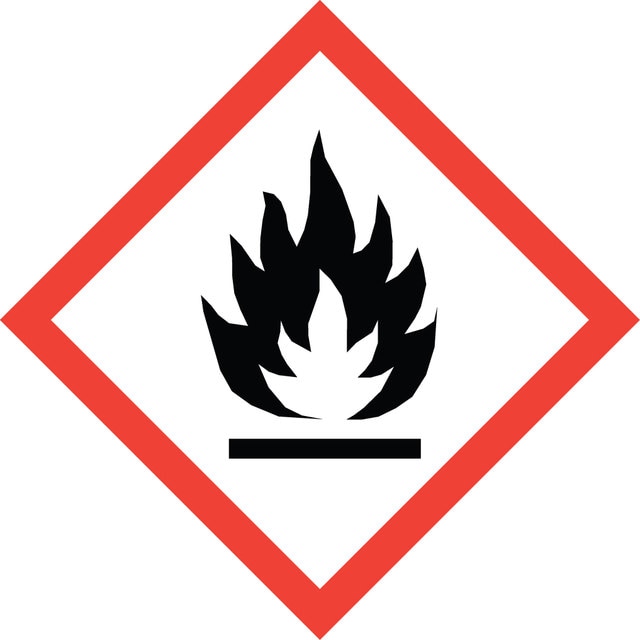
Eye Dam. 1 - Flam. Liq. 3 - Skin Corr. 1B - STOT SE 3

target_organs

Respiratory system

Storage Class

3 - Flammable liquids

wgk

WGK 3

flash_point_f

125.6 °F - closed cup

flash_point_c

52 °C - closed cup

ppe

Faceshields, Gloves, Goggles, type ABEK (EN14387) respirator filter


Regulatory Listings

Regulatory Listings are mainly provided for chemical products. Only limited information can be provided here for non-chemical products. No entry means none of the components are listed. It is the user’s obligation to ensure the safe and legal use of the product.

Group 4: Flammable liquids + Type 2 petroleums + Hazardous rank III + Water insoluble liquid

fsl

167185-VAR: + 167185-BULK: + 167185-25G: + 167185-100G: + 167185-500G:

jan


Choose from one of the most recent versions:

Certificates of Analysis (COA)

Lot/Batch Number

Don't see the Right Version?

If you require a particular version, you can look up a specific certificate by the Lot or Batch number.

Already Own This Product?

Find documentation for the products that you have recently purchased in the Document Library.

Visit the Document Library

Gerard Lligadas et al.
Biomacromolecules, 18(10), 2981-3008 (2017-08-30)
The most fundamental aspects of single-electron transfer (SET) principles are presented. They are discussed according to different definitions used by expert practitioners and are applied to SET living radical polymerization (SET-LRP) according to the definition of the division of organic
Nagavarakishore Pillarsetty et al.
Journal of nuclear medicine : official publication, Society of Nuclear Medicine, 50(10), 1709-1714 (2009-09-18)
There is a high interest in developing an (18)F-labeled PET tracer that can aid in diagnosis and therapy monitoring of prostate cancer. In the current study, we have evaluated the potential of 2-(18)F-fluoropropionic acid ((18)F-FPA) as a PET tracer for
Shuhui Qin et al.
Journal of the American Chemical Society, 126(1), 170-176 (2004-01-08)
Polymer brushes with single-walled carbon nanotubes (SWNT) as backbones were synthesized by grafting n-butyl methacrylate (nBMA) from the ends and sidewalls of SWNT via atom transfer radical polymerization (ATRP). Carboxylic acid groups on SWNT were formed by nitric acid oxidation.
Yu Wang
Polymers, 11(8) (2019-07-31)
Atom transfer radical polymerization (ATRP) of methyl acrylate (MA) was carried out by continuous feeding of Cu(I) activators. Typically, the solvent, the monomer, the initiator, and the CuBr2/Me6TREN deactivator are placed in a Schlenk flask (Me6TREN: tris[2-(dimethylamino)ethyl]amine), while the CuBr/Me6TREN
Federico Di Sacco et al.
Nanomaterials (Basel, Switzerland), 9(3) (2019-03-22)
Novel, multipurpose terpolymers based on styrene (PS), tert-butyl methacrylate (tBMA) and glycidyl methacrylate (GMA), have been synthesized via Atom Transfer Radical Polymerization (ATRP). Post-synthetic modification with 1-pyrenemethylamine (AMP) allows non-covalent functionalization of carbon nanotubes, eventually yielding a conductive nanocomposite materials

Our team of scientists has experience in all areas of research including Life Science, Material Science, Chemical Synthesis, Chromatography, Analytical and many others.

Contact Technical Service