
289132

Urea hydrogen peroxide
97%
Synonym(s):
Hydrogen peroxide–Urea adduct, Carbamide Per hydrate, Carbamide peroxide, Percarbamide, Urea hydrogen peroxide
Select a Size
About This Item
Quality Level
vapor pressure
23.3 mmHg ( 30 °C)
assay
97%
form
solid
reaction suitability
reagent type: oxidant
mp
90-93 °C (lit.)
functional group
amine
storage temp.
room temp
SMILES string
OO.NC(N)=O
InChI
1S/CH4N2O.H2O2/c2-1(3)4;1-2/h(H4,2,3,4);1-2H
InChI key
AQLJVWUFPCUVLO-UHFFFAOYSA-N
General description
Application
- In the conversion of sulfides to sulfoxides or sulfones under solvent free condition.
- In the conversion of nitrogen heterocycles to their corresponding N-oxides.
- In the epoxidation of various alkene in combination with number of carboxylic anhydrides and disodium hydrogen phosphate in anhydrous organic solvents.
- In the Baeyer–Villiger oxidation reaction where in aldehydes and ketones undergo oxidation to produce esters and lactones using various peroxycarboxylic acids.
Features and Benefits
- Inexpensive.
- Stable.
- Easy handling reagent.
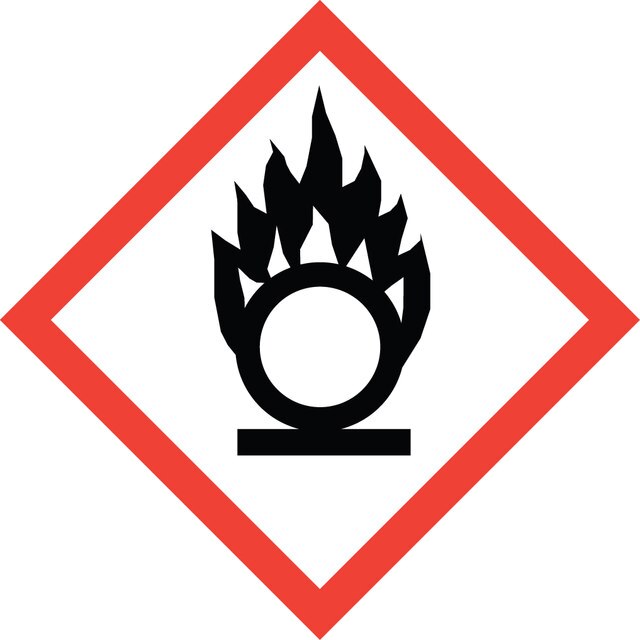

signalword
Danger
hcodes
Hazard Classifications
Eye Dam. 1 - Ox. Sol. 3 - Skin Irrit. 2
Storage Class
5.1B - Oxidizing hazardous materials
flash_point_f
Not applicable
flash_point_c
Not applicable
ppe
Eyeshields, Faceshields, Gloves, type P3 (EN 143) respirator cartridges
Regulatory Listings
Regulatory Listings are mainly provided for chemical products. Only limited information can be provided here for non-chemical products. No entry means none of the components are listed. It is the user’s obligation to ensure the safe and legal use of the product.
Substances Subject to be Indicated Names
ishl_indicated
Substances Subject to be Notified Names
ishl_notified
289132-250G:4.548173130354E12 + 289132-100G:4.548173130347E12 + 289132-5G:4.548173130361E12 + 289132-500G:4.548173368658E12
jan
Choose from one of the most recent versions:
Already Own This Product?
Find documentation for the products that you have recently purchased in the Document Library.