
Skip to Content
Merck

360716

Tris(trimethylsilyl)silane

97%

Synonym(s):

1,1,1,3,3,3-Hexamethyl-2-trimethylsilyl-trisilane, TTMSS

Sign In to View Organizational & Contract Pricing.

Select a Size


About This Item

Linear Formula:
[(CH3)3Si]3SiH
CAS Number:
Molecular Weight:
248.66
UNSPSC Code:
12161700
NACRES:
NA.22
PubChem Substance ID:
MDL number:
Beilstein/REAXYS Number:
1923953
Technical Service
Need help? Our team of experienced scientists is here for you.
Let Us Assist
Technical Service
Need help? Our team of experienced scientists is here for you.
Let Us Assist

InChI key

SQMFULTZZQBFBM-UHFFFAOYSA-N

SMILES string

C[Si](C)(C)[SiH]([Si](C)(C)C)[Si](C)(C)C

InChI

1S/C9H28Si4/c1-11(2,3)10(12(4,5)6)13(7,8)9/h10H,1-9H3

assay

97%

form

liquid

reaction suitability

reagent type: reductant

Quality Level

bp

73 °C/5 mmHg (lit.)

density

0.806 g/mL at 25 °C (lit.)

General description

Tris(trimethylsilyl)silane is an organosilicon generally used as a radical reducing agent for xanthates, organic halides, isocyanides, selenides, and acid chlorides. It is also used for hydrosilylation of alkenes, alkynes, and dialkyl ketones.

Application

Super Silyl Protecting Groups

Used in:
  • Hydrosilylations
  • Radical reactions
  • Reductions of acid chlorides
  • Reductions of carbon-halogen bonds
  • Hydrosilations of carbonyls

  • Another common application involves the use of the tris(trimethylsilyl)silyl (TTMSS, or super silyl) group when complexed with transition metals and main group elements

  • More recently, the super silyl group is being utilized in carbon–carbon bond forming reactions
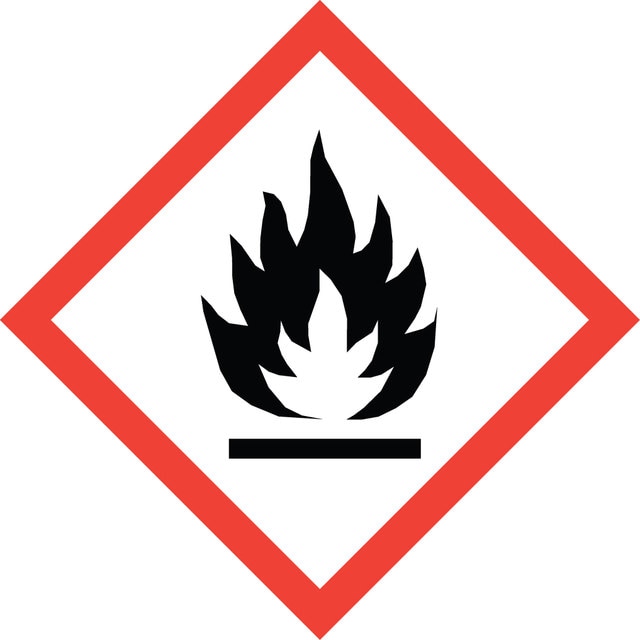
pictograms

Flame

signalword

Warning

hcodes

pcodes

Hazard Classifications

Flam. Liq. 3

Storage Class

3 - Flammable liquids

wgk

WGK 3

flash_point_f

131.0 °F - closed cup

flash_point_c

55 °C - closed cup

ppe

Eyeshields, Faceshields, Gloves, type ABEK (EN14387) respirator filter


Regulatory Listings

Regulatory Listings are mainly provided for chemical products. Only limited information can be provided here for non-chemical products. No entry means none of the components are listed. It is the user’s obligation to ensure the safe and legal use of the product.

Group 4: Flammable liquids + Type 2 petroleums + Hazardous rank III + Water insoluble liquid

fsl

360716-1G: + 360716-25G: + 360716-5G: + 360716-BULK: + 360716-VAR:

jan


Choose from one of the most recent versions:

Certificates of Analysis (COA)

Lot/Batch Number

Don't see the Right Version?

If you require a particular version, you can look up a specific certificate by the Lot or Batch number.

Already Own This Product?

Find documentation for the products that you have recently purchased in the Document Library.

Visit the Document Library

Accounts of Chemical Research, 25, 188-188 (1992)
Tris (trimethylsilyl) silane: an efficient hydrosilylating agent of alkenes and alkynes
Kopping B, et al.
The Journal of Organic Chemistry, 57(14), 3994-4000 (1992)
Synlett, 91-91 (1990)
Changxia Shi et al.
Science advances, 6(34), eabc0495-eabc0495 (2020-09-03)
Three types of seemingly unyielding trade-offs have continued to challenge the rational design for circular polymers with both high chemical recyclability and high-performance properties: depolymerizability/performance, crystallinity/ductility, and stereo-disorder/crystallinity. Here, we introduce a monomer design strategy based on a bridged bicyclic
Roberto Morales-Cerrada et al.
Chemistry (Weinheim an der Bergstrasse, Germany), 25(1), 296-308 (2018-09-20)
Thermal decarbonylation of the acyl compounds [Mn(CO)5 (CORF )] (RF =CF3 , CHF2 , CH2 CF3 , CF2 CH3 ) yielded the corresponding alkyl derivatives [Mn(CO)5 (RF )], some of which have not been previously reported. The compounds were fully

Articles

シリコン表面上の分子単分子膜の方法、その特性、分子エレクトロニクスやセンシングへの応用を探る。

Explore methods for molecular monolayers on silicon surfaces, their properties, and applications in molecular electronics and sensing.

Related Content

The Yamamoto group has employed several applications in catalysis.

Our team of scientists has experience in all areas of research including Life Science, Material Science, Chemical Synthesis, Chromatography, Analytical and many others.

Contact Technical Service