
369497

N,N,N′,N′′,N′′-Pentamethyldiethylenetriamine
99%
Synonym(s):
PMDETA, PMDTA
Select a Size
About This Item
vapor pressure
0.23 mmHg ( 20 °C)
Quality Level
assay
99%
form
liquid
autoignition temp.
311 °F
expl. lim.
5.6 %
refractive index
n20/D 1.442 (lit.)
bp
198 °C (lit.)
mp
−20 °C (lit.)
density
0.83 g/mL at 25 °C (lit.)
SMILES string
CN(C)CCN(C)CCN(C)C
InChI
1S/C9H23N3/c1-10(2)6-8-12(5)9-7-11(3)4/h6-9H2,1-5H3
InChI key
UKODFQOELJFMII-UHFFFAOYSA-N
General description
Application
- A catalyst in the synthesis of multifunctional silicone acrylate prepolymers for use in UV-curable coatings.
- A multifunctional initiating and cross-linking agent in the synthesis of polyacrylamide hydrogels. It improves the mechanical properties of the hydrogels, such as toughness and resilience, without compromising their biocompatibility.
- An organocatalyst in ring-opening polymerization (ROP) of trimethylene carbonate. This catalyst can be easily removed after the reaction compared to metal catalysts.
- A catalyst along with CuBr to synthesize a series of side-chain azobenzene poly(meth)acrylates via the atom transfer radical polymerization(ATRP) technique.
- An initiator to grow polystyrene chains to prepare polyolefin-polystyrene copolymers.
Still not finding the right product?
Explore all of our products under N,N,N′,N′′,N′′-Pentamethyldiethylenetriamine
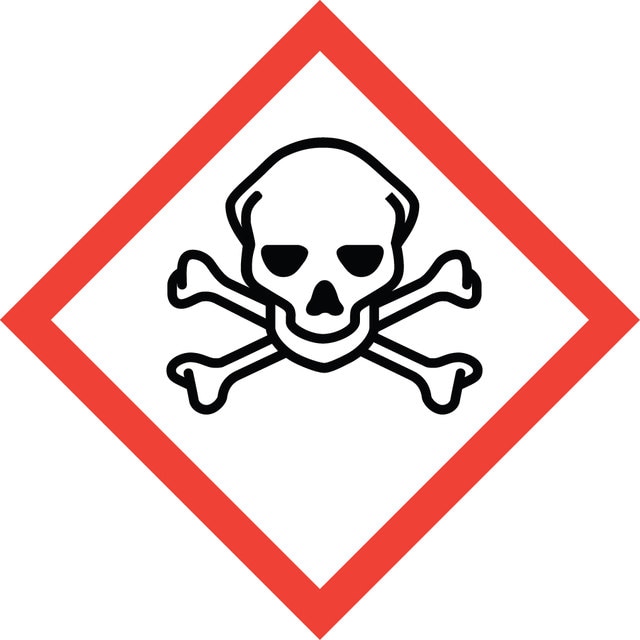

signalword
Danger
hcodes
Hazard Classifications
Acute Tox. 3 Dermal - Acute Tox. 4 Oral - Eye Dam. 1 - Skin Corr. 1B
Storage Class
6.1A - Combustible acute toxic Cat. 1 and 2 / very toxic hazardous materials
wgk
WGK 2
flash_point_f
168.8 °F - closed cup
flash_point_c
76 °C - closed cup
ppe
Faceshields, Gloves, Goggles, type ABEK (EN14387) respirator filter
Regulatory Listings
Regulatory Listings are mainly provided for chemical products. Only limited information can be provided here for non-chemical products. No entry means none of the components are listed. It is the user’s obligation to ensure the safe and legal use of the product.
Group 4: Flammable liquids + Type 3 petroleums + Hazardous rank III + Water insoluble liquid
fsl
Substances Subject to be Indicated Names
ishl_indicated
Substances Subject to be Notified Names
ishl_notified
Choose from one of the most recent versions:
Already Own This Product?
Find documentation for the products that you have recently purchased in the Document Library.
Protocols
We present an article about RAFT, or Reversible Addition/Fragmentation Chain Transfer, which is a form of living radical polymerization.
Polymerization via ATRP procedures demonstrated by Prof. Dave Haddleton's research group at the University of Warwick.
We presents an article featuring procedures that describe polymerization of methyl methacrylate and vinyl acetate homopolymers and a block copolymer as performed by researchers at CSIRO.
Articles
Micro Review:RAFT(可逆的付加/開裂連鎖移動)重合
ATRP is a successful method for precise polymer synthesis with controlled molecular weights and high chain end functionalities.
Micro review of reversible addition/fragmentation chain transfer (RAFT) polymerization.