Skip to Content
Merck

396494

Aminoguanidine hydrochloride

≥98%

Synonym(s):

Guanylhydrazine hydrochloride

Sign In to View Organizational & Contract Pricing.

Select a Size


About This Item

Linear Formula:
NH2NHC(=NH)NH2 · HCl
CAS Number:
Molecular Weight:
110.55
UNSPSC Code:
12352100
NACRES:
NA.22
PubChem Substance ID:
EC Number:
217-707-7
Beilstein/REAXYS Number:
3909606
MDL number:
Assay:
≥98%
Form:
solid
Technical Service
Need help? Our team of experienced scientists is here for you.
Let Us Assist
Technical Service
Need help? Our team of experienced scientists is here for you.
Let Us Assist

InChI key

UBDZFAGVPPMTIT-UHFFFAOYSA-N

InChI

1S/CH6N4.ClH/c2-1(3)5-4;/h4H2,(H4,2,3,5);1H

SMILES string

Cl.NNC(N)=N

assay

≥98%

form

solid

Quality Level

functional group

amine, hydrazine

General description

Aminoguanidine hydrochloride has been reported in a study as inhibitor of animal nitric oxide (NO)-synthase. Crystal structure of aminoguanidine hydrochloride has been investigated by Fourier and least squares method. Its crystals were monoclinic and the guanidine part of the aminoguanidinium ion is planar.

Application

Aminoguanidine hydrochloride may be employed as nitric oxide synthase (NOS) inhibitor to investigate its effect on the reduction of alveolar bone loss in ligature induced periodontitis in rats. It may be used in the synthesis of 5-guanylhydrazone derivatives, having antibacterial activity against antibacterial activity against both Escherichia coli and Staphylococcus aureus.

Biochem/physiol Actions

Inhibits both constitutive and inducible nitric oxide synthetase.

pictograms

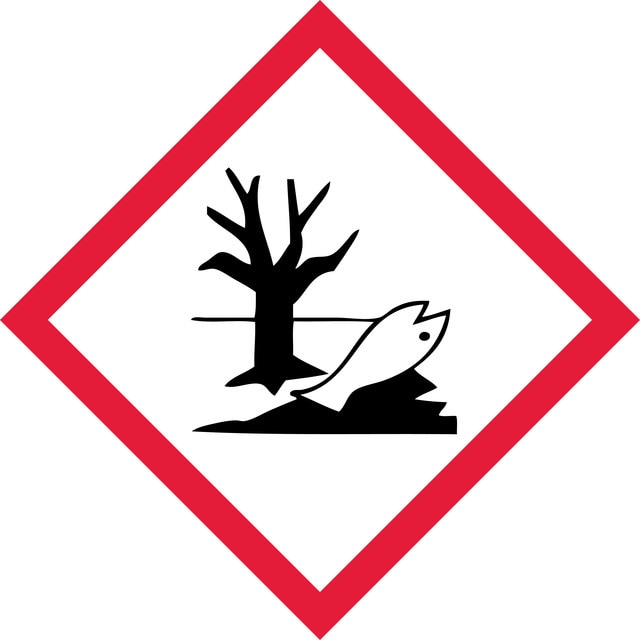
Exclamation markEnvironment

signalword

Warning

hcodes

Hazard Classifications

Aquatic Chronic 2 - Skin Sens. 1B

Storage Class

13 - Non Combustible Solids

wgk

WGK 3

flash_point_f

Not applicable

flash_point_c

Not applicable

ppe

dust mask type N95 (US), Eyeshields, Gloves


Regulatory Listings

Regulatory Listings are mainly provided for chemical products. Only limited information can be provided here for non-chemical products. No entry means none of the components are listed. It is the user’s obligation to ensure the safe and legal use of the product.

396494-BULK: + 396494-100G: + 396494-VAR: + 396494-25G:

jan


Choose from one of the most recent versions:

Certificates of Analysis (COA)

Lot/Batch Number

Don't see the Right Version?

If you require a particular version, you can look up a specific certificate by the Lot or Batch number.

Already Own This Product?

Find documentation for the products that you have recently purchased in the Document Library.

Visit the Document Library

The crystal structure of aminoguanidine hydrochloride.
Bryden JH.
Acta Crystallographica, 10(11), 677-680 (1957)
Lina Nordquist et al.
Advances in experimental medicine and biology, 765, 185-193 (2012-08-11)
Sustained hyperglycemia is closely associated with increased risk to develop nephropathy. We have previously reported alterations in the intrarenal oxygen metabolism already after the early onset of diabetes. Furthermore, formation of advanced glycation end-products (AGE) is postulated as a major
A K Gadad et al.
European journal of medicinal chemistry, 35(9), 853-857 (2000-09-28)
6-Arylimidazo[2,1-b]-1,3,4-thiadiazole-2-sulfonamides 3 on Vilsmeier-Haak reaction produced 5-formyl-6-arylimidazo[2,1-b]-1,3, 4-thiadiazole-2-[N-(dimethylaminomethino)]sulfonamides 4, while 3 on treatment with potassium thiocyanate in the presence of bromine in acetic acid produced 5-thiocyanato-2-sulfonamides 6. Interaction of 4 with aminoguanidine hydrochloride in ethanol produced the corresponding 5-guanylhydrazone derivatives
A K Glyan'ko
Biochemistry. Biokhimiia, 78(5), 471-476 (2013-07-16)
The level of nitric oxide (NO) in roots of 2-day-old etiolated pea (Pisum sativum L.) seedlings was investigated by fluorescence microscopy using the fluorescent probe 4,5-diaminofluorescein diacetate. Segments representing transversal (cross) cuts of the roots having thickness of 100 to
Zahid M Delwar et al.
Cancer research, 78(3), 718-730 (2017-11-10)
The first oncolytic virotherapy employing HSV-1 (oHSV-1) was approved recently by the FDA to treat cancer, but further improvements in efficacy are needed to eradicate challenging refractory tumors, such as glioblastomas (GBM). Microglia/macrophages comprising approximately 40% of a GBM tumor

Our team of scientists has experience in all areas of research including Life Science, Material Science, Chemical Synthesis, Chromatography, Analytical and many others.

Contact Technical Service