Skip to Content
Merck

S4117

Formamide, Deionized

Synonym(s):

DI formamide, formamide for hybridization

Sign In to View Organizational & Contract Pricing.

Select a Size


About This Item

UNSPSC Code:
41116012
eCl@ss:
32160405
NACRES:
NA.21
Technical Service
Need help? Our team of experienced scientists is here for you.
Let Us Assist
Technical Service
Need help? Our team of experienced scientists is here for you.
Let Us Assist

packaging

pkg of 500 mL

Quality Level

manufacturer/tradename

Chemicon®

technique(s)

hybridization: suitable

shipped in

wet ice

General description

This product is intended for use in hybridization applications for in situ, Southern, Northern, dot and slot blot analyses, and colony, plaque, and YAC screening. Formamide is used primarily as a component in probe hybridization solutions to promote probe hybridization specificity. It denatures nucleic acids by disrupting hydrogen bonds.

Application

Dilute formamide according to specific application requirements. Formamide concentrations of 45-50% are typically used in Southern and Northern analyses and a 50% or greater concentration for in situ hybridization techniques. In DNA to DNA hybridization, each 1% increase in formamide concentration lowers the Tm by 0.7%.
Research Category
All

Physical form

This preperation of formamide is deionized, triple distilled and packaged under nitrogen and is free of detectable DNAse, RNAse, and protease activity.

Preparation Note

Store at -20°C. Keep cap tightly closed after opening or aliquot and store at -15°C to -25°C.

Analysis Note

Each lot of material is pre-filtered through a mixed-ion exchange resin to eliminate products of decomposition and residual metal cations. This filtering process guarantees that each lot has a final purity of greater than 99.5% and an adsorbance value of less than 0.02 adsorbance units at 280nm. Each lot then undergoes rigid quality control testing to insure that assay specifications are met prior to release.

Legal Information

CHEMICON is a registered trademark of Merck KGaA, Darmstadt, Germany

Disclaimer

Unless otherwise stated in our catalog or other company documentation accompanying the product(s), our products are intended for research use only and are not to be used for any other purpose, which includes but is not limited to, unauthorized commercial uses, in vitro diagnostic uses, ex vivo or in vivo therapeutic uses or any type of consumption or application to humans or animals.

Pictograms

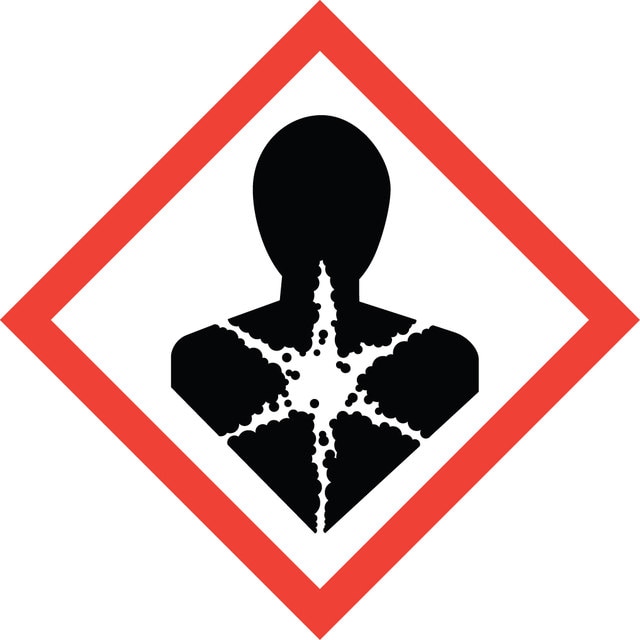
Health hazard

Signal Word

Danger

Hazard Statements

Hazard Classifications

Carc. 2 - Repr. 1B - STOT RE 2 Oral

Target Organs

Blood

Storage Class Code

6.1C - Combustible acute toxic Cat.3 / toxic compounds or compounds which causing chronic effects

WGK

WGK 1

Flash Point(F)

305.6 °F

Flash Point(C)

152 °C


Regulatory Listings

Regulatory Listings are mainly provided for chemical products. Only limited information can be provided here for non-chemical products. No entry means none of the components are listed. It is the user’s obligation to ensure the safe and legal use of the product.

PRTR

Class II Designated Chemical Substances

FSL

Group 4: Flammable liquids
Type 3 petroleums
Hazardous rank III
Water soluble liquid

ISHL Indicated Name

Substances Subject to be Indicated Names

ISHL Notified Names

Substances Subject to be Notified Names

JAN Code

S4117:


Certificates of Analysis (COA)

Search for Certificates of Analysis (COA) by entering the products Lot/Batch Number. Lot and Batch Numbers can be found on a product’s label following the words ‘Lot’ or ‘Batch’.

Already Own This Product?

Find documentation for the products that you have recently purchased in the Document Library.

Visit the Document Library

Isaac A Klein et al.
Science (New York, N.Y.), 368(6497), 1386-1392 (2020-06-20)
The nucleus contains diverse phase-separated condensates that compartmentalize and concentrate biomolecules with distinct physicochemical properties. Here, we investigated whether condensates concentrate small-molecule cancer therapeutics such that their pharmacodynamic properties are altered. We found that antineoplastic drugs become concentrated in specific

Global Trade Item Number

SKUGTIN
S411704053252611698

Our team of scientists has experience in all areas of research including Life Science, Material Science, Chemical Synthesis, Chromatography, Analytical and many others.

Contact Technical Service