Skip to Content
Merck

05-5895

Copper(II) chloride

SAJ first grade, ≥98.0%

Synonym(s):

Cupric chloride

Sign In to View Organizational & Contract Pricing.

Select a Size


About This Item

Linear Formula:
CuCl2
CAS Number:
Molecular Weight:
134.45
UNSPSC Code:
12352302
PubChem Substance ID:
MDL number:
Technical Service
Need help? Our team of experienced scientists is here for you.
Let Us Assist
Technical Service
Need help? Our team of experienced scientists is here for you.
Let Us Assist

InChI

1S/2ClH.Cu/h2*1H;/q;;+2/p-2

SMILES string

Cl[Cu]Cl

InChI key

ORTQZVOHEJQUHG-UHFFFAOYSA-L

grade

SAJ first grade

assay

≥98.0%

form

solid

reaction suitability

reagent type: catalyst
core: copper

availability

available only in Japan

mp

620 °C (lit.)

density

3.386 g/mL at 25 °C (lit.)

storage temp.

15-25°C

Looking for similar products? Visit Product Comparison Guide

signalword

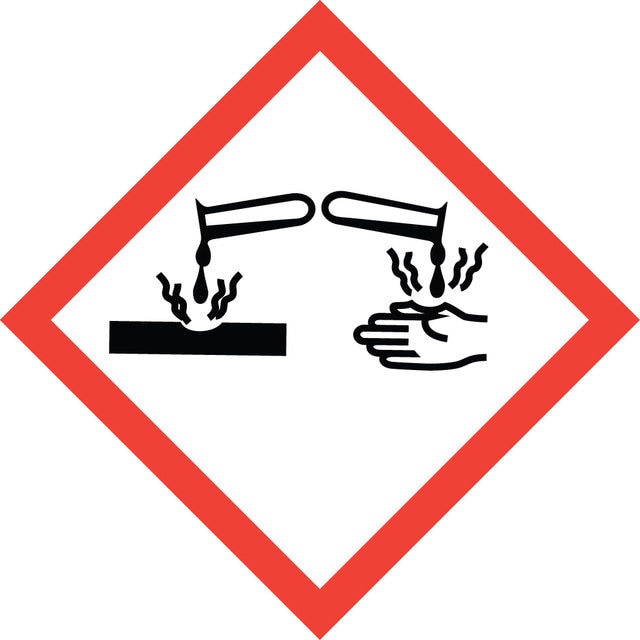
Danger

Hazard Classifications

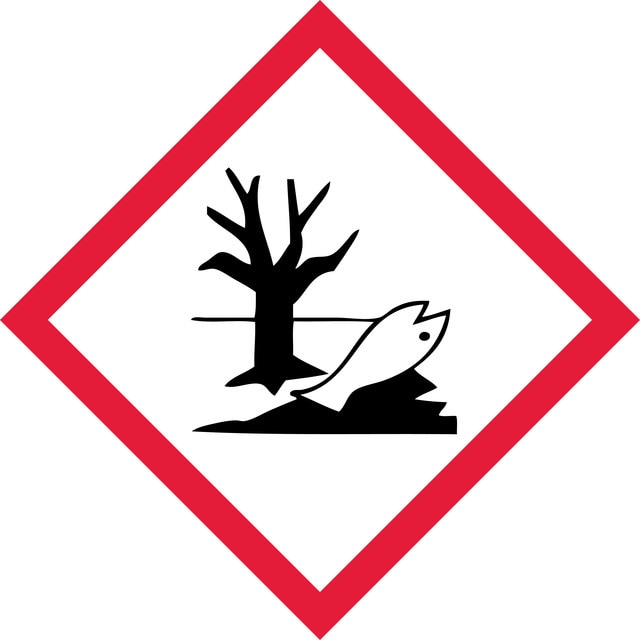
Acute Tox. 4 Dermal - Acute Tox. 4 Oral - Aquatic Acute 1 - Aquatic Chronic 2 - Eye Dam. 1 - Skin Irrit. 2

Storage Class

8A - Combustible corrosive hazardous materials

wgk

WGK 3


Regulatory Listings

Regulatory Listings are mainly provided for chemical products. Only limited information can be provided here for non-chemical products. No entry means none of the components are listed. It is the user’s obligation to ensure the safe and legal use of the product.

Deleterious substance

pdsc

Class I Designated Chemical Substances

prtr

Substances Subject to be Indicated Names

ishl_indicated

Substances Subject to be Notified Names

ishl_notified

05-5895-5-500G-J:

jan


Choose from one of the most recent versions:

Certificates of Analysis (COA)

Lot/Batch Number

Don't see the Right Version?

If you require a particular version, you can look up a specific certificate by the Lot or Batch number.

Already Own This Product?

Find documentation for the products that you have recently purchased in the Document Library.

Visit the Document Library

Pieter Spincemaille et al.
Toxicology and applied pharmacology, 280(2), 345-351 (2014-08-20)
Wilson disease (WD) is caused by accumulation of excess copper (Cu) due to a mutation in the gene encoding the liver Cu transporter ATP7B, and is characterized by acute liver failure or cirrhosis and neuronal cell death. We investigated the
Su-Jeong Kim et al.
Free radical biology & medicine, 53(4), 936-950 (2012-06-12)
Loss-of-function mutations in the PARK7/DJ-1 gene cause early onset autosomal-recessive Parkinson disease. DJ-1 has been implicated in protection of neurons from oxidative stress and in regulation of transcriptional activity. However, whether there is a relationship between the subcellular localization of
Landon John G Edgar et al.
Organic letters, 14(16), 4226-4229 (2012-08-01)
Glycosyl 1-phosphates enriched in the α-anomer are obtained without the use of protecting groups in two steps starting from the free hemiacetal. Condensation of free hemiacetals with toluenesulfonylhydrazide yields a range of glycosylsulfonohydrazide donors which can be oxidized using cupric
Mónica João Barros Amorim et al.
Environmental pollution (Barking, Essex : 1987), 164, 164-168 (2012-03-01)
Environmental effects of copper nanoparticles are little studied in terrestrial ecosystems. In the present article, the toxicity of copper nanoparticles (Cu-NP) on the enchytraeid Enchytraeus albidus is compared to the toxicity of a copper-salt (CuCl(2)). The effect parameters studied were
Kenji Funaki et al.
Organic letters, 14(24), 6186-6189 (2012-12-12)
Direct arylation of thiophenes and benzothiophenes with aryltrimethylsilanes was effectively catalyzed by PdCl(2)(MeCN)(2) in the presence of CuCl(2) as an oxidant. The reaction preferentially occurred at the β-position of both thiophenes and benzothiophenes.

Our team of scientists has experience in all areas of research including Life Science, Material Science, Chemical Synthesis, Chromatography, Analytical and many others.

Contact Technical Service