Skip to Content
Merck

09-1661

Ethylene glycol butyl ether

SAJ first grade, ≥99.0%

Synonym(s):

2-Butoxyethanol, Butyl glycol

Sign In to View Organizational & Contract Pricing.

Select a Size


About This Item

Linear Formula:
CH3(CH2)3OCH2CH2OH
CAS Number:
Molecular Weight:
118.17
EC Number:
203-905-0
UNSPSC Code:
12352104
PubChem Substance ID:
Beilstein/REAXYS Number:
1732511
MDL number:
Technical Service
Need help? Our team of experienced scientists is here for you.
Let Us Assist
Technical Service
Need help? Our team of experienced scientists is here for you.
Let Us Assist

grade

SAJ first grade

vapor density

4.1 (vs air)

vapor pressure

<1 mmHg ( 20 °C), 10 mmHg ( 81 °C)

assay

≥99.0%

form

liquid

autoignition temp.

473 °F

expl. lim.

10.6 %

availability

available only in Japan

refractive index

n20/D 1.419 (lit.)

bp

169-172.5 °C (lit.)

mp

−75 °C (lit.)

density

0.902 g/mL at 25 °C (lit.)

SMILES string

CCCCOCCO

InChI

1S/C6H14O2/c1-2-3-5-8-6-4-7/h7H,2-6H2,1H3

InChI key

POAOYUHQDCAZBD-UHFFFAOYSA-N

Looking for similar products? Visit Product Comparison Guide

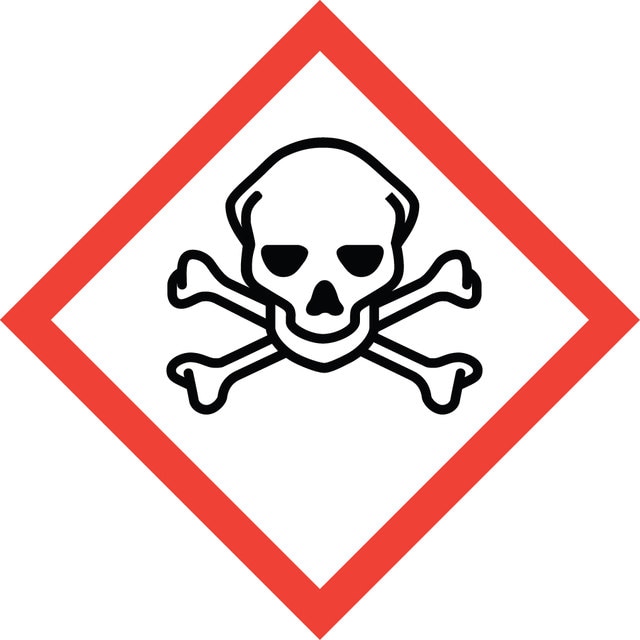
pictograms

Skull and crossbones

signalword

Danger

Hazard Classifications

Acute Tox. 3 Inhalation - Acute Tox. 4 Oral - Eye Irrit. 2 - Skin Irrit. 2

Storage Class

6.1C - Combustible acute toxic Cat.3 / toxic compounds or compounds which causing chronic effects

wgk

WGK 1

flash_point_f

152.6 °F - Pensky-Martens closed cup

flash_point_c

67 °C - Pensky-Martens closed cup

ppe

Eyeshields, Faceshields, Gloves, type ABEK (EN14387) respirator filter


Regulatory Listings

Regulatory Listings are mainly provided for chemical products. Only limited information can be provided here for non-chemical products. No entry means none of the components are listed. It is the user’s obligation to ensure the safe and legal use of the product.

Class I Designated Chemical Substances

prtr

Group 4: Flammable liquids + Type 2 petroleums + Hazardous rank III + Water insoluble liquid

fsl

Substances Subject to be Indicated Names

ishl_indicated

Substances Subject to be Notified Names

ishl_notified

09-1661-5-500ML-J:

jan


Choose from one of the most recent versions:

Certificates of Analysis (COA)

Lot/Batch Number

It looks like we've run into a problem, but you can still download Certificates of Analysis from our Documents section.

If you need assistance, please contact Customer Support

Already Own This Product?

Find documentation for the products that you have recently purchased in the Document Library.

Visit the Document Library

R Rella et al.
Journal of environmental monitoring : JEM, 14(10), 2659-2662 (2012-08-18)
Indoor air quality is important because people are spending an increasing amount of time in the workplace. They are exposed to outdoor pollutants as well as pollutants emitted from products used indoors. Some chemicals, belonging to the category of volatile
Lisa M Kamendulis et al.
Toxicology, 270(2-3), 131-136 (2010-02-16)
2-Butoxyethanol increases hemangiosarcomas selectively in male mouse liver after chronic inhalation through mechanisms that have not fully been elucidated. Hemolysis, a primary toxic effect associated with 2-butoxyethanol exposure in rodents, increased hemosiderin (iron) deposition in Kupffer cells in the liver.
Annette L Bunge et al.
International journal of pharmaceutics, 435(1), 50-62 (2012-02-15)
Absorption of 2-butoxyethanol (BE) from neat and aqueous solutions of BE was measured through rat skin in vitro and in vivo and through silicone membranes. Like previous studies in human and guinea pig skin, BE flux increased proportional to BE
Gintautas Korinth et al.
Toxicology letters, 170(2), 97-103 (2007-04-07)
We determined percutaneous absorption kinetics of 2-butoxyethanol (BE) in volunteers using microdialysis. Four male volunteers were dermally exposed twice to 90% and 50% aqueous solutions (v/v) of BE for 4.5h. To determine percutaneous absorption kinetics the concentration of BE was
Horst Christoph Broding et al.
Journal der Deutschen Dermatologischen Gesellschaft = Journal of the German Society of Dermatology : JDDG, 9(8), 618-627 (2011-07-28)
Presently, percutaneous absorption of potentially hazardous chemicals in humans can only be assessed in animal experiments, in vitro, or predicted mathematically. Our aim was to demonstrate the proof-of-principle of a novel quantitative in vivo assay for percutaneous absorption: confocal Raman

Our team of scientists has experience in all areas of research including Life Science, Material Science, Chemical Synthesis, Chromatography, Analytical and many others.

Contact Technical Service