Sign In to View Organizational & Contract Pricing.
Select a Size
About This Item
Linear Formula:
H2SO4
CAS Number:
Molecular Weight:
98.08
PubChem Substance ID:
UNSPSC Code:
12352106
Beilstein/REAXYS Number:
2037554
MDL number:
Product Name
Sulfuric acid solution, SAJ first grade, 32.2-36.8% in H2O
SMILES string
OS(O)(=O)=O
InChI
1S/H2O4S/c1-5(2,3)4/h(H2,1,2,3,4)
InChI key
QAOWNCQODCNURD-UHFFFAOYSA-N
grade
SAJ first grade
form
liquid
availability
available only in Japan
concentration
32.2-36.8% in H2O
Looking for similar products? Visit Product Comparison Guide
signalword
Danger
hcodes
Hazard Classifications
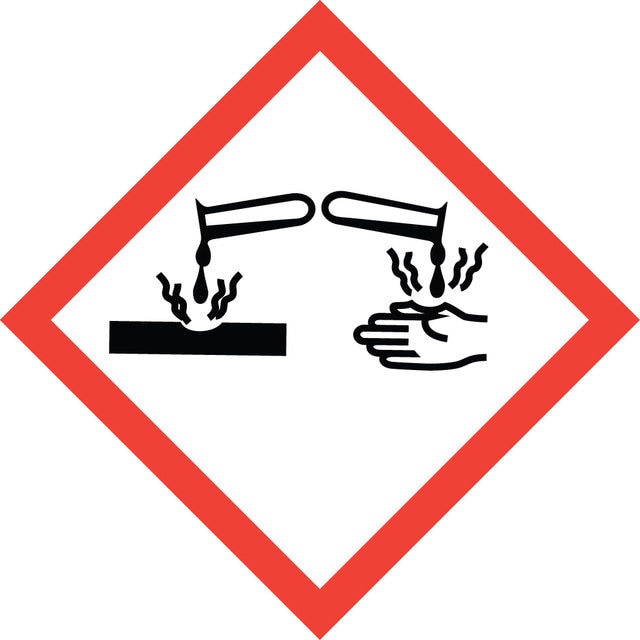
Met. Corr. 1 - Skin Corr. 1A
Storage Class
8A - Combustible corrosive hazardous materials
wgk
WGK 1
flash_point_f
Not applicable
flash_point_c
Not applicable
Choose from one of the most recent versions:
Already Own This Product?
Find documentation for the products that you have recently purchased in the Document Library.
Ying Gu et al.
Cell research, 25(5), 604-620 (2015-03-21)
Hepatitis E virus (HEV), a non-enveloped, positive-sense, single-stranded RNA virus, is a major cause of enteric hepatitis. Classified into the family Hepeviridae, HEV comprises four genotypes (genotypes 1-4), which belong to a single serotype. We describe a monoclonal antibody (mAb)
Francesco Riccobono et al.
Science (New York, N.Y.), 344(6185), 717-721 (2014-05-17)
Atmospheric new-particle formation affects climate and is one of the least understood atmospheric aerosol processes. The complexity and variability of the atmosphere has hindered elucidation of the fundamental mechanism of new-particle formation from gaseous precursors. We show, in experiments performed
Shih-Yeh Lin et al.
Biotechnology and bioengineering, 112(10), 2005-2015 (2015-05-23)
Enterovirus 71 (EV71) is responsible for the outbreaks of hand-foot-and-mouth disease in the Asia-Pacific region. To produce the virus-like particle (VLP) vaccine, we previously constructed recombinant baculoviruses to co-express EV71 P1 polypeptide and 3CD protease using the Bac-to-Bac(®) vector system.
João Almeida et al.
Nature, 502(7471), 359-363 (2013-10-08)
Nucleation of aerosol particles from trace atmospheric vapours is thought to provide up to half of global cloud condensation nuclei. Aerosols can cause a net cooling of climate by scattering sunlight and by leading to smaller but more numerous cloud
Siegfried Schobesberger et al.
Proceedings of the National Academy of Sciences of the United States of America, 110(43), 17223-17228 (2013-10-09)
Atmospheric aerosols formed by nucleation of vapors affect radiative forcing and therefore climate. However, the underlying mechanisms of nucleation remain unclear, particularly the involvement of organic compounds. Here, we present high-resolution mass spectra of ion clusters observed during new particle
Our team of scientists has experience in all areas of research including Life Science, Material Science, Chemical Synthesis, Chromatography, Analytical and many others.
Contact Technical Service