Skip to Content
Merck

124052

Bromoethane

reagent grade, 98%, liquid

Synonym(s):

Ethyl bromide

Sign In to View Organizational & Contract Pricing.

Select a Size


About This Item

Empirical Formula (Hill Notation):
C2H5Br
CAS Number:
Molecular Weight:
108.97
NACRES:
NA.21
PubChem Substance ID:
UNSPSC Code:
12352100
EC Number:
200-825-8
MDL number:
Beilstein/REAXYS Number:
1209224
Assay:
98%
Grade:
reagent grade
Bp:
37-40 °C (lit.)
Vapor pressure:
25.32 psi ( 55 °C), 7.54 psi ( 20 °C)
Technical Service
Need help? Our team of experienced scientists is here for you.
Let Us Assist
Technical Service
Need help? Our team of experienced scientists is here for you.
Let Us Assist

Product Name

Bromoethane, reagent grade, 98%

grade

reagent grade

Quality Level

vapor density

~3.75 (vs air)

vapor pressure

25.32 psi ( 55 °C), 7.54 psi ( 20 °C)

assay

98%

form

liquid

autoignition temp.

952 °F

expl. lim.

11.25 %

refractive index

n20/D 1.425 (lit.)

bp

37-40 °C (lit.)

mp

−119 °C (lit.)

density

1.46 g/mL at 25 °C (lit.)

functional group

alkyl halide, bromo

SMILES string

CCBr

InChI

1S/C2H5Br/c1-2-3/h2H2,1H3

InChI key

RDHPKYGYEGBMSE-UHFFFAOYSA-N

Looking for similar products? Visit Product Comparison Guide

General description

Bromoethane (Ethyl bromide) is an alkyl halide. Microwave spectral investigations of ethyl bromide and its isotopic species have been reported. It has been synthesized either by employing Grignard waste water as a precursor3 or by reacting potassium bromide with concentrated sulfuric acid in ethanol.

Application

Bromoethane may be employed as a promoter during the preparation of 1-butene.4 It has been used to prepare anion-exchange membranes, which can be used for the isolation and purification of plasmid DNA and also for the separation of plasmid DNA and RNA from cell lysates, measured using ultraviolet-visible light spectrophotometer.

signalword

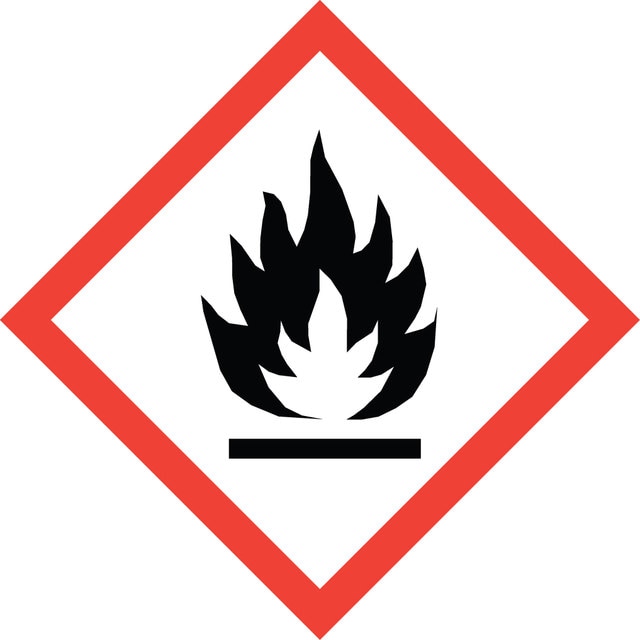
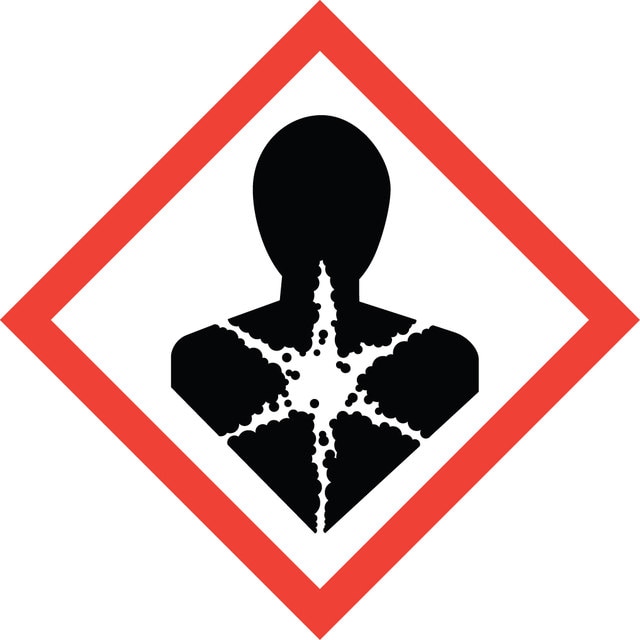
Danger

Hazard Classifications

Acute Tox. 4 Inhalation - Acute Tox. 4 Oral - Carc. 2 - Flam. Liq. 2 - Ozone 1

Storage Class

3 - Flammable liquids

wgk

WGK 1

flash_point_f

-9.4 °F - closed cup

flash_point_c

-23 °C - closed cup

ppe

Eyeshields, Faceshields, Gloves


Regulatory Listings

Regulatory Listings are mainly provided for chemical products. Only limited information can be provided here for non-chemical products. No entry means none of the components are listed. It is the user’s obligation to ensure the safe and legal use of the product.

Group 4: Flammable liquids + Special flammables + Hazardous rank I

fsl

Substances Subject to be Indicated Names

ishl_indicated

Substances Subject to be Notified Names

ishl_notified

124052-VAR: + 124052-250ML: + 124052-BULK: + 124052-1L: + 124052-500G:4548173103815 + 124052-1KG:4548173103808

jan


Choose from one of the most recent versions:

Certificates of Analysis (COA)

Lot/Batch Number

It looks like we've run into a problem, but you can still download Certificates of Analysis from our Documents section.

If you need assistance, please contact Customer Support

Already Own This Product?

Find documentation for the products that you have recently purchased in the Document Library.

Visit the Document Library

Ramsden.N.E et al.
A-Level Chemistry (2000)
"Preparation of inorganic?organic anion-exchange membranes and their application in plasmid DNA and RNA separation"
Chang S-C, et al.
Journal of Membrane Science, 311(1), 336-348 (2008)
Microwave Spectrum, Structure, and Quadrupole Coupling Constant Tensor of Ethyl Bromide.
Flanagan C and Pierce L.
J. Chem. Phys., 38(12), 2963-2969 (1963)
Microwave Spectra of Molecules Exhibiting Internal Rotation. V. Barrier Height in Ethyl Chloride and Ethyl Bromide.
Lide Jr DR.
J. Chem. Phys., 30(1), 37-39 (1959)
J H Shears et al.
The Biochemical journal, 226(2), 499-507 (1985-03-01)
Photoinactivation of ammonia oxidation by Nitrosomonas europaea cells by near-u.v. light was confirmed and further shown to occur with the same rate constant as loss of bromoethane-oxidation activity. Hydroxylamine oxidation was much less photosensitive. Protection against inactivation was afforded by

Our team of scientists has experience in all areas of research including Life Science, Material Science, Chemical Synthesis, Chromatography, Analytical and many others.

Contact Technical Service