Skip to Content
Merck

36627

1,2,4-Trichlorobenzene

PESTANAL®, analytical standard

Sign In to View Organizational & Contract Pricing.

Select a Size


About This Item

Empirical Formula (Hill Notation):
C6H3Cl3
CAS Number:
Molecular Weight:
181.45
UNSPSC Code:
41116107
NACRES:
NA.24
PubChem Substance ID:
EC Number:
204-428-0
Beilstein/REAXYS Number:
956819
MDL number:
Technical Service
Need help? Our team of experienced scientists is here for you.
Let Us Assist
Technical Service
Need help? Our team of experienced scientists is here for you.
Let Us Assist

grade

analytical standard

Quality Level

vapor density

>6 (vs air)

vapor pressure

1 mmHg ( 40 °C)

product line

PESTANAL®

autoignition temp.

1060 °F

shelf life

limited shelf life, expiry date on the label

expl. lim.

6.6 %, 150 °F

technique(s)

HPLC: suitable, gas chromatography (GC): suitable

refractive index

n20/D 1.571 (lit.)

bp

214 °C (lit.)

mp

16 °C (lit.)

density

1.454 g/mL at 25 °C (lit.)

application(s)

agriculture
environmental

format

neat

SMILES string

Clc1ccc(Cl)c(Cl)c1

InChI

1S/C6H3Cl3/c7-4-1-2-5(8)6(9)3-4/h1-3H

InChI key

PBKONEOXTCPAFI-UHFFFAOYSA-N

Looking for similar products? Visit Product Comparison Guide

General description

1,2,4-Trichlorobenzene can be used as a solvent for industrial purposes. It can also find applications as a termiticide and lubricant for household uses.

Application

1,2,4-Trichlorobenzene may be used as an eluent in order to determine the polydispersity index and also the molecular weight of benzo[c][1,2,5]oxadiazole based copolymers using high-temperature gel-permeation chromatography (GPC).
Refer to the product′s Certificate of Analysis for more information on a suitable instrument technique. Contact Technical Service for further support.

Legal Information

PESTANAL is a registered trademark of Merck KGaA, Darmstadt, Germany

pictograms

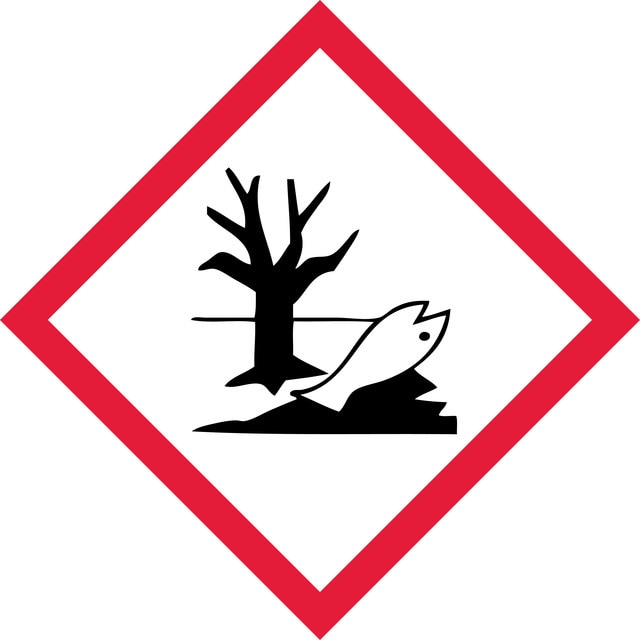
Exclamation markEnvironment

signalword

Warning

Hazard Classifications

Acute Tox. 4 Oral - Aquatic Acute 1 - Aquatic Chronic 1 - Skin Irrit. 2

Storage Class

6.1C - Combustible acute toxic Cat.3 / toxic compounds or compounds which causing chronic effects

wgk

WGK 3

flash_point_f

235.4 °F - closed cup

flash_point_c

113.0 °C - closed cup

ppe

Eyeshields, Faceshields, Gloves, type ABEK (EN14387) respirator filter


Regulatory Listings

Regulatory Listings are mainly provided for chemical products. Only limited information can be provided here for non-chemical products. No entry means none of the components are listed. It is the user’s obligation to ensure the safe and legal use of the product.

Class I Designated Chemical Substances

prtr

Group 4: Flammable liquids + Type 3 petroleums + Hazardous rank III + Water insoluble liquid

fsl

Substances Subject to be Indicated Names

ishl_indicated

Substances Subject to be Notified Names

ishl_notified

36627-1G:4548173372044 + 36627-VAR: + 36627-BULK:

jan


Choose from one of the most recent versions:

Certificates of Analysis (COA)

Lot/Batch Number

It looks like we've run into a problem, but you can still download Certificates of Analysis from our Documents section.

If you need assistance, please contact Customer Support

Already Own This Product?

Find documentation for the products that you have recently purchased in the Document Library.

Visit the Document Library

National study of chemical residues in fish Volume II (1993)
Novel benzo [c][1, 2, 5] oxadiazole-naphthalenediimide based copolymer for high-performance air-stable n-type field-effect transistors exhibiting high electron mobility of 2.43 cm 2 V- 1 s- 1
Zhao Z, et al.
Journal of Materials Chemistry, 5(11), 2892-2898 (2017)
Jie Cao et al.
The Science of the total environment, 409(11), 2336-2341 (2011-03-29)
Monodispersed carboxymethyl cellulose (CMC)-stabilized Fe-Cu bimetal nanoparticles with an average diameter of less than 20nm were successfully synthesized by a modified water-based approach. The as-resulting particles exhibit a core-shell structure and are quite uniform in size and shape. Batch experiments
Shijing Lin et al.
Journal of hazardous materials, 192(3), 1697-1704 (2011-07-30)
Co(3)O(4) was synthesized with cabbage-like, plate-like and sphere-like morphologies. The effect of different morphologies on the degradation of 1,2,4-trichlorobenzene (1,2,4-TrCB) was evaluated, and the cabbage-like Co(3)O(4) exhibited the highest reactivity. The degradation of 1,2,4-TrCB on the cabbage-like Co(3)O(4) is hypothesized
Ernest Marco-Urrea et al.
Journal of hazardous materials, 166(2-3), 1141-1147 (2009-01-31)
The degradation of 1,2,3-, 1,3,5- and 1,2,4-trichlorobenzene (TCB) by the white-rot fungus Trametes versicolor was studied. Time course experiments showed a degradation rate of 2.27 and 2.49 nmol d(-1)mg(-1) dry weight of biomass during the first 4d of incubation in

Our team of scientists has experience in all areas of research including Life Science, Material Science, Chemical Synthesis, Chromatography, Analytical and many others.

Contact Technical Service