Skip to Content
Merck

82118

Propylbenzene

analytical standard

Synonym(s):

1-Phenylpropane

Sign In to View Organizational & Contract Pricing.

Select a Size


About This Item

Linear Formula:
C6H5CH2CH2CH3
CAS Number:
Molecular Weight:
120.19
UNSPSC Code:
41116107
NACRES:
NA.24
PubChem Substance ID:
EC Number:
203-132-9
Beilstein/REAXYS Number:
1903006
MDL number:
Technical Service
Need help? Our team of experienced scientists is here for you.
Let Us Assist
Technical Service
Need help? Our team of experienced scientists is here for you.
Let Us Assist

grade

analytical standard

Quality Level

vapor density

4.14 (vs air)

vapor pressure

2 mmHg ( 20 °C)

assay

≥99.0% (GC)

autoignition temp.

842 °F

shelf life

limited shelf life, expiry date on the label

expl. lim.

6 %

technique(s)

HPLC: suitable, gas chromatography (GC): suitable

refractive index

n20/D 1.491 (lit.), n20/D 1.492

bp

159 °C (lit.)

mp

−99 °C (lit.)

density

0.862 g/mL at 25 °C (lit.)

application(s)

environmental

format

neat

SMILES string

CCCc1ccccc1

InChI

1S/C9H12/c1-2-6-9-7-4-3-5-8-9/h3-5,7-8H,2,6H2,1H3

InChI key

ODLMAHJVESYWTB-UHFFFAOYSA-N

Looking for similar products? Visit Product Comparison Guide

General description

Propylbenzene belongs to the class of aromatic hydrocarbons, commonly used as a solvent in organic synthesis and precursor to synthesize intermediates such as 4-phenylbutyraldehyde and ethyl phenyl ketone.

Application

Propylbenzene may be used as an internal standard for the quantification of the vanillin in fruits and as an analytical reference standard for the quantification of the analyte in eluates of pyrolysis solid residues using different chromatography techniques.
Refer to the product′s Certificate of Analysis for more information on a suitable instrument technique. Contact Technical Service for further support.

Other Notes

Find a digital Reference Material for this product available on our online platform ChemisTwin® for NMR. You can use this digital equivalent on ChemisTwin® for your sample identity confirmation and compound quantification (with digital external standard). An NMR spectrum of this substance can be viewed and an online comparison against your sample can be performed with a few mouseclicks. Learn more here and start your free trial.

signalword

Danger

Hazard Classifications

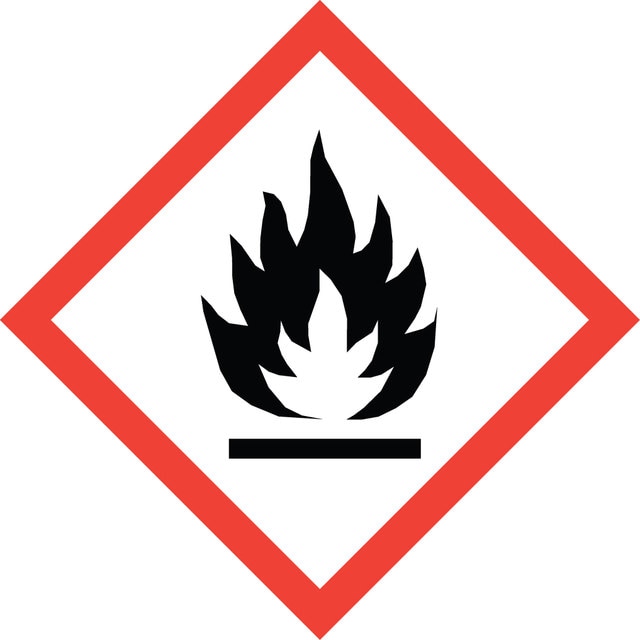
Aquatic Chronic 2 - Asp. Tox. 1 - Flam. Liq. 3 - STOT SE 3

target_organs

Respiratory system

Storage Class

3 - Flammable liquids

wgk

WGK 2

flash_point_f

107.6 °F - closed cup

flash_point_c

42.0 °C - closed cup

ppe

Eyeshields, Faceshields, Gloves, type ABEK (EN14387) respirator filter


Regulatory Listings

Regulatory Listings are mainly provided for chemical products. Only limited information can be provided here for non-chemical products. No entry means none of the components are listed. It is the user’s obligation to ensure the safe and legal use of the product.

Group 4: Flammable liquids + Type 2 petroleums + Hazardous rank III + Water insoluble liquid

fsl

Substances Subject to be Indicated Names

ishl_indicated

Substances Subject to be Notified Names

ishl_notified

82118-10ML: + 82118-5ML: + 82118-BULK: + 82118-VAR:

jan


Choose from one of the most recent versions:

Certificates of Analysis (COA)

Lot/Batch Number

It looks like we've run into a problem, but you can still download Certificates of Analysis from our Documents section.

If you need assistance, please contact Customer Support

Already Own This Product?

Find documentation for the products that you have recently purchased in the Document Library.

Visit the Document Library

Determination of aromatic compounds in eluates of pyrolysis solid residues using HS-GC-MS and DLLME-GC-MS
Bernardo.SM, et al.
Talanta, 80(1), 104-108 (2009)
Determination of vanillin in orange, grapefruit, tangerine, lemon, and lime juices using GC- olfactometry and GC- MS/MS
Goodner.LK, et al.
Journal of Agricultural and Food Chemistry, 48(7), 2882-2886 (2000)
Sara Eriksson et al.
Biodegradation, 16(3), 253-263 (2005-05-04)
The metabolism of monoaromatic hydrocarbons by an iron-reducing bacterial enrichment culture originating from diesel-contaminated groundwater was examined using d7-propylbenzene as a model hydrocarbon. Sequence analysis of the 16S rDNA gene showed that the dominant part (10 of 10 clones) of
R Andrew Shalliker et al.
Journal of chromatography. A, 1216(5), 787-793 (2008-12-20)
The effect of solvent viscosity mismatch on elution performance in reversed-phase HPLC was studied using moment analysis. Two conditions were tested: (1) the mobile phase viscosity was less than the injection plug viscosity, and (2) the mobile phase viscosity was
Matthew Giardina et al.
Analytical chemistry, 75(7), 1604-1614 (2003-04-23)
With increasing interest in the detection of disease-related volatile organic compounds (VOCs) found in human breath, breath analysis could prove to be a very useful diagnostic tool, especially for the early detection of lung cancer. Solid-phase microextraction (SPME) is a

Articles

A shortened review of fundamentals of Porous Graphitic Carbon (PGC) materials. What they are and how do they work as a stationary phase material in HPLC?.

Our team of scientists has experience in all areas of research including Life Science, Material Science, Chemical Synthesis, Chromatography, Analytical and many others.

Contact Technical Service