Skip to Content
Merck

12634

Potassium chlorate

puriss., 99-101%

Sign In to View Organizational & Contract Pricing.

Select a Size

Change View

About This Item

Linear Formula:
KClO3
CAS Number:
Molecular Weight:
122.55
NACRES:
NA.21
PubChem Substance ID:
UNSPSC Code:
12352302
EC Number:
223-289-7
MDL number:
Assay:
99-101%
Form:
powder or crystals
Technical Service
Need help? Our team of experienced scientists is here for you.
Let Us Assist


grade

puriss.

Quality Level

assay

99-101%

form

powder or crystals

impurities

≤0.001% heavy metals (as Pb)

pH

5-6.5 (25 °C, 61.3 g/L)

mp

356 °C (lit.)

anion traces

chloride (Cl-): ≤100 mg/kg, sulfate (SO42-): ≤100 mg/kg

cation traces

As: ≤2 mg/kg, Ca: ≤50 mg/kg, Fe: ≤30 mg/kg

SMILES string

[K+].[O-]Cl(=O)=O

InChI

1S/ClHO3.K/c2-1(3)4;/h(H,2,3,4);/q;+1/p-1

InChI key

VKJKEPKFPUWCAS-UHFFFAOYSA-M

General description

Crystals of potassium chlorate belong to the monoclinic crystal system. On heating above 400°C, it degrades to give potassium chloride and potassium perchlorate. It has strong oxidizing properties. On exposure to X-rays, oxygen-17 enriched KClO3 generates O3- radical, which was investigated by ESR (Electron Spin Resonance). Irradiation of potassium chlorate with X-ray causes the degradation to generate chloride, chlorite, hypochlorite and occluded oxygen. Significant quantities of dichlorine hexoxide and a trace of chlorine dioxide were also produced.

Application

Potassium chlorate may be used in the preparation of graphite oxide (GO).


Still not finding the right product?

Explore all of our products under Potassium chlorate
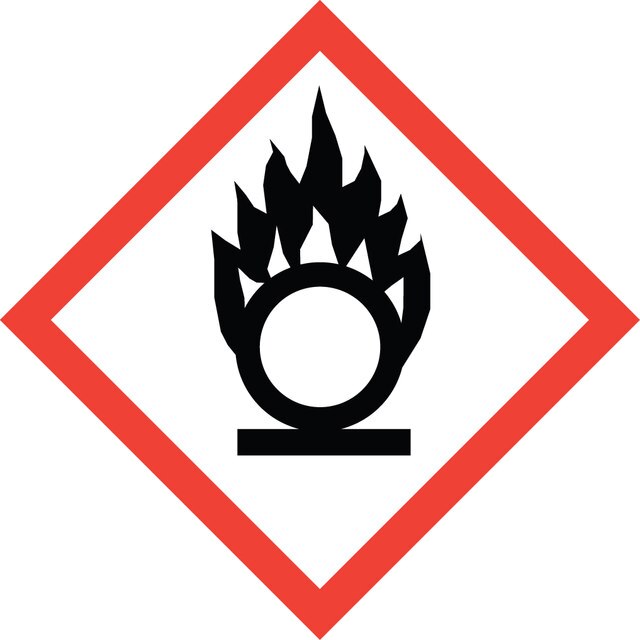

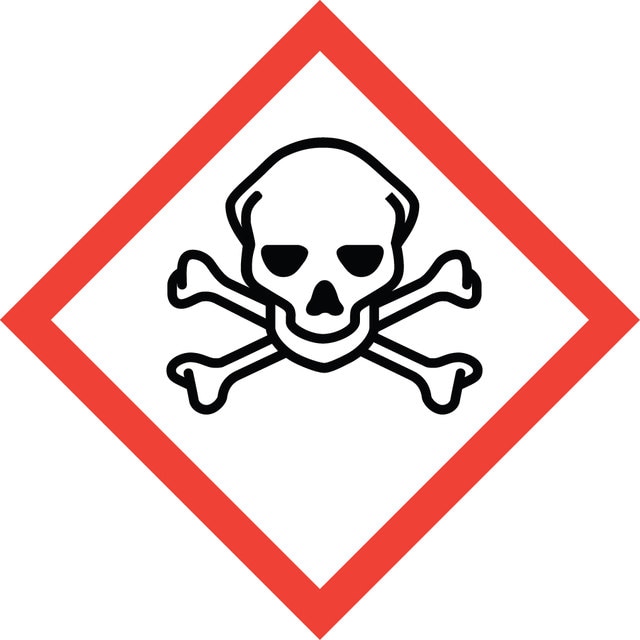
pictograms

Flame over circleSkull and crossbones

signalword

Danger

hcodes

Hazard Classifications

Acute Tox. 3 Oral - Ox. Sol. 1

Storage Class

5.1A - Strongly oxidizing hazardous materials

wgk

WGK 2

flash_point_f

Not applicable

flash_point_c

Not applicable


Regulatory Listings

Regulatory Listings are mainly provided for chemical products. Only limited information can be provided here for non-chemical products. No entry means none of the components are listed. It is the user’s obligation to ensure the safe and legal use of the product.

Deleterious substance

pdsc

Class I Designated Chemical Substances

prtr

Group 1: Oxidizing solids + Chlorates + Hazardous rank I + 1st oxidizing solid

fsl

Substances Subject to be Indicated Names

ishl_indicated

Substances Subject to be Notified Names

ishl_notified


Choose from one of the most recent versions:

Certificates of Analysis (COA)

Lot/Batch Number

It looks like we've run into a problem, but you can still download Certificates of Analysis from our Documents section.

If you need assistance, please contact Customer Support

Already Own This Product?

Find documentation for the products that you have recently purchased in the Document Library.

Visit the Document Library


Arda Gülay et al.
mBio, 10(6) (2019-11-07)
Nitrification, the oxidative process converting ammonia to nitrite and nitrate, is driven by microbes and plays a central role in the global nitrogen cycle. Our earlier investigations based on 16S rRNA and amoA amplicon analysis, amoA quantitative PCR and metagenomics
The Decomposition of Solid Potassium Chlorate by X Rays.
Heal HG.
Canadian Journal of Chemistry, 37(5), 979-987 (1959)
Single sheet functionalized graphene by oxidation and thermal expansion of graphite.
McAllister MJ, et al.
Chemistry of Materials, 19(18), 4396-4404 (2007)