Skip to Content
Merck

293237

Ethylene glycol

spectrophotometric grade, ≥99%

Synonym(s):

1,2-Ethanediol

Sign In to View Organizational & Contract Pricing.

Select a Size


About This Item

Linear Formula:
HOCH2CH2OH
CAS Number:
Molecular Weight:
62.07
NACRES:
NA.21
PubChem Substance ID:
eCl@ss:
39020501
UNSPSC Code:
12352137
EC Number:
203-473-3
MDL number:
Beilstein/REAXYS Number:
505945
Assay:
≥99%
Grade:
spectrophotometric grade
Technique(s):
UV/Vis spectroscopy: suitable
Bp:
195-198 °C
Vapor pressure:
0.08 mmHg ( 20 °C)
Technical Service
Need help? Our team of experienced scientists is here for you.
Let Us Assist
Technical Service
Need help? Our team of experienced scientists is here for you.
Let Us Assist

assay

≥99%

form

liquid

InChI key

LYCAIKOWRPUZTN-UHFFFAOYSA-N

InChI

1S/C2H6O2/c3-1-2-4/h3-4H,1-2H2

SMILES string

OCCO

grade

spectrophotometric grade

vapor density

2.1 (vs air)

vapor pressure

0.08 mmHg ( 20 °C)

autoignition temp.

752 °F

expl. lim.

15.3 %

technique(s)

UV/Vis spectroscopy: suitable

impurities

<0.050% water

refractive index

n20/D 1.431 (lit.)

bp

195-198 °C

mp

−13 °C (lit.)

density

1.113 g/mL at 25 °C (lit.)

λ

H2O reference

UV absorption

λ: 210 nm Amax: 1.00, λ: 220 nm Amax: 0.40, λ: 250 nm Amax: 0.10, λ: 300 nm Amax: 0.01

Quality Level

Looking for similar products? Visit Product Comparison Guide

Application

Ethylene glycol solvent is featured in:
  • Tandem affinity purification-mass spectrometry (TAP-MS) characterization of protein complexes
  • Measurement of total protein content using a ninhydrin-based quantification method
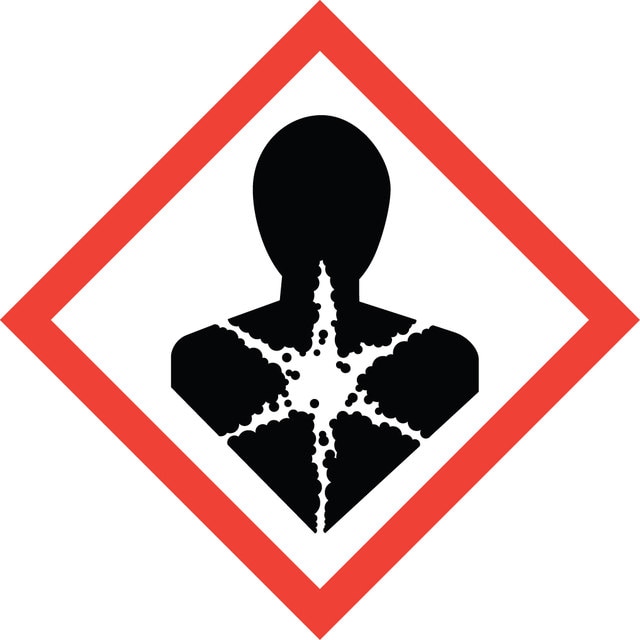
pictograms

Health hazardExclamation mark

signalword

Warning

hcodes

Hazard Classifications

Acute Tox. 4 Oral - STOT RE 2 Oral

target_organs

Kidney

Storage Class

10 - Combustible liquids

wgk

WGK 1

flash_point_f

239.0 °F - open cup

flash_point_c

115 °C - open cup


Regulatory Listings

Regulatory Listings are mainly provided for chemical products. Only limited information can be provided here for non-chemical products. No entry means none of the components are listed. It is the user’s obligation to ensure the safe and legal use of the product.

Group 4: Flammable liquids + Type 3 petroleums + Hazardous rank III + Water soluble liquid

fsl

Substances Subject to be Indicated Names

ishl_indicated

Substances Subject to be Notified Names

ishl_notified

293237-6X1L:4548173936031 + 293237-VAR: + 293237-100ML: + 293237-2L:4548173936024 + 293237-1L:4548173936017 + 293237-900ML: + 293237-500ML: + 293237-BULK: + 293237-4X2L:4548173925653

jan


Choose from one of the most recent versions:

Certificates of Analysis (COA)

Lot/Batch Number

Don't see the Right Version?

If you require a particular version, you can look up a specific certificate by the Lot or Batch number.

Already Own This Product?

Find documentation for the products that you have recently purchased in the Document Library.

Visit the Document Library

Study of polyol synthesis reaction parameters controlling high yield of silver nanocubes.
Panfilova EV, et al.
Colloid Journal, 74(1), 99-109 (2012)
Boris N Khlebtsov et al.
Langmuir : the ACS journal of surfaces and colloids, 28(24), 8994-9002 (2012-03-13)
We describe a novel strategy for the fabrication of plasmonic nanopowders (dried gold nanoparticles) by using wet chemical nanoparticle synthesis, PEG-SH functionalization, and a standard freeze-drying technique. Our strategy is illustrated by successful fabrication of different plasmonic nanopowders, including gold
Anomalously increased effective thermal conductivities of ethylene glycol-based nanofluids containing copper nanoparticles.
Eastman JA, et al.
Applied Physics Letters, 78(6), 718-720 (2001)
Lennart Treuel et al.
Chemphyschem : a European journal of chemical physics and physical chemistry, 11(14), 3093-3099 (2010-09-04)
Interactions between differently functionalised silver and gold nanoparticles (NPs) as well as polystyrene nanoparticles with bovine serum albumin (BSA) are studied using circular dichroism (CD) spectroscopy. It is found that the addition of NPs to the protein solution destroys part
Synthesis and characterization of yttrium iron garnet nanoparticles.
Vaqueiro P, et al.
Journal of Solid State Chemistry, 126(2), 161-168 (1996)

Our team of scientists has experience in all areas of research including Life Science, Material Science, Chemical Synthesis, Chromatography, Analytical and many others.

Contact Technical Service