Skip to Content
Merck

H2198

Heptane

greener alternative

ReagentPlus®, 99%

Synonym(s):

Heptyl hydride, n-Heptane

Sign In to View Organizational & Contract Pricing.

Select a Size

Change View

About This Item

Linear Formula:
CH3(CH2)5CH3
CAS Number:
Molecular Weight:
100.20
UNSPSC Code:
12352001
NACRES:
NA.06
PubChem Substance ID:
EC Number:
205-563-8
Beilstein/REAXYS Number:
1730763
MDL number:
Assay:
99%
Vapor pressure:
40 mmHg ( 20 °C), 83 mmHg ( 37.7 °C)
Technical Service
Need help? Our team of experienced scientists is here for you.
Let Us Assist


vapor density

3.5 (vs air)

Quality Level

vapor pressure

40 mmHg ( 20 °C), 83 mmHg ( 37.7 °C)

product line

ReagentPlus®

assay

99%

form

liquid

autoignition temp.

433 °F

expl. lim.

7 %

greener alternative product characteristics

Safer Solvents and Auxiliaries
Learn more about the Principles of Green Chemistry.

sustainability

Greener Alternative Product

dilution

(for general lab use)

refractive index

n20/D 1.387 (lit.)

mp

−91 °C (lit.)

density

0.684 g/mL at 25 °C (lit.)

greener alternative category

SMILES string

CCCCCCC

InChI

1S/C7H16/c1-3-5-7-6-4-2/h3-7H2,1-2H3

InChI key

IMNFDUFMRHMDMM-UHFFFAOYSA-N

General description

We are committed to bringing you Greener Alternative Products, which adhere to one or more of The 12 Principles of Greener Chemistry. Heptane is an environmentally preferable solvent and greener alternative to hexane and thus has been enhanced for "Safer Solvents and Auxiliaries". Click here for more information.

Application

Greener alternatives to Hexane.

Features and Benefits

Greener alternative for hexane

Other Notes

Pure-Pac® II containers require the Micromatic MacroValve coupler for dispensing solvents, Z560723.

Legal Information

ReagentPlus is a registered trademark of Merck KGaA, Darmstadt, Germany
Pure-Pac is a registered trademark of Merck KGaA, Darmstadt, Germany


Still not finding the right product?

Explore all of our products under Heptane
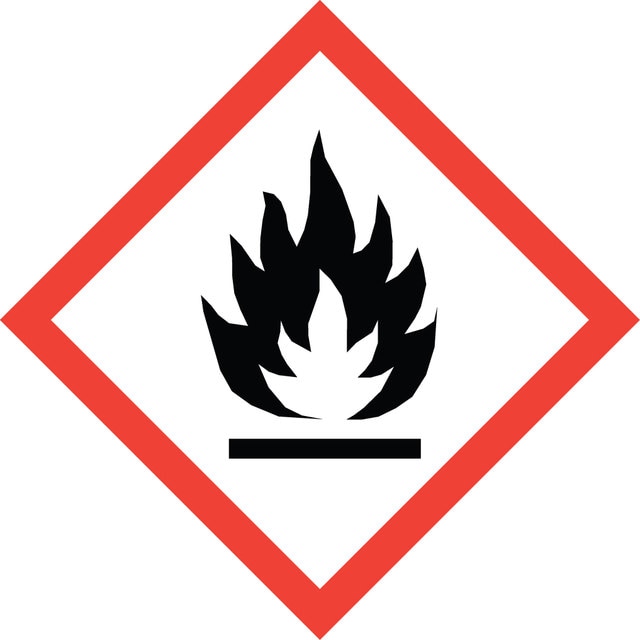

signalword

Danger

Hazard Classifications

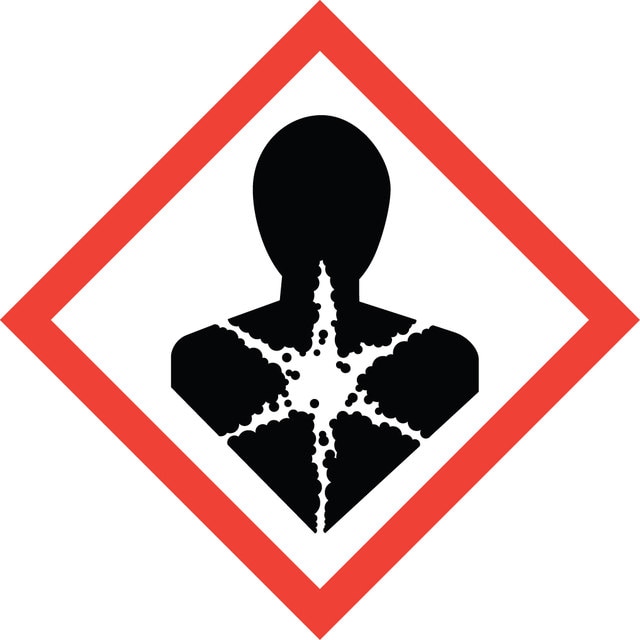
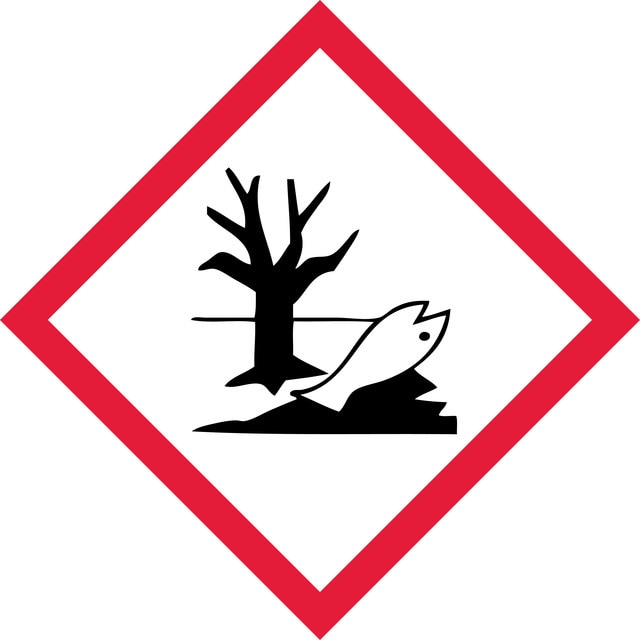
Aquatic Acute 1 - Aquatic Chronic 1 - Asp. Tox. 1 - Flam. Liq. 2 - Skin Irrit. 2 - STOT SE 3

target_organs

Central nervous system

Storage Class

3 - Flammable liquids

flash_point_f

24.8 °F - closed cup

flash_point_c

-4 °C - closed cup


Regulatory Listings

Regulatory Listings are mainly provided for chemical products. Only limited information can be provided here for non-chemical products. No entry means none of the components are listed. It is the user’s obligation to ensure the safe and legal use of the product.

Class I Designated Chemical Substances

prtr

Group 4: Flammable liquids + Type 1 petroleums + Hazardous rank II + Water insoluble liquid

fsl

Substances Subject to be Indicated Names

ishl_indicated

Substances Subject to be Notified Names

ishl_notified

H2198-VAR: + H2198-56L-P1-LS: + H2198-100ML: + H2198-500ML: + H2198-200L-SD: + H2198-2.5L: + H2198-200L: + H2198-4X2.5L: + H2198-200L-PW: + H2198-50L-P2-LS: + H2198-7L-RC: + H2198-20L:4548173955858 + H2198-7L-BULK: + H2198-200L-LSNBBR: + H2198-1L:4548173955834 + H2198-4L:4548173955841 + H2198-RSAMPLE: + H2198-BULK: + H2198-200L-P2-LS: + H2198-18L: + H2198-200L-RC: + H2198-18L-CS: + H2198-4X4L-PB: + H2198-4X4L:

jan


Choose from one of the most recent versions:

Certificates of Analysis (COA)

Lot/Batch Number

It looks like we've run into a problem, but you can still download Certificates of Analysis from our Documents section.

If you need assistance, please contact Customer Support

Already Own This Product?

Find documentation for the products that you have recently purchased in the Document Library.

Visit the Document Library


Arun K Kota et al.
Advanced materials (Deerfield Beach, Fla.), 24(43), 5838-5843 (2012-08-30)
Hierarchically structured, superoleophobic surfaces are demonstrated that display one of the lowest contact angle hysteresis values ever reported - even with extremely low-surface-tension liquids such as n-heptane. Consequently, these surfaces allow, for the first time, even ≈2 μL n-heptane droplets
Bing Chen et al.
Journal of hazardous materials, 188(1-3), 369-374 (2011-02-26)
The influence of the initial fuel temperature on the burning behavior of n-heptane pool fire was experimentally studied at the State Key Laboratory of Fire Science (SKLFS) large test hall. Circular pool fires with diameters of 100mm, 141 mm, and
Jovana Zečević et al.
Nature, 528(7581), 245-248 (2015-12-15)
The ability to control nanoscale features precisely is increasingly being exploited to develop and improve monofunctional catalysts. Striking effects might also be expected in the case of bifunctional catalysts, which are important in the hydrocracking of fossil and renewable hydrocarbon