
M1136

Mercury(II) chloride
ReagentPlus®, 99%
Synonym(s):
Mercuric chloride
Select a Size
About This Item
vapor pressure
1.3 mmHg ( 236 °C)
Quality Level
product line
ReagentPlus®
assay
99%
form
powder
reaction suitability
reagent type: catalyst
core: mercury
mp
277 °C (lit.)
SMILES string
Cl[Hg]Cl
InChI
1S/2ClH.Hg/h2*1H;/q;;+2/p-2
InChI key
LWJROJCJINYWOX-UHFFFAOYSA-L
General description
Application
It may be used as a catalyst for the addition reaction between aromatic amines and terminal acetylenes. It may also be used in the synthesis of [(HgCl2)2(HgCl2)(2-bppt)]n where 2-bppt= bis[4-(pyridine-2-yl)pyrimidin-2-ylthio]methane.
It assists in the following reactions:
- Cyclization of amidinothioureas with phenyl hydrazine to afford 3-amino-1,2,4-triazole derivatives.
- Cyclization-rearrangement of O-propargyl glycolaldehyde dithioacetals leading to the formation of 3-pyranones.
- Reductive dimerization and cyclization of α,β-unsaturated ketones to generate 3,4-trans-diarylcyclopentanols.
Analysis Note
Legal Information
Still not finding the right product?
Explore all of our products under Mercury(II) chloride
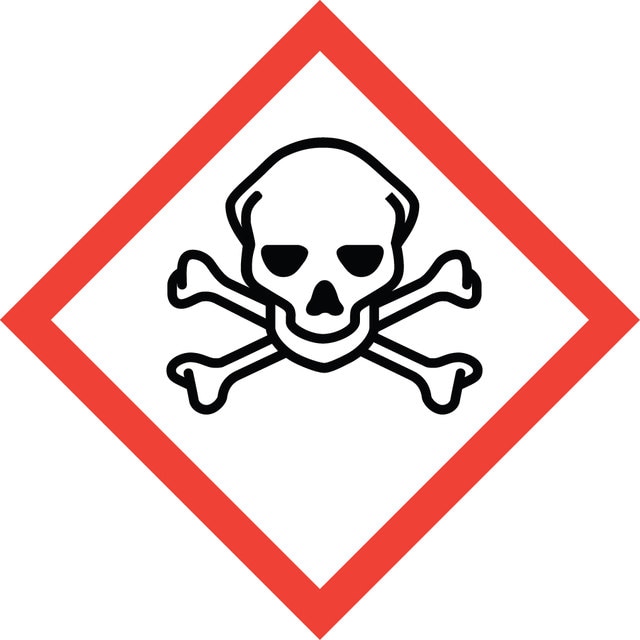



signalword
Danger
Hazard Classifications
Acute Tox. 2 Oral - Aquatic Acute 1 - Aquatic Chronic 1 - Muta. 2 - Repr. 2 - Skin Corr. 1B - STOT RE 1
Storage Class
6.1B - Non-combustible acute toxic Cat. 1 and 2 / very toxic hazardous materials
wgk
WGK 3
flash_point_f
Not applicable
flash_point_c
Not applicable
Regulatory Listings
Regulatory Listings are mainly provided for chemical products. Only limited information can be provided here for non-chemical products. No entry means none of the components are listed. It is the user’s obligation to ensure the safe and legal use of the product.
Poisonous substance
pdsc
Class I Designated Chemical Substances
prtr
Substances Subject to be Indicated Names
ishl_indicated
Substances Subject to be Notified Names
ishl_notified
M1136-500G:4.548173202013E12 + M1136-100G:4.548173201986E12 + M1136-25G:4.548173202006E12 + M1136-1KG:4.548173201993E12
jan
Choose from one of the most recent versions:
Already Own This Product?
Find documentation for the products that you have recently purchased in the Document Library.