ログインで組織・契約価格をご覧ください。
サイズを選択してください
表示を変更する
この商品について
実験式(ヒル表記法):
C3H6O
CAS番号:
分子量:
58.08
UNSPSC Code:
12162002
NACRES:
NA.23
PubChem Substance ID:
EC Number:
200-879-2
Beilstein/REAXYS Number:
79763
MDL number:
vapor density
2 (vs air)
Quality Level
vapor pressure
29.43 psi ( 55 °C), 8.59 psi ( 20 °C)
product line
ReagentPlus®
assay
≥99%
autoignition temp.
1378 °F
expl. lim.
37 %
refractive index
n20/D 1.366 (lit.)
bp
34 °C (lit.)
mp
−112 °C (lit.)
density
0.83 g/mL at 25 °C (lit.)
shipped in
wet ice
storage temp.
2-8°C
SMILES string
CC1CO1
InChI
1S/C3H6O/c1-3-2-4-3/h3H,2H2,1H3
InChI key
GOOHAUXETOMSMM-UHFFFAOYSA-N
General description
(±)-プロピレンオキシドは、さまざまな化学反応において中間体として使用される有機化合物です。活性水素原子と容易に反応します。
Application
ポリエーテルポリオール、プロピレングリコール、プロピレングリコールエーテルの生成に使用されます。水表面から石油膜を除去するための、アンモニウム型複合体の合成における中間体として使用されます。
Packaging
リターナブル容器のオプションをご覧ください。
Other Notes
カタログ番号110205-4X1Lは取り扱いを終了しております。110205-1Lをご購入ください。
Legal Information
ReagentPlus is a registered trademark of Merck KGaA, Darmstadt, Germany
Still not finding the right product?
Explore all of our products under (±)-Propylene oxide
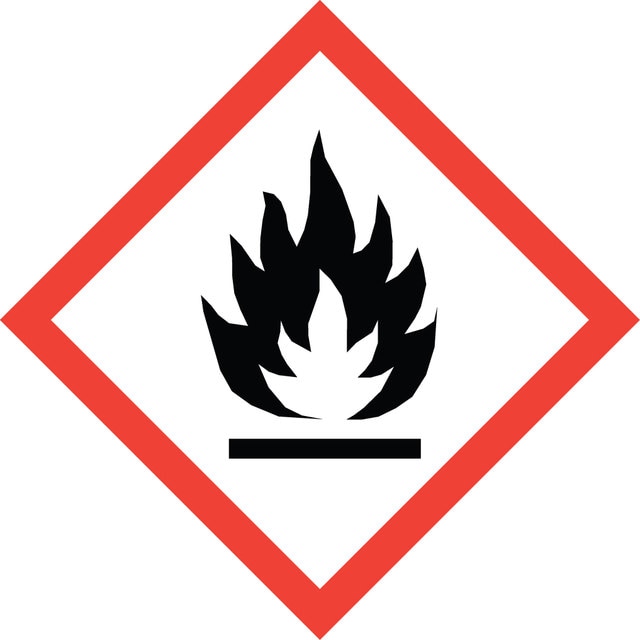
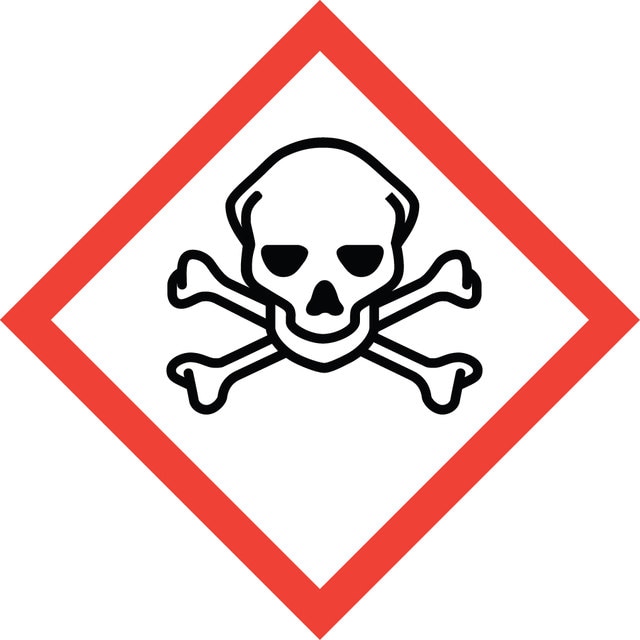
signalword
Danger
Hazard Classifications
Acute Tox. 3 Dermal - Acute Tox. 3 Inhalation - Acute Tox. 4 Oral - Carc. 1B - Eye Irrit. 2 - Flam. Liq. 1 - Muta. 1B - STOT SE 3
target_organs
Respiratory system
保管分類
3 - Flammable liquids
wgk
WGK 3
flash_point_f
-36.4 °F - Equilibrium method
flash_point_c
-38 °C - Equilibrium method
ppe
Faceshields, Gloves, Goggles
適用法令
試験研究用途を考慮した関連法令を主に挙げております。化学物質以外については、一部の情報のみ提供しています。 製品を安全かつ合法的に使用することは、使用者の義務です。最新情報により修正される場合があります。WEBの反映には時間を要することがあるため、適宜SDSをご参照ください。
第一種指定化学物質
prtr
第4類:引火性液体 + 特殊引火物 + 危険等級I
fsl
名称等を表示すべき危険物及び有害物
ishl_indicated
名称等を通知すべき危険物及び有害物
ishl_notified
110205-18L:4.548173303468E12 + 110205-100ML:4.548173309989E12 + 110205-1L:4.548173303475E12 + 110205-500ML:4.548173303482E12
jan
Josep Casamada Ribot et al.
Chemical communications (Cambridge, England), 46(37), 6971-6973 (2010-08-24)
The aqueous gelation of a quaternary ammonium oligo(propylene oxide)-based ionic liquid yields ion gels with a reverse thermoresponsive behavior (i.e., mechanical moduli and viscosity increase with temperature) and enhanced ionic conductivities.
Enantioselective complexation of chiral propylene oxide by an enantiopure water-soluble cryptophane.
Aude Bouchet et al.
The Journal of organic chemistry, 76(10), 4178-4181 (2011-04-08)
ECD and NMR experiments show that the complexation of propylene oxide (PrO) within the cavity of an enantiopure water-soluble cryptophane 1 in NaOH solution is enantioselective and that the (R)-PrO@PP-1 diastereomer is more stable than the (S)-PrO@PP-1 diastereomer with a
Denis Merlet et al.
Journal of magnetic resonance (San Diego, Calif. : 1997), 209(2), 315-322 (2011-02-25)
The application of the G-SERFph pulse sequence is presented on enantiomeric mixtures dissolved in a chiral liquid crystal. It aims at editing, within one single 2D spectrum, every proton coupling which is experienced by a given proton site in the