
25190

4-クロロ-2-メチルフェノキシ酢酸
technical, ≥95.0% (T)
別名:
4-クロロ-o-トリルオシキ酢酸, MCPA
ログインで組織・契約価格をご覧ください。
サイズを選択してください
この商品について
化学式:
ClC6H3(CH3)OCH2CO2H
CAS番号:
分子量:
200.62
UNSPSC Code:
12352100
NACRES:
NA.22
PubChem Substance ID:
EC Number:
202-360-6
Beilstein/REAXYS Number:
2051752
MDL number:
製品名
4-クロロ-2-メチルフェノキシ酢酸, technical, ≥95.0% (T)
InChI key
WHKUVVPPKQRRBV-UHFFFAOYSA-N
InChI
1S/C9H9ClO3/c1-6-4-7(10)2-3-8(6)13-5-9(11)12/h2-4H,5H2,1H3,(H,11,12)
SMILES string
Cc1cc(Cl)ccc1OCC(O)=O
grade
technical
assay
≥95.0% (T)
form
solid
mp
114-118 °C (lit.)
solubility
water: insoluble(lit.)
functional group
carboxylic acid
chloro
Quality Level
類似した製品をお探しですか? 訪問 製品比較ガイド
関連するカテゴリー
General description
4-Chloro-2-methylphenoxyacetic acid (MPCA) is a herbicide. Various MCPA-mineralising bacterial combinations has been tested using a high-throughput microplate radiorespirometric mineralisation assay. Degradation mechanisms of OH and MCPA including molecular form and anionic form have been studied. Rapid and sensitive LC-electrospray tandem mass spectrometry method has been developed for the quantitation of MCPA in water and soil samples.
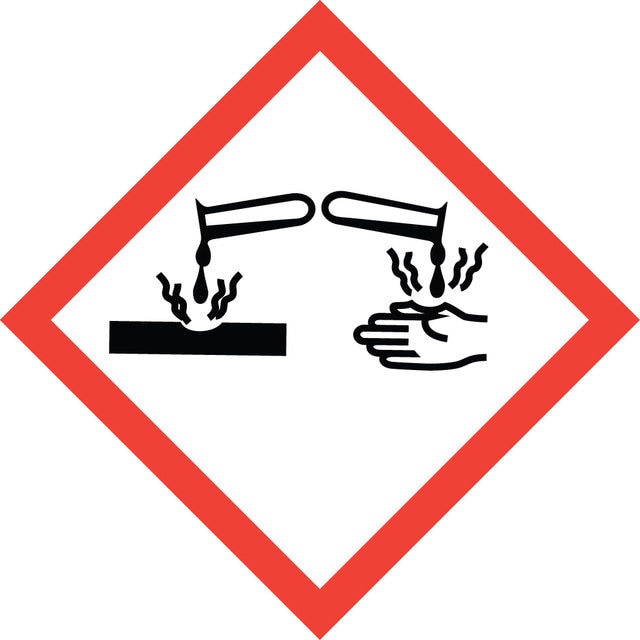


signalword
Danger
hcodes
Hazard Classifications
Acute Tox. 4 Oral - Aquatic Acute 1 - Aquatic Chronic 1 - Eye Dam. 1 - Skin Irrit. 2
保管分類
11 - Combustible Solids
wgk
WGK 2
ppe
dust mask type N95 (US), Eyeshields, Gloves
Urse S Krüger et al.
Pest management science, 71(2), 257-265 (2014-04-17)
The herbicide 4-chloro-2-methylphenoxyacetic acid (MCPA) is found frequently in Danish groundwater in concentrations exceeding the EU threshold limit of 0.1 µg L(-1) . Groundwater is used for drinking water, and one potential remediation strategy is bioaugmentation using inoculation of sand filters at
Xiaohua Ren et al.
Chemosphere, 88(1), 39-48 (2012-03-27)
The initial degradation mechanisms of ⁱOH and 4-chloro-2-methylphenoxyacetic acid (MCPA) including molecular form and anionic form are studied at the MPWB1K/6-311+G(3df, 2p)//MPWB1K/6-31+G(d, p) level. Possible reaction pathways of H-atom abstraction and ⁱOH addition are considered in detail. By result comparison
Erkin Gözdereliler et al.
Applied and environmental microbiology, 79(1), 367-375 (2012-11-06)
Two 4-chloro-2-methylphenoxyacetic acid (MCPA)-degrading enrichment cultures selected from an aquifer on low (0.1 mg liter(-1)) or high (25 mg liter(-1)) MCPA concentrations were compared in terms of metabolic activity, community composition, population growth, and single cell physiology. Different community compositions
G G Bond et al.
British journal of industrial medicine, 50(4), 340-348 (1993-04-01)
For the purpose of assessing the human carcinogenic potential of the chlorophenoxy herbicides MCPA, MCPP, and 2,4-DP, the relevant epidemiological and toxicological evidence is reviewed. These compounds have not produced tumours in animal studies conducted under current test guidelines, giving
Edgar Hiller et al.
Chemosphere, 87(5), 437-444 (2011-12-31)
Herbicide leaching through soil into groundwater greatly depends upon sorption-desorption and degradation phenomena. Batch adsorption, desorption and degradation experiments were performed with acidic herbicide MCPA and three soil types collected from their respective soil horizons. MCPA was found to be
ライフサイエンス、有機合成、材料科学、クロマトグラフィー、分析など、あらゆる分野の研究に経験のあるメンバーがおります。.
製品に関するお問い合わせはこちら(テクニカルサービス)