ログインで組織・契約価格をご覧ください。
サイズを選択してください
この商品について
化学式:
Cl2C6H3NH2
CAS番号:
分子量:
162.02
UNSPSC Code:
12352100
NACRES:
NA.22
PubChem Substance ID:
EC Number:
202-448-4
Beilstein/REAXYS Number:
636837
MDL number:
Assay:
98%
InChI key
SDYWXFYBZPNOFX-UHFFFAOYSA-N
InChI
1S/C6H5Cl2N/c7-5-2-1-4(9)3-6(5)8/h1-3H,9H2
SMILES string
Nc1ccc(Cl)c(Cl)c1
assay
98%
bp
272 °C (lit.)
mp
69-71 °C (lit.)
functional group
chloro
Quality Level
類似した製品をお探しですか? 訪問 製品比較ガイド
関連するカテゴリー
General description
3,4-ジクロロアニリン(3,4-DCA)は芳香族アミンの1つであり、環境汚染物質の1つのモデルとされています。何種類かの除草剤の合成および分解生成物の重要な前駆体でもあります。 3,4-DCAは除草剤として広く使用されている 3,4-ジクロロプロピオンアニリド(プロパニル)の代謝生成物です。 3,4-DCAの生物分解の反応速度が報告されています。 新たに開発された誘電体バリア放電プラズマ反応器を使用して、水に溶解した 3,4-DCAの分解機序が研究されています。GC-MS分析により、分解の中間生成物として以下の化合物が同定されています:2-ジクロロベンゼン、2-クロロ-1,4-ベンゾキノン、3,4-ジクロロフェニルイソシアネート、2-クロロヒドロキノン、3,4-ジクロロニトロベンゼン、および 3,4-ジクロロフェノール。
Application
3,4-ジクロロアニリンは、ペルフルオロオクタン酸(PFOA)のHPLC分析で使用する誘導体化試薬として使用されます。
signalword
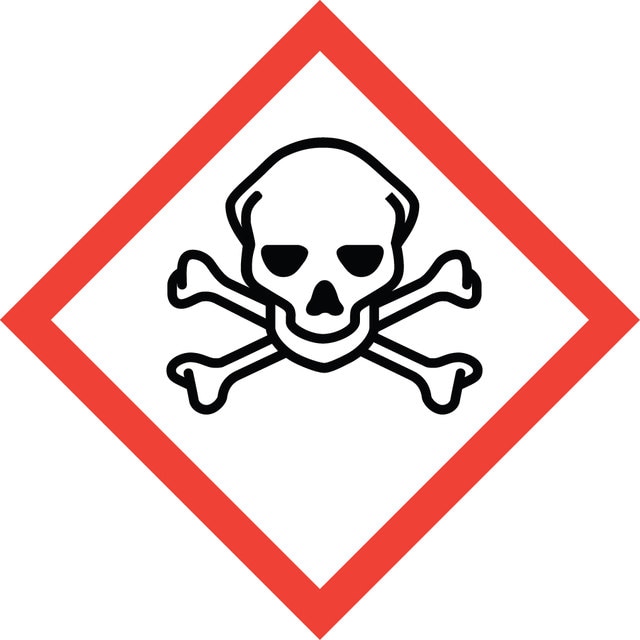
Danger
Hazard Classifications
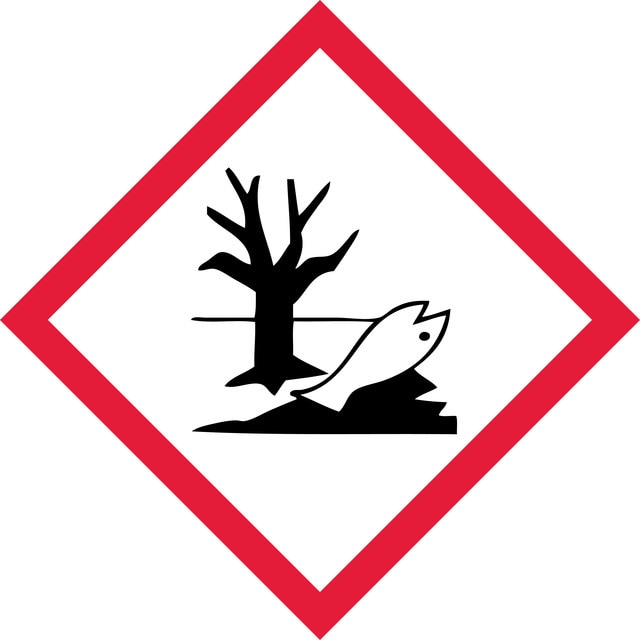
Acute Tox. 3 Dermal - Acute Tox. 3 Inhalation - Acute Tox. 3 Oral - Aquatic Acute 1 - Aquatic Chronic 1 - Eye Dam. 1 - Skin Sens. 1
保管分類
6.1A - Combustible acute toxic Cat. 1 and 2 / very toxic hazardous materials
wgk
WGK 3
flash_point_f
275.0 °F - closed cup
flash_point_c
135.00 °C - closed cup
ppe
Eyeshields, Faceshields, Gloves, type P2 (EN 143) respirator cartridges
適用法令
試験研究用途を考慮した関連法令を主に挙げております。化学物質以外については、一部の情報のみ提供しています。 製品を安全かつ合法的に使用することは、使用者の義務です。最新情報により修正される場合があります。WEBの反映には時間を要することがあるため、適宜SDSをご参照ください。
第一種指定化学物質
prtr
名称等を表示すべき危険物及び有害物
ishl_indicated
名称等を通知すべき危険物及び有害物
ishl_notified
437778-BULK: + 437778-1KG: + 437778-250G: + 437778-VAR: + 437778-5G:
jan
M Monteiro et al.
Chemosphere, 62(8), 1333-1339 (2005-09-20)
The aromatic amine 3,4-dichloroaniline (DCA) is a model environmental contaminant, precursor for synthesis and degradation product of several herbicides, which is commonly found in European estuarine ecosystems. In this work, the possibility of using biochemical and histological markers to assess
Nan Ye et al.
Nanotoxicology, 12(5), 423-438 (2018-04-17)
Concomitant releases of various engineered nanoparticles (NPs) into the environment have resulted in concerns regarding their combined toxicity to aquatic organisms. It is however, still elusive to distinguish the contribution to toxicity of components in NP mixtures. In the present
Guoqiang Shan et al.
Se pu = Chinese journal of chromatography, 32(9), 942-947 (2015-03-11)
A simple derivatization method followed by high performance liquid chromatography (HPLC) for the analysis of perfluorooctanoic acid (PFOA) was developed. PFOA was firstly derivatized with 3,4-dichloroaniline (DCA) using carbodiimide method. The typical amidate product was characterized by mass spectrometry (MS).
Ricardo Marques et al.
Environmental science and pollution research international, 22(9), 6687-6695 (2014-11-26)
This study models the biodegradation kinetics of two toxic xenobiotic compounds in enriched mixed cultures: a commonly applied herbicide (3,4-dichloropropionanilide or propanil) and its metabolite (3,4-dichloroaniline or DCA). The dependence of the metabolite degradation kinetics on the presence of the
Ellen D G Michiels et al.
Environmental toxicology and chemistry, 38(3), 533-547 (2018-12-21)
Fish (embryo) toxicity test guidelines are mostly based on aquatic exposures. However, in some cases, other exposure routes can be more practical and relevant. Micro-injection into the yolk of fish embryos could offer a particular advantage for administering hydrophobic compounds
ライフサイエンス、有機合成、材料科学、クロマトグラフィー、分析など、あらゆる分野の研究に経験のあるメンバーがおります。.
製品に関するお問い合わせはこちら(テクニカルサービス)