
12-0995

グルタルアルデヒド 溶液
SAJ first grade, 20.0-26.0%
別名:
グルタル酸ジアルデヒド 溶液, ペンタン-1,5-ジオール
ログインで組織・契約価格をご覧ください。
サイズを選択してください
表示を変更する
この商品について
化学式:
OHC(CH2)3CHO
CAS番号:
分子量:
100.12
PubChem Substance ID:
UNSPSC Code:
41116133
Beilstein/REAXYS Number:
605390
MDL number:
Grade:
SAJ first grade
grade
SAJ first grade
form
liquid
availability
available only in Japan
concentration
20.0-26.0%
dilution
(for analytical testing)
SMILES string
[H]C(CCCC([H])=O)=O
InChI
1S/C5H8O2/c6-4-2-1-3-5-7/h4-5H,1-3H2
InChI key
SXRSQZLOMIGNAQ-UHFFFAOYSA-N
Still not finding the right product?
Explore all of our products under グルタルアルデヒド 溶液
flash_point_c
Not applicable
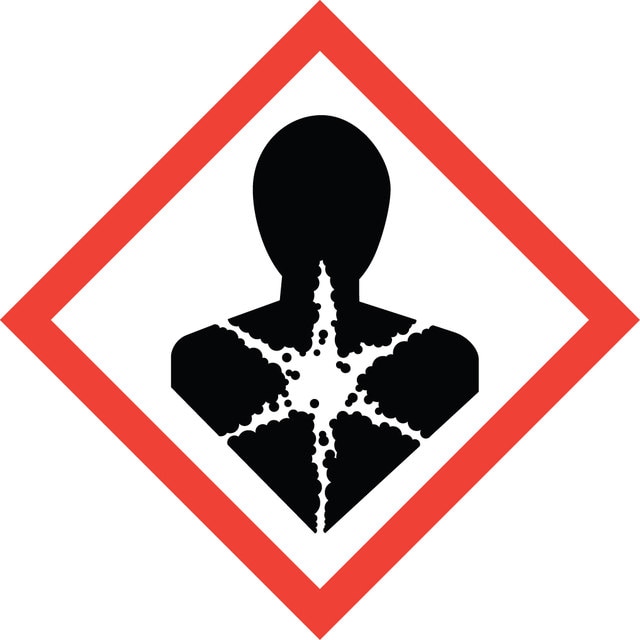
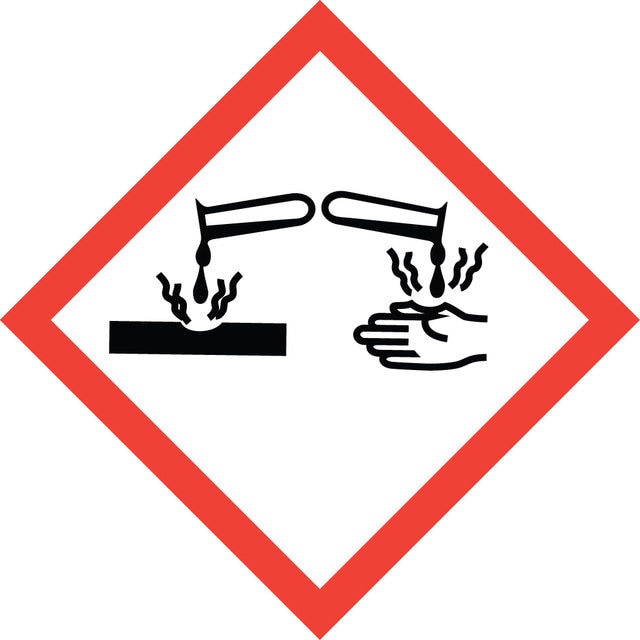

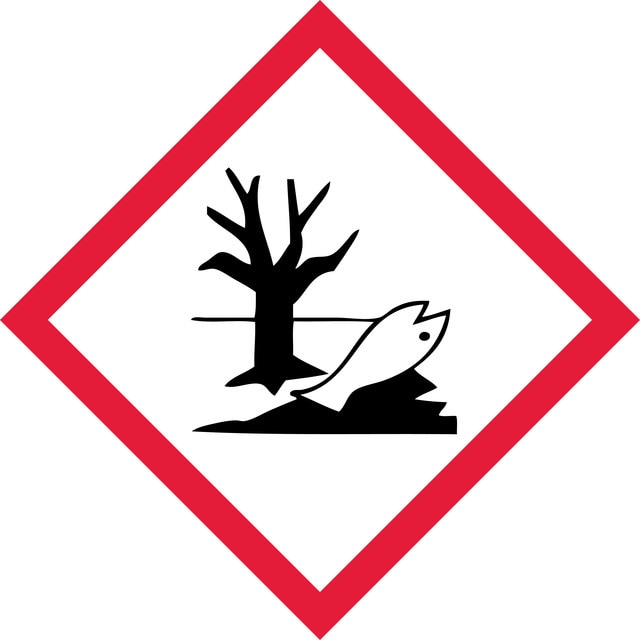
signalword
Danger
Hazard Classifications
Acute Tox. 4 Inhalation - Acute Tox. 4 Oral - Aquatic Acute 1 - Aquatic Chronic 2 - Eye Dam. 1 - Resp. Sens. 1 - Skin Corr. 1B - Skin Sens. 1 - STOT SE 3
target_organs
Respiratory system
supp_hazards
保管分類
8A - Combustible corrosive hazardous materials
wgk
WGK 3
flash_point_f
Not applicable
適用法令
試験研究用途を考慮した関連法令を主に挙げております。化学物質以外については、一部の情報のみ提供しています。 製品を安全かつ合法的に使用することは、使用者の義務です。最新情報により修正される場合があります。WEBの反映には時間を要することがあるため、適宜SDSをご参照ください。
第一種指定化学物質
prtr
名称等を表示すべき危険物及び有害物
ishl_indicated
名称等を通知すべき危険物及び有害物
ishl_notified
12-0995-5-500ML-J:4.548173007922E12
jan
Irene Costantini et al.
Scientific reports, 5, 9808-9808 (2015-05-08)
Extensive mapping of neuronal connections in the central nervous system requires high-throughput µm-scale imaging of large volumes. In recent years, different approaches have been developed to overcome the limitations due to tissue light scattering. These methods are generally developed to
Stéphane Jauréguiberry et al.
Blood, 124(2), 167-175 (2014-05-27)
Patients with severe malaria treated with artesunate sometimes experience a delayed hemolytic episode. Artesunate (AS) induces pitting, a splenic process whereby dead parasites are expelled from their host erythrocytes. These once-infected erythrocytes then return to the circulation. We analyzed hematologic
Andri K Riau et al.
Investigative ophthalmology & visual science, 55(5), 3186-3194 (2014-04-26)
To compare flap adhesion strength, stromal bed quality, and tissue responses after flap preparation using nJ- and μJ-energy level femtosecond lasers. All corneal flaps were created by either VisuMax laser (μJ-energy level) or femto-LDV (nJ-energy level). Flap adhesion strength in