コンテンツへスキップ
Merck

424633

アゾベンゼン

98%

別名:

1,2-Diphenyldiazene; Diphenyldiazene

ログインで組織・契約価格をご覧ください。

サイズを選択してください


この商品について

化学式:
C6H5N=NC6H5
CAS番号:
分子量:
182.22
UNSPSC Code:
12171500
NACRES:
NA.47
PubChem Substance ID:
EC Number:
203-102-5
Beilstein/REAXYS Number:
1819138
MDL number:
テクニカルサービス
お困りのことがあれば、経験豊富なテクニカルサービスチームがお客様をサポートします。
お手伝いします
テクニカルサービス
お困りのことがあれば、経験豊富なテクニカルサービスチームがお客様をサポートします。
お手伝いします

製品名

アゾベンゼン, 98%

InChI key

DMLAVOWQYNRWNQ-BUHFOSPRSA-N

InChI

1S/C12H10N2/c1-3-7-11(8-4-1)13-14-12-9-5-2-6-10-12/h1-10H/b14-13+

SMILES string

c1ccc(cc1)\N=N\c2ccccc2

vapor pressure

1 mmHg ( 104 °C)

assay

98%

form

powder or crystals

autoignition temp.

890 °F

technique(s)

titration: suitable

bp

293 °C (lit.)

mp

65-68 °C (lit.)

density

1.09 g/mL at 25 °C (lit.)

application(s)

diagnostic assay manufacturing
hematology
histology

storage temp.

room temp

Quality Level

類似した製品をお探しですか? 訪問 製品比較ガイド

関連するカテゴリー

Application

アゾベンゼンおよびその誘導体は、機械的および光学的材料、光薬理学、および生体プローブを含む分子光スイッチの分野において、多くの用途があります。
ヒトの組織は赤および近赤外光に対しては半透明ですが、青および紫外光に対しては不透明であるため、アゾベンゼンは、医療および光薬理学において、アゾベンゼンのtransおよびcis異性体の両方の吸収をより長い波長にシフトさせる用途に重要です。


General description

アゾベンゼンは色原体であり、trans/cis異性を示し色の異なる異性体を生じるアゾ化合物です。光に応答してアゾ結合の周囲でcis-trans異性化を示す単純なアゾアレーン化合物です。

signalword

Danger

Hazard Classifications

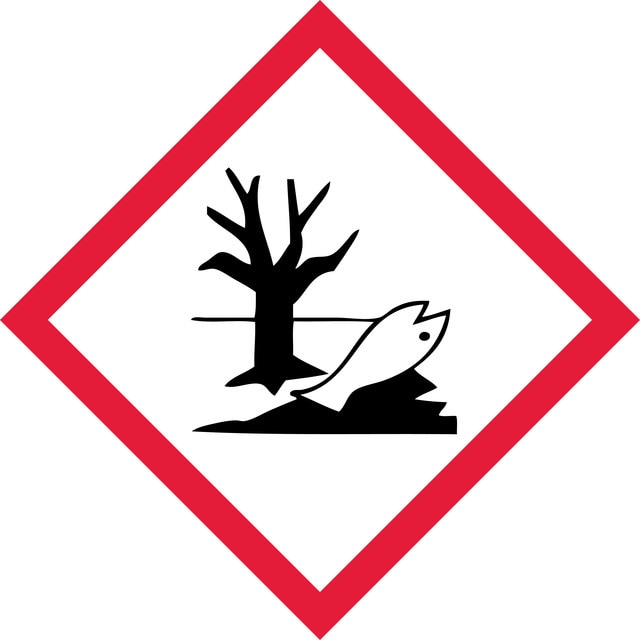
Acute Tox. 4 Inhalation - Acute Tox. 4 Oral - Aquatic Acute 1 - Aquatic Chronic 1 - Carc. 1B - Muta. 2 - STOT RE 2

保管分類

6.1C - Combustible acute toxic Cat.3 / toxic compounds or compounds which causing chronic effects

wgk

WGK 3

flash_point_f

212.0 °F - closed cup

flash_point_c

100.0 °C - closed cup

ppe

Eyeshields, Gloves, type P3 (EN 143) respirator cartridges


最新バージョンのいずれかを選択してください:

試験成績書(COA)

Lot/Batch Number

適切なバージョンが見つかりませんか。

特定のバージョンが必要な場合は、ロット番号またはバッチ番号で特定の証明書を検索できます。

以前この製品を購入いただいたことがある場合

文書ライブラリで、最近購入した製品の文書を検索できます。

文書ライブラリにアクセスする

Michael S Scholz et al.
The journal of physical chemistry. A, 121(34), 6413-6419 (2017-08-05)
Because of their high photoisomerization efficiencies, azobenzenes and their functionalized derivatives are used in a broad range of molecular photoswitches. Here, the photochemical properties of the trans isomers of protonated azobenzene (ABH
Daisuke Ishikawa et al.
Langmuir : the ACS journal of surfaces and colloids, 29(14), 4622-4631 (2012-12-20)
The growth processes of self-assembled monolayers (SAMs) of two azobenzene disulfides formed on flat gold surfaces were studied to confirm the effect of the intermolecular interactions between azobenzene molecules on the light-triggered surface morphologies of the SAMs. Scanning tunneling microscopy
C Renner et al.
The journal of peptide research : official journal of the American Peptide Society, 65(1), 4-14 (2005-02-03)
Over the last decades azobenzene has been the most widely used optical trigger for the synthesis of photoresponsive systems ranging from poly-alpha-amino acids to innovative materials with light-controlled mechanical and optical properties. More recently, its use in form of appropriate
Laura Maggini et al.
Nanoscale, 5(2), 634-645 (2012-12-12)
Photothermally responsive supramolecular polymers containing azobenzene units have been synthesised and employed as dispersants for multi-walled carbon nanotubes (MWCNTs) in organic solvents. Upon triggering the trans-cis isomerisation of the supramolecular polymer intermolecular interactions between MWCNTs and the polymer are established
Shiki Yagai et al.
Journal of the American Chemical Society, 134(44), 18205-18208 (2012-10-23)
We report a precise control over the hierarchy levels in the outstanding self-organization process shown by chiral azobenzene dimer 1. This compound forms uniform toroidal nanostructures that can hierarchically organize into chiral nanotubes under the control by temperature, concentration, or

ライフサイエンス、有機合成、材料科学、クロマトグラフィー、分析など、あらゆる分野の研究に経験のあるメンバーがおります。.

製品に関するお問い合わせはこちら(テクニカルサービス)