
87920

テトラメチルシラン
analytical standard, suitable for NMR (spectroscopy), ACS reagent
ログインで組織・契約価格をご覧ください。
サイズを選択してください
この商品について
化学式:
Si(CH3)4
CAS番号:
分子量:
88.22
UNSPSC Code:
12142201
NACRES:
NA.24
PubChem Substance ID:
EC Number:
200-899-1
Beilstein/REAXYS Number:
1696908
MDL number:
InChI key
CZDYPVPMEAXLPK-UHFFFAOYSA-N
InChI
1S/C4H12Si/c1-5(2,3)4/h1-4H3
SMILES string
C[Si](C)(C)C
grade
ACS reagent, analytical standard
vapor pressure
11.66 psi ( 20 °C)
assay
≥99.5% (GC)
Quality Level
autoignition temp.
842 °F
refractive index
n20/D 1.358 (lit.), n20/D 1.359
bp
26-28 °C (lit.)
mp
−99 °C (lit.)
density
0.648 g/mL at 25 °C (lit.)
suitability
suitable for NMR (spectroscopy)
application(s)
environmental
format
neat
storage temp.
2-8°C
類似した製品をお探しですか? 訪問 製品比較ガイド
General description
Tetramethylsilane has been recommended by the International Union of Pure and Applied Chemistry (IUPAC) as a universal reference for all nuclides. It is commonly used as a reference standard in nuclear magnetic resonance (NMR) for measuring proton chemical shifts and the temperature dependence of the 1H chemical shift of TMS in solvents such as chloroform, methanol, and dimethylsulfoxide is studied.
Application
Tetramethylsilane may be used as an internal standard for the quantitative analysis of medicinal plant extracts and herbal products using the quantitative NMR (qNMR) method. It may also be used as an internal standard to investigate peroxide-based chemical systems for the crosslinking reactions carried on isotactic polypropylene using FT-IR spectrometry and proton nuclear magnetic resonance (1H NMR) techniques.
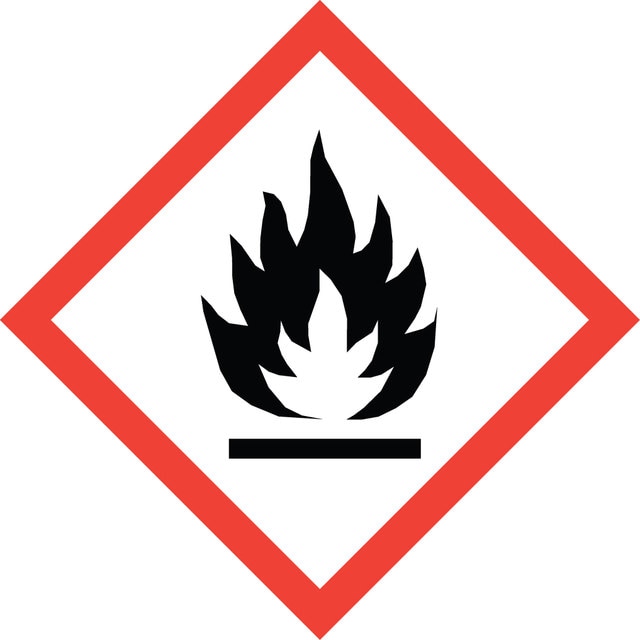
signalword
Danger
hcodes
Hazard Classifications
Flam. Liq. 1
保管分類
3 - Flammable liquids
wgk
WGK 3
flash_point_f
-16.6 °F - closed cup
flash_point_c
-27 °C - closed cup
ppe
Eyeshields, Faceshields, Gloves
適用法令
試験研究用途を考慮した関連法令を主に挙げております。化学物質以外については、一部の情報のみ提供しています。 製品を安全かつ合法的に使用することは、使用者の義務です。最新情報により修正される場合があります。WEBの反映には時間を要することがあるため、適宜SDSをご参照ください。
第4類:引火性液体 + 特殊引火物 + 危険等級I
fsl
名称等を表示すべき危険物及び有害物
ishl_indicated
名称等を通知すべき危険物及び有害物
ishl_notified
87920-VAR: + 87920-BULK: + 87920-100ML: + 87920-25ML:
jan
Ramesh C Sharma et al.
Spectrochimica acta. Part A, Molecular and biomolecular spectroscopy, 65(3-4), 787-791 (2006-03-15)
The decomposition of trimethylsilane and tetramethylsilane has been investigated for the first time, using hot wire (catalytic) at various temperatures. Trimethylsilane is catalytic-dissociated in these species SiH(2), CH(3)SiH, CH(3), CH(2)Si. Time of flight mass spectroscopy signal of these species are
K Eberle et al.
Physics in medicine and biology, 48(21), 3555-3564 (2003-12-05)
First measurements with a prototype ionization chamber are described to be applied in online monitoring of modulated fields in radiation therapy. The liquids isooctane, isononane (TMP) and tetramethylsilane (TMS) are used in a high purity grade in order to realize
Robin K Harris et al.
Magnetic resonance in chemistry : MRC, 45 Suppl 1, S174-S186 (2007-12-25)
Computations for chemical shifts of molecular organic compounds using the gauge-including projector augmented wave method and the NMR-CASTEP code are reviewed. The methods are briefly introduced, and some general aspects involving the sources of uncertainty in the results are explored.
Roy E Hoffman
Journal of magnetic resonance (San Diego, Calif. : 1997), 163(2), 325-331 (2003-08-14)
The chemical shift of TMS is commonly assumed to be zero. However, it varies by over 1 ppm for 1H and 4 ppm for 13C and shows a correlation with the physical properties of the solvent. Using the commonly accepted
Maria T Proetto et al.
ChemMedChem, 9(6), 1176-1187 (2014-05-23)
A series of methoxy- and fluorine-substituted [salophene]platinum(II) complexes (salophene=N,N'-bis(salicylidene)-1,2-phenylenediamine) were synthesized and characterized by (1) H NMR spectroscopy and mass spectrometry. The structure was confirmed on the example of [5-OCH3 -salophene]platinum(II) (4-Pt) by crystal structure analysis. The cytotoxicity of all
ライフサイエンス、有機合成、材料科学、クロマトグラフィー、分析など、あらゆる分野の研究に経験のあるメンバーがおります。.
製品に関するお問い合わせはこちら(テクニカルサービス)