
E8751

臭化エチジウム
~95% (HPLC)
別名:
3,8-ジアミノ-5-エチル-6-フェニルフェナントリジニウムブロミド, EtBr, 臭化ホミジウム
ログインで組織・契約価格をご覧ください。
サイズを選択してください
この商品について
実験式(ヒル表記法):
C21H20BrN3
CAS番号:
分子量:
394.31
UNSPSC Code:
41105322
NACRES:
NB.22
PubChem Substance ID:
EC Number:
214-984-6
Beilstein/REAXYS Number:
3642536
MDL number:
製品名
臭化エチジウム, ~95% (HPLC)
InChI
1S/C21H19N3.BrH/c1-2-24-20-13-16(23)9-11-18(20)17-10-8-15(22)12-19(17)21(24)14-6-4-3-5-7-14;/h3-13,23H,2,22H2,1H3;1H
InChI key
ZMMJGEGLRURXTF-UHFFFAOYSA-N
SMILES string
[Br-].CC[n+]1c(-c2ccccc2)c3cc(N)ccc3c4ccc(N)cc14
assay
~95% (HPLC)
mp
260-262 °C (dec.) (lit.)
Quality Level
類似した製品をお探しですか? 訪問 製品比較ガイド
関連するカテゴリー
Application
臭化エチジウム(EtBr)は、PAGEまたはアガロースゲル電気泳動に最もよく使用される核酸染色です。EtBrの蛍光は、二本鎖RNAに結合すると21倍に、二本鎖DNAに結合すると25倍に増加するため、バックグラウンドの脱色は不要であり、染色濃度を抑えることができます(10 μg/mL)。EtBrは、多数の核酸蛍光アッセイで使用されています。一本鎖DNA(それほど強くはありませんが)および三本鎖DNAに結合することが示されています。DNAに結合できるため、EtBrはDNAポリメラーゼの阻害剤です。
二本鎖DNAおよびRNAをインターカレーションするフレームシフト変異誘発物質です。
二本鎖DNAおよびRNAをインターカレーションするフレームシフト変異誘発物質です。
Biochem/physiol Actions
エチジウムブロミドは、二本鎖のDNAとRNAにインターカレーションし、フレームシフト変異誘発物質として働きます。アクリジンオレンジとともに使用することによって、生細胞、アポトーシス細胞、壊死細胞を識別することもできます。
Preparation Note
電気泳動後のゲルの染色に用いる場合は、ストック溶液を水で0.5 μg/mLに希釈し、ゲルを15~30分間浸漬します。通常は脱染は不要ですが、バックグラウンドを低下させる必要がある場合は、水で15分間脱染できます。 UVライトボックス(波長254 nm)でDNAバンドを検出できます。ゲルおよび泳動用バッファーに臭化エチジウムを0.5 μg/mLとなるよう添加しておくと、泳動終了後すぐにバンド検出を行なうことができます。
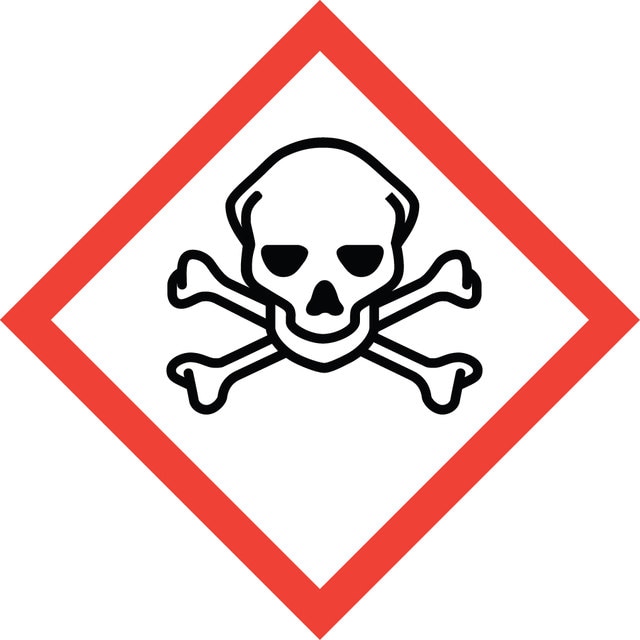
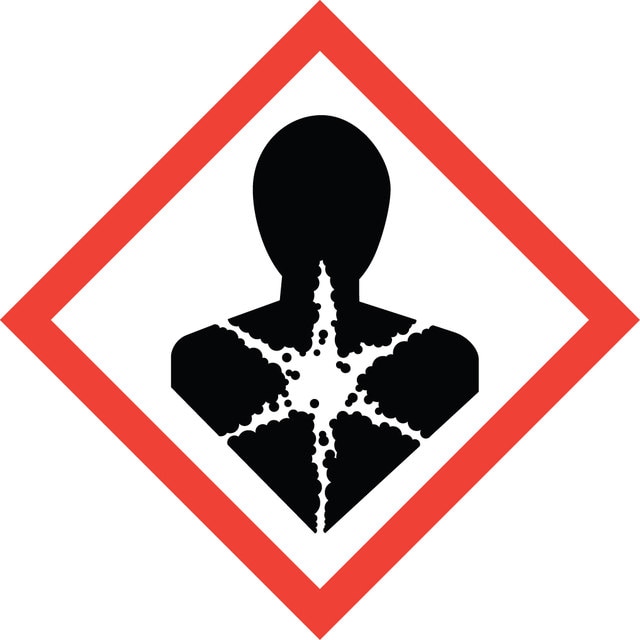
signalword
Danger
hcodes
Hazard Classifications
Acute Tox. 1 Inhalation - Acute Tox. 4 Oral - Muta. 2
保管分類
6.1A - Combustible acute toxic Cat. 1 and 2 / very toxic hazardous materials
wgk
WGK 1
flash_point_f
Not applicable
flash_point_c
Not applicable
ppe
Eyeshields, Faceshields, Gloves, type P3 (EN 143) respirator cartridges
Ulrich Braunschweig et al.
Genome research, 24(11), 1774-1786 (2014-09-27)
Alternative splicing (AS) of precursor RNAs is responsible for greatly expanding the regulatory and functional capacity of eukaryotic genomes. Of the different classes of AS, intron retention (IR) is the least well understood. In plants and unicellular eukaryotes, IR is
Patrick Seitz et al.
PLoS genetics, 10(1), e1004066-e1004066 (2014-01-07)
The DNA uptake of naturally competent bacteria has been attributed to the action of DNA uptake machineries resembling type IV pilus complexes. However, the protein(s) for pulling the DNA across the outer membrane of Gram-negative bacteria remain speculative. Here we
Li Zhang et al.
Comparative biochemistry and physiology. Part A, Molecular & integrative physiology, 186, 39-51 (2014-12-04)
Bill Milsom has made seminal contributions to our understanding of ventilatory control in a wide range of vertebrates. Teleosts are particularly interesting, because they produce a 3rd, potentially toxic respiratory gas (ammonia) in large amounts. Fish are well known to
Yuanhao Zhang et al.
PloS one, 10(6), e0130902-e0130902 (2015-07-01)
Adherent-invasive Escherichia coli (AIEC) strains are detected more frequently within mucosal lesions of patients with Crohn's disease (CD). The AIEC phenotype consists of adherence and invasion of intestinal epithelial cells and survival within macrophages of these bacteria in vitro. Our
Suguru Shigemori et al.
Microbial cell factories, 14, 189-189 (2015-11-27)
Mucosal delivery of therapeutic proteins using genetically modified strains of lactic acid bacteria (gmLAB) is being investigated as a new therapeutic strategy. We developed a strain of gmLAB, Lactococcus lactis NZ9000 (NZ-HO), which secretes the anti-inflammatory molecule recombinant mouse heme
関連コンテンツ
Ethidium bromide is a well-known and widely used fluorescent dye in biotechnology research.
ライフサイエンス、有機合成、材料科学、クロマトグラフィー、分析など、あらゆる分野の研究に経験のあるメンバーがおります。.
製品に関するお問い合わせはこちら(テクニカルサービス)