コンテンツへスキップ
Merck

T1022

(±)Thiopental solution

1.0 mg/mL in methanol, analytical standard, for drug analysis

ログインで組織・契約価格をご覧ください。

サイズを選択してください


この商品について

CAS番号:
NACRES:
NA.24
PubChem Substance ID:
UNSPSC Code:
41116107
EC Number:
200-659-6
MDL number:
テクニカルサービス
お困りのことがあれば、経験豊富なテクニカルサービスチームがお客様をサポートします。
お手伝いします
テクニカルサービス
お困りのことがあれば、経験豊富なテクニカルサービスチームがお客様をサポートします。
お手伝いします

InChI key

IUJDSEJGGMCXSG-UHFFFAOYSA-N

InChI

1S/C11H18N2O2S/c1-4-6-7(3)11(5-2)8(14)12-10(16)13-9(11)15/h7H,4-6H2,1-3H3,(H2,12,13,14,15,16)

SMILES string

CCCC(C)C1(CC)C(=O)NC(=S)NC1=O

assay

≥98%

concentration

1.0 mg/mL in methanol

technique(s)

HPLC: suitable, gas chromatography (GC): suitable

application(s)

pharmaceutical (small molecule)

format

single component solution

storage temp.

2-8°C

Quality Level

Application

Refer to the product′s Certificate of Analysis for more information on a suitable instrument technique. Contact Technical Service for further support.

signalword

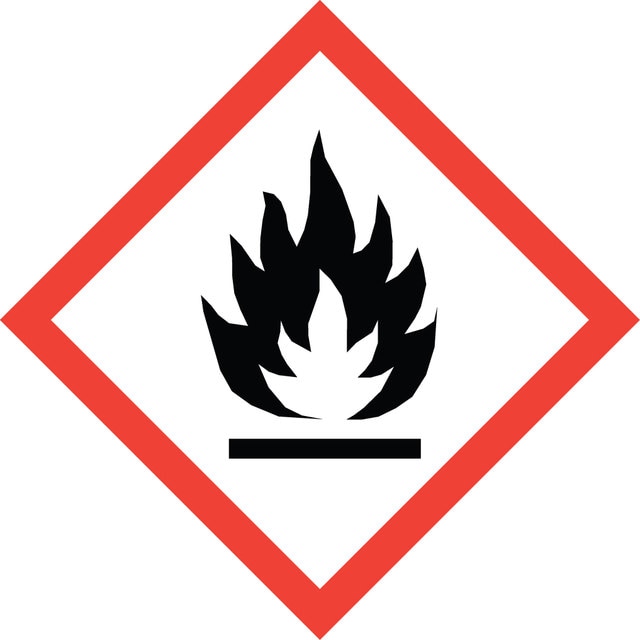
Danger

Hazard Classifications

Acute Tox. 3 Dermal - Acute Tox. 3 Inhalation - Acute Tox. 3 Oral - Flam. Liq. 2 - STOT SE 1

target_organs

Eyes

保管分類

3 - Flammable liquids

wgk

WGK 2

flash_point_f

51.8 °F - closed cup

flash_point_c

11 °C - closed cup

ppe

Eyeshields, Faceshields, Gloves, type ABEK (EN14387) respirator filter


適用法令

試験研究用途を考慮した関連法令を主に挙げております。化学物質以外については、一部の情報のみ提供しています。 製品を安全かつ合法的に使用することは、使用者の義務です。最新情報により修正される場合があります。WEBの反映には時間を要することがあるため、適宜SDSをご参照ください。

Group 4: Flammable liquids + Alcohols + Hazardous rank II

fsl

Substances Subject to be Indicated Names

ishl_indicated

Substances Subject to be Notified Names

ishl_notified

T1022-1ML:4548173212333 + T1022-BULK: + T1022-VAR:

jan


最新バージョンのいずれかを選択してください:

試験成績書(COA)

Lot/Batch Number

適切なバージョンが見つかりませんか。

特定のバージョンが必要な場合は、ロット番号またはバッチ番号で特定の証明書を検索できます。

以前この製品を購入いただいたことがある場合

文書ライブラリで、最近購入した製品の文書を検索できます。

文書ライブラリにアクセスする

Chadi G Abdallah et al.
The journal of ECT, 28(3), 157-161 (2012-08-01)
Studies now provide strong evidence that the N-methyl-D-aspartate receptor antagonist ketamine possesses rapidly acting antidepressant properties. This study aimed to determine if a low dose of ketamine could be used to expedite and augment the antidepressant effects of electroconvulsive therapy
Elisabeth Norman et al.
Pediatric research, 73(1), 87-94 (2012-11-07)
Sedative and analgesic medications are used in critically ill newborns, but little is known about their effects on electrocortical activity in preterm infants. We hypothesized that morphine might induce prolonged neurodepression, independent of blood pressure, as compared with rapid sequence
Anna Rosati et al.
Neurology, 79(24), 2355-2358 (2012-12-01)
To evaluate the efficacy and safety of ketamine (KE) in the management of refractory convulsive status epilepticus (RSE) in children. In November 2009, we started using KE for treating all children consecutively referred for RSE. Clinical and treatment data were
Bernd Walter et al.
International journal of developmental neuroscience : the official journal of the International Society for Developmental Neuroscience, 31(3), 157-164 (2013-01-12)
The transition from mild sedation to deep anaesthesia is marked by the phenomenon of burst suppression (BS). FDG-PET studies show that the cerebral metabolic rate for glucose (CMRglc) declines dramatically with onset of BS in the adult brain. Global CMRglc
Cecilia Lindgren et al.
Neurocritical care, 17(3), 367-373 (2012-08-31)
Non-convulsive seizures (NCSZ) can be more prevalent than previously recognized among comatose neuro-intensive care patients. The aim of this study was to evaluate the frequency of NCSZ and non-convulsive status epilepticus (NCSE) in sedated and ventilated subarachnoid hemorrhage (SAH) patients.

ライフサイエンス、有機合成、材料科学、クロマトグラフィー、分析など、あらゆる分野の研究に経験のあるメンバーがおります。.

製品に関するお問い合わせはこちら(テクニカルサービス)