
M32658

3-メチル-1-ブタノール
reagent grade, 98%
別名:
イソアミルアルコール, イソペンチルアルコール
ログインで組織・契約価格をご覧ください。
サイズを選択してください
この商品について
化学式:
(CH3)2CHCH2CH2OH
CAS番号:
分子量:
88.15
UNSPSC Code:
12352001
NACRES:
NA.21
PubChem Substance ID:
EC Number:
204-633-5
Beilstein/REAXYS Number:
1718835
MDL number:
Assay:
98%
Grade:
reagent grade
Bp:
130 °C (lit.)
Vapor pressure:
2 mmHg ( 20 °C)
grade
reagent grade
Quality Level
vapor density
3 (vs air)
vapor pressure
2 mmHg ( 20 °C)
assay
98%
form
liquid
autoignition temp.
644 °F
expl. lim.
1.2-9 %, 100 °F
dilution
(for analytical testing)
refractive index
n20/D 1.406 (lit.)
pH
5.6 (20 °C, 25 g/L)
bp
130 °C (lit.)
mp
−117 °C (lit.)
density
0.809 g/mL at 25 °C (lit.)
SMILES string
CC(C)CCO
InChI
1S/C5H12O/c1-5(2)3-4-6/h5-6H,3-4H2,1-2H3
InChI key
PHTQWCKDNZKARW-UHFFFAOYSA-N
類似した製品をお探しですか? 訪問 製品比較ガイド
関連するカテゴリー
Application
3-Methyl-1-butanol has been used in the preparation of bioactive beads (BABs) with uniform size for transformation.
Biochem/physiol Actions
3-Methyl-1-butanol is a pentanol isomer useful in biofuels. It is used as a starting material for the production of isoamyl acetate, a flavoring agent applicable in the food industry. 3-Methyl-1-butanol shows anti-fungal action by inhibiting the hyphal formation and reducing biofilm formation in Candida albicans. It is also used in DNA extraction protocols.
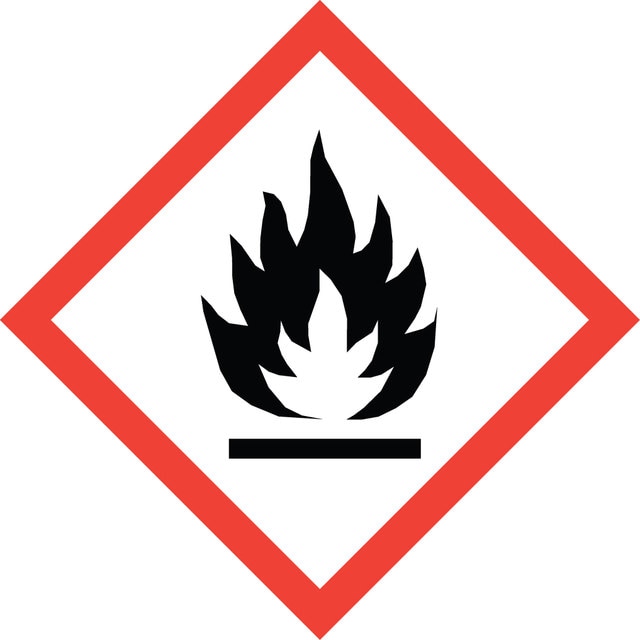


signalword
Danger
hcodes
Hazard Classifications
Acute Tox. 4 Inhalation - Eye Dam. 1 - Flam. Liq. 3 - Skin Irrit. 2 - STOT SE 3
target_organs
Respiratory system
保管分類
3 - Flammable liquids
wgk
WGK 1
flash_point_f
110.3 °F - closed cup
flash_point_c
43.5 °C - closed cup
適用法令
試験研究用途を考慮した関連法令を主に挙げております。化学物質以外については、一部の情報のみ提供しています。 製品を安全かつ合法的に使用することは、使用者の義務です。最新情報により修正される場合があります。WEBの反映には時間を要することがあるため、適宜SDSをご参照ください。
第4類:引火性液体 + 第二石油類 + 危険等級III + 非水溶性液体
fsl
名称等を表示すべき危険物及び有害物
ishl_indicated
名称等を通知すべき危険物及び有害物
ishl_notified
M32658-100ML:4548173202679 + M32658-1L:4548173202686 + M32658-250ML: + M32658-2.5L: + M32658-18L:4548173279688 + M32658-500ML:4548173202716 + M32658-VAR: + M32658-20L:4548173202693 + M32658-4L:4548173202709 + M32658-25ML: + M32658-VAR-D: + M32658-BULK:
jan
Vicente Pérez-Brocal et al.
Scientific reports, 10(1), 17377-17377 (2020-10-17)
Human lungs harbor a scarce microbial community, requiring to develop methods to enhance the recovery of nucleic acids from bacteria and fungi, leading to a more efficient analysis of the lung tissue microbiota. Here we describe five extraction protocols including
Mary J Dunlop et al.
Molecular systems biology, 7, 487-487 (2011-05-11)
Many compounds being considered as candidates for advanced biofuels are toxic to microorganisms. This introduces an undesirable trade-off when engineering metabolic pathways for biofuel production because the engineered microbes must balance production against survival. Cellular export systems, such as efflux
Kazushi Yoshida et al.
Nature communications, 3, 739-739 (2012-03-15)
The same odorant can induce attractive or repulsive responses depending on its concentration in various animals including humans. However, little is understood about the neuronal basis of this behavioural phenomenon. Here we show that Caenorhabditis elegans avoids high concentrations of
Frédéric Ravyts et al.
Food microbiology, 27(7), 945-954 (2010-08-07)
Differences in the production of bacterial metabolites with potential impact on fermented sausage flavour were found in meat simulation medium when comparing different strains of Staphylococcus xylosus and Staphylococcus carnosus as starter cultures. Overall, higher levels of 3-methyl-1-butanol and acetoin
Niels O Verhulst et al.
Malaria journal, 10, 28-28 (2011-02-10)
Anopheles gambiae sensu stricto is considered to be highly anthropophilic and volatiles of human origin provide essential cues during its host-seeking behaviour. A synthetic blend of three human-derived volatiles, ammonia, lactic acid and tetradecanoic acid, attracts A. gambiae. In addition
ライフサイエンス、有機合成、材料科学、クロマトグラフィー、分析など、あらゆる分野の研究に経験のあるメンバーがおります。.
製品に関するお問い合わせはこちら(テクニカルサービス)