
O5500

四酸化オスミウム
Sealed ampule.
別名:
オスミウム酸, 酸化オスミウム(VIII)
ログインで組織・契約価格をご覧ください。
サイズを選択してください
この商品について
化学式:
OsO4
CAS番号:
分子量:
254.23
NACRES:
NA.47
PubChem Substance ID:
UNSPSC Code:
12171500
EC Number:
244-058-7
MDL number:
Form:
powder
General description
四酸化オスミウム(OsO4)は、四面体で対称性の重分子であり、第三列遷移金属であるオスミウムで構成されています。四酸化オスミウムは、組織病理学検査室における生体分子成分の検査に主に用いられる電子顕微鏡の色素、かつ非凝集固定剤です。脂質の保存を確実にするため、サンプルを四酸化オスミウムで後固定します。
Application
四酸化オスミウムはBrevibacterium mcbrellneriおよびクルクミン処理されたヒト肺癌細胞株の走査電子顕微鏡による観察のための固定試薬として用いられています。Toxoplasma gondii(トキソプラズマ)を有する骨格筋細胞の超微細構造解析の固定剤にも適しています
Biochem/physiol Actions
四酸化オスミウムは脂質と化学結合して、脂質を不溶性にします。固定後には脂質の7%しか抽出できません。そのため、リン脂質で構成される細胞膜は、四酸化オスミウム中での固定後には黒く、高電子密度となります。また、パラフィン処理時に切片内に保存する少量の脂肪の固定にも用いられています。
Other Notes
四酸化オスミウムは有害な性質を有するため、使用時にはアンプルオープナーを使用することを推奨します。
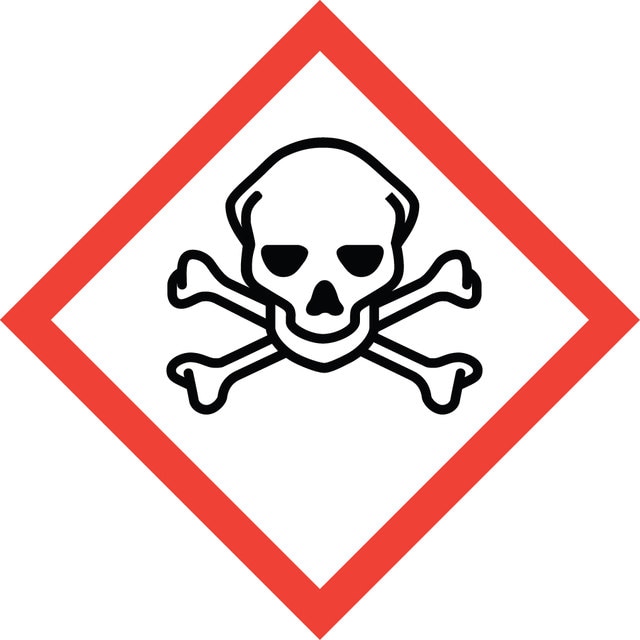

signalword
Danger
hcodes
Hazard Classifications
Acute Tox. 1 Dermal - Acute Tox. 2 Inhalation - Acute Tox. 2 Oral - Eye Dam. 1 - Skin Corr. 1B
保管分類
6.1A - Combustible acute toxic Cat. 1 and 2 / very toxic hazardous materials
wgk
WGK 1
flash_point_f
Not applicable
flash_point_c
Not applicable
ppe
Eyeshields, Faceshields, Gloves, type P3 (EN 143) respirator cartridges
適用法令
試験研究用途を考慮した関連法令を主に挙げております。化学物質以外については、一部の情報のみ提供しています。 製品を安全かつ合法的に使用することは、使用者の義務です。最新情報により修正される場合があります。WEBの反映には時間を要することがあるため、適宜SDSをご参照ください。
名称等を表示すべき危険物及び有害物
ishl_indicated
名称等を通知すべき危険物及び有害物
ishl_notified
O5500-250MG:4548173950556 + O5500-VAR: + O5500-10X1G:4548173950532 + O5500-1G:4548173950549 + O5500-1G-PW: + O5500-BULK: + O5500-250MG-PW:
jan
Yukihiko Sugita et al.
The Journal of general virology, 92(Pt 11), 2485-2493 (2011-07-29)
Negatively stained influenza virions sometimes show irregular morphology and are often referred to as pleomorphic. However, this irregular morphology has not been visualized when ultrathin-section transmission and scanning electron microscopies are used. This study focused on the effects of ultracentrifugation
Carsten Købler et al.
Analytical and bioanalytical chemistry, 406(16), 3863-3873 (2014-01-23)
Ultrastructural characterisation is important for understanding carbon nanotube (CNT) toxicity and how the CNTs interact with cells and tissues. The standard method for this involves using transmission electron microscopy (TEM). However, in particular, the sample preparation, using a microtome to
F Wyss et al.
Veterinary pathology, 52(6), 1235-1242 (2015-01-27)
Pododermatitis is frequent in captive flamingos worldwide, but little is known about the associated histopathologic lesions. Involvement of a papillomavirus or herpesvirus has been suspected. Histopathologic evaluation and viral assessment of biopsies from 19 live and 10 dead captive greater
Manuel Marx et al.
Nature protocols, 7(2), 394-407 (2012-02-04)
In this report, we describe a reliable protocol for biocytin labeling of neuronal tissue and diaminobenzidine (DAB)-based processing of brain slices. We describe how to embed tissues in different media and how to subsequently histochemically label the tissues for light
Stephanie J Bissel et al.
Journal of neuropathology and experimental neurology, 74(8), 767-777 (2015-06-27)
Human parechovirus 3 (HPeV3) is a picornavirus associated with neurologic disease in neonates. Human parechovirus 3 infection of preterm and term infants is associated with seizures and destructive periventricular white matter lesions. Despite unremarkable cerebrospinal fluid (CSF), HPeV3 RNA can
ライフサイエンス、有機合成、材料科学、クロマトグラフィー、分析など、あらゆる分野の研究に経験のあるメンバーがおります。.
製品に関するお問い合わせはこちら(テクニカルサービス)