ログインで組織・契約価格をご覧ください。
サイズを選択してください
この商品について
化学式:
CH3CH2COOH
CAS番号:
分子量:
74.08
UNSPSC Code:
12352207
NACRES:
NA.71
PubChem Substance ID:
EC Number:
201-176-3
Beilstein/REAXYS Number:
506071
MDL number:
製品名
プロピオン酸, BioReagent, suitable for insect cell culture, ~98%
InChI key
XBDQKXXYIPTUBI-UHFFFAOYSA-N
InChI
1S/C3H6O2/c1-2-3(4)5/h2H2,1H3,(H,4,5)
SMILES string
CCC(O)=O
vapor density
2.55 (vs air)
vapor pressure
2.4 mmHg ( 20 °C)
product line
BioReagent
assay
~98%
autoignition temp.
955 °F
expl. lim.
12.1 %
technique(s)
cell culture | insect: suitable
refractive index
n20/D 1.386 (lit.)
bp
141 °C (lit.)
mp
−24-−23 °C (lit.)
solubility
H2O: soluble
density
0.99 g/mL at 25 °C (lit.)
0.993 g/mL at 25 °C (lit.)
Quality Level
類似した製品をお探しですか? 訪問 製品比較ガイド
Application
Use in insect cell culture to inhibit mold growth.
General description
Propionic acid (PA) is a naturally occurring carboxylic acid, which in its pure state exists as a colorless corrosive liquid with an unpleasant odor. It is miscible in water. Industrially it is produced by hydrocarboxylation of ethylene in presence nickel carbonyl as a catalyst. PA has been found to reduce food intake, lower the fatty acids content in plasma and liver, might improve tissue insulin sensitivity and exerts immunosuppressive actions. Propionic acid is an excellent raw material as it is stable, cheap and safe and can even be used as a food additive.
signalword
Danger
hcodes
Hazard Classifications
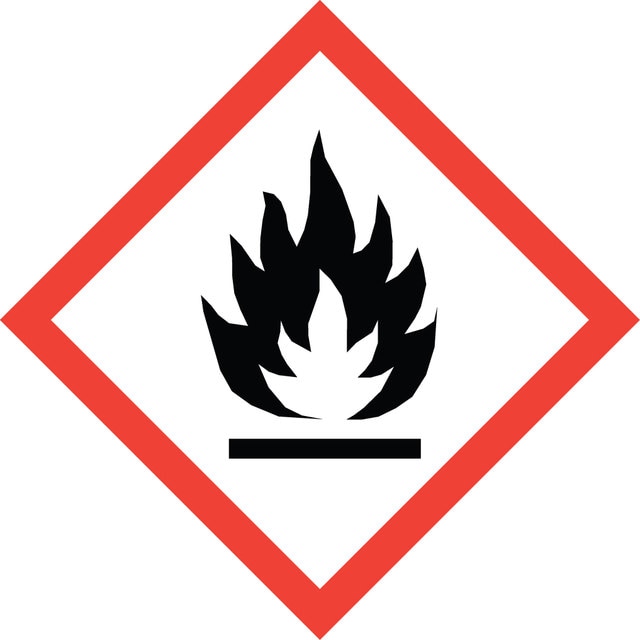
Eye Dam. 1 - Flam. Liq. 3 - Skin Corr. 1B - STOT SE 3
target_organs
Respiratory system
保管分類
3 - Flammable liquids
wgk
WGK 1
flash_point_f
129.2 °F - closed cup
flash_point_c
54 °C - closed cup
ppe
Faceshields, Gloves, Goggles, type ABEK (EN14387) respirator filter
Nucleophilic ?-Carbon Activation of Propionic Acid as a 3-Carbon Synthon by Carbene Organocatalysis
Jin, Zhichao, et al.
Chemistry?A European Journal, 21 (26), 9360-9363 (2015)
Flour and Breads and their Fortification in Health and Disease Prevention.
Victor R. Preedy, Ronald Ross Watson, Vinood B
Technology & Engineering, 476-476 (2011)
Biological effects of propionic acid in humans; metabolism, potential applications and underlying mechanisms
Sa'ad, H., et al.
Molecular and Cellular Biology, 1801 (11), 1175-1183 (2010)
Sa'ad H Al-Lahham et al.
Biochimica et biophysica acta, 1801(11), 1175-1183 (2010-08-10)
Undigested food is fermented in the colon by the microbiota and gives rise to various microbial metabolites. Short-chain fatty acids (SCFA), including acetic, propionic and butyric acid, are the principal metabolites produced. However, most of the literature focuses on butyrate
Eddy J Smid et al.
Current opinion in biotechnology, 24(2), 148-154 (2012-12-12)
Most known natural and industrial food fermentation processes are driven by either simple or complex communities of microorganisms. Obviously, these fermenting microbes will not only interact with the fermentable substrate but also with each other. These microbe-microbe interactions are complex
ライフサイエンス、有機合成、材料科学、クロマトグラフィー、分析など、あらゆる分野の研究に経験のあるメンバーがおります。.
製品に関するお問い合わせはこちら(テクニカルサービス)