コンテンツへスキップ
Merck

40012

1,1-Dichloroethane solution

certified reference material, 5000 μg/mL in methanol

ログインで組織・契約価格をご覧ください。

サイズを選択してください


この商品について

実験式(ヒル表記法):
C2H4Cl2
CAS番号:
分子量:
98.96
MDL number:
UNSPSC Code:
41116107
EC Number:
200-659-6
テクニカルサービス
お困りのことがあれば、経験豊富なテクニカルサービスチームがお客様をサポートします。
お手伝いします
テクニカルサービス
お困りのことがあれば、経験豊富なテクニカルサービスチームがお客様をサポートします。
お手伝いします

製品名

1,1-Dichloroethane solution, certified reference material, 5000 μg/mL in methanol

SMILES string

ClC(Cl)C

InChI key

SCYULBFZEHDVBN-UHFFFAOYSA-N

InChI

1S/C2H4Cl2/c1-2(3)4/h2H,1H3

grade

certified reference material
TraceCERT®

product line

TraceCERT®

CofA

current certificate can be downloaded

packaging

ampule of 1 mL

concentration

5000 μg/mL in methanol

technique(s)

HPLC: suitable
gas chromatography (GC): suitable

application(s)

environmental

format

single component solution

storage temp.

2-8°C

類似した製品をお探しですか? 訪問 製品比較ガイド

Application

Refer to the product′s Certificate of Analysis for more information on a suitable instrument technique. Contact Technical Service for further support.

Other Notes

This Certified Reference Material (CRM) is produced and certified in accordance with ISO 17034 and ISO/IEC 17025. All information regarding the use of this CRM can be found on the certificate of analysis.

Legal Information

TraceCERT is a registered trademark of Merck KGaA, Darmstadt, Germany

signalword

Danger

Hazard Classifications

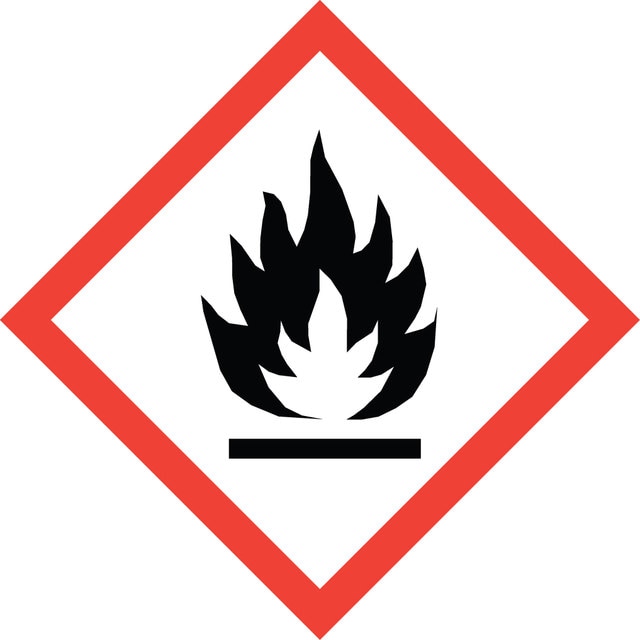
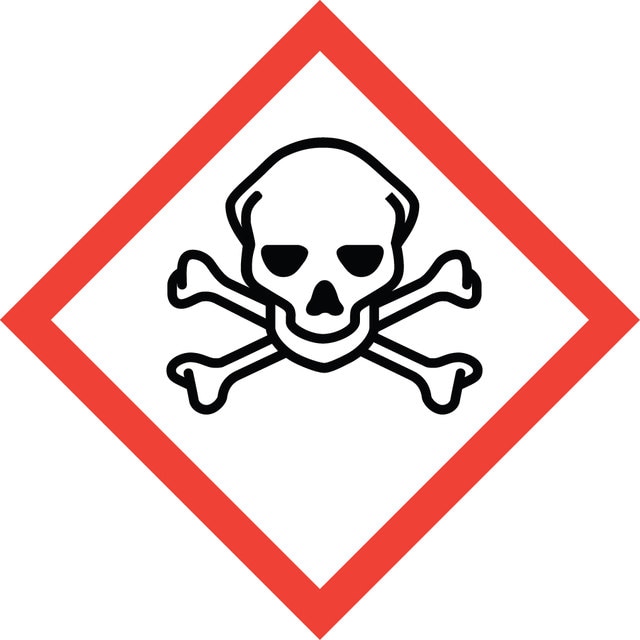
Acute Tox. 3 Dermal - Acute Tox. 3 Inhalation - Acute Tox. 3 Oral - Flam. Liq. 2 - STOT SE 1

target_organs

Eyes

保管分類

3 - Flammable liquids

wgk

WGK 2

flash_point_f

51.8 °F - closed cup

flash_point_c

11 °C - closed cup

ppe

Eyeshields, Faceshields, Gloves


試験成績書(COA)

製品のロット番号・バッチ番号を入力して、試験成績書(COA) を検索できます。ロット番号・バッチ番号は、製品ラベルに「Lot」または「Batch」に続いて記載されています。

以前この製品を購入いただいたことがある場合

文書ライブラリで、最近購入した製品の文書を検索できます。

文書ライブラリにアクセスする

Nancy Vanstone et al.
Environmental science & technology, 42(1), 126-132 (2008-03-21)
Degradation of 1,1- and 1,2-dichloroethane (1,1-DCA, 1,2-DCA) and carbon tetrachloride (CCl4) on Zn0 was investigated using compound specific isotope analysis (CSIA) to measure isotopic fractionation factors for chloroalkane degradation by hydrogenolysis, by alpha-elimination, and by beta-elimination. Significant differences in enrichment
Simon M Pimblott et al.
The journal of physical chemistry. A, 109(45), 10294-10301 (2006-07-13)
The yields of chloride ion and molecular hydrogen were determined in the gamma, the fast electron, and the 5 MeV helium ion radiolysis of deaerated and aerated aqueous solutions of 1,1- and 1,2-dichloroethane. In deaerated solutions irradiated with gamma-rays or
Lewis Semprini et al.
Journal of contaminant hydrology, 103(3-4), 157-167 (2008-11-22)
A field study was performed to evaluate the potential for in-situ aerobic cometabolism of 1,1,1-trichloroethane (1,1,1-TCA) through bioaugmentation with a butane enrichment culture containing predominantly two Rhodococcus sp. strains named 179BP and 183BP that could cometabolize 1,1,1-TCA and 1,1-dicholoroethene (1,1-DCE).
Miklós Lakatos
Journal of pharmaceutical and biomedical analysis, 47(4-5), 954-957 (2008-04-26)
The purge-and-trap (P&T) gas extraction method combined with gas chromatography was studied for its suitability for quantitative residual solvents determination in a water-soluble active pharmaceutical ingredient (API). Some analytical method performance characteristics were investigated, namely, the repeatability, the accuracy and
Babu P Patlolla et al.
International journal of environmental research and public health, 2(1), 101-106 (2006-05-19)
The major concern for the halogenated compounds is their widespread distribution, in addition to occupational exposures. Several chlorinated alkanes and alkenes were found to induce toxic effects. In this study, we investigated the genotoxic potential of 1,1-dichloroethane in the bone

ライフサイエンス、有機合成、材料科学、クロマトグラフィー、分析など、あらゆる分野の研究に経験のあるメンバーがおります。.

製品に関するお問い合わせはこちら(テクニカルサービス)