
Skip to Content
Merck

W270733

6-Methyl-5-hepten-2-one

greener alternative

natural, ≥98%, FCC

Synonym(s):

6-methylhept-5-en-2-one, Methyl heptenone

Sign In to View Organizational & Contract Pricing.

Select a Size

Change View

About This Item

Linear Formula:
(CH3)2C=CHCH2CH2COCH3
CAS Number:
Molecular Weight:
126.20
FEMA Number:
2707
Council of Europe no.:
149c
UNSPSC Code:
12164502
PubChem Substance ID:
Flavis number:
7.015
EC Number:
203-816-7
NACRES:
NA.21
MDL number:
Beilstein/REAXYS Number:
1741705
Organoleptic:
apple; musty; fruity
Grade:
Fragrance grade, Kosher, natural
Agency:
follows IFRA guidelines, meets purity specifications of JECFA
Food allergen:
no known allergens
Technical Service
Need help? Our team of experienced scientists is here for you.
Let Us Assist


Quality Segment

grade

Fragrance grade, Kosher, natural

agency

follows IFRA guidelines, meets purity specifications of JECFA

reg. compliance

EU Regulation 1223/2009, FCC

assay

≥98%

greener alternative product characteristics

Less Hazardous Chemical Syntheses
Use of Renewable Feedstocks
Learn more about the Principles of Green Chemistry.

sustainability

Greener Alternative Product

refractive index

n20/D 1.439 (lit.)

bp

73 °C/18 mmHg (lit.)

density

0.858 g/mL at 20 °C, 0.855 g/mL at 25 °C (lit.)

application(s)

flavors and fragrances

documentation

see Safety & Documentation for available documents

food allergen

no known allergens

fragrance allergen

no known allergens

greener alternative category

organoleptic

apple; musty; fruity

SMILES string

C\C(C)=C\CCC(C)=O

InChI

1S/C8H14O/c1-7(2)5-4-6-8(3)9/h5H,4,6H2,1-3H3

InChI key

UHEPJGULSIKKTP-UHFFFAOYSA-N

General description

6-Methyl-5-hepten-2-one is one of the main flavor volatile of tomatoes.
We are committed to bringing you Greener Alternative Products, which adhere to one of the four categories of Greener Alternatives . This product is a Biobased products, showing key improvements in Green Chemistry Principles “Less Hazardous Chemical Syntheses” and “Use of Renewable Feedstock”.

Disclaimer

For R&D or non-EU Food use. Not for retail sale.


Still not finding the right product?

Explore all of our products under 6-Methyl-5-hepten-2-one
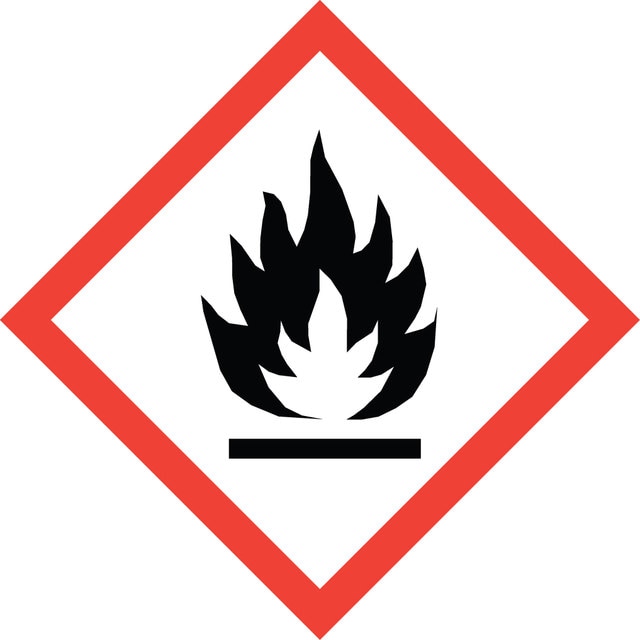

pictograms

Flame

signalword

Warning

hcodes

Hazard Classifications

Flam. Liq. 3

Storage Class

3 - Flammable liquids

wgk

WGK 1

flash_point_f

132.8 °F - closed cup

flash_point_c

56 °C - closed cup

ppe

Eyeshields, Gloves, multi-purpose combination respirator cartridge (US)


Choose from one of the most recent versions:

Certificates of Analysis (COA)

Lot/Batch Number

Don't see the Right Version?

If you require a particular version, you can look up a specific certificate by the Lot or Batch number.

Already Own This Product?

Find documentation for the products that you have recently purchased in the Document Library.

Visit the Document Library


Relationship between sensory and instrumental analysis for tomato flavor.
Baldwin EA, et al.
J. Am. Soc. Hort. Sci., 123(5), 906-915 (1998)
B D Whitaker et al.
Journal of agricultural and food chemistry, 48(6), 2040-2043 (2000-07-11)
Conjugated triene (CT) oxidation products of alpha-farnesene have long been thought to be involved in development of superficial scald in apple fruit. Early studies found that CT hydroperoxides and the volatile 6-methyl-5-hepten-2-one (MHO) are major in vitro autoxidation products of
Thangavel Rajagopal et al.
Behavioural processes, 85(1), 58-67 (2010-06-16)
In ungulates the process of chemical communication by urinary scent marking has been directly related to reproductive dominance, territorial defense and proximity to resources. The differences in the frequency of urine marking and chemical composition of urine of males Antelope