Sign In to View Organizational & Contract Pricing.
Select a Size
Change View
About This Item
Linear Formula:
CH3(CH2)3COCH3
CAS Number:
Molecular Weight:
100.16
UNSPSC Code:
77101502
NACRES:
NA.24
PubChem Substance ID:
EC Number:
209-731-1
Beilstein/REAXYS Number:
1737676
MDL number:
grade
analytical standard
Quality Level
agency
ASTM® D5580
vapor pressure
10 mmHg ( 39 °C)
CofA
current certificate can be downloaded
packaging
pkg of 5 mL
technique(s)
HPLC: suitable, gas chromatography (GC): suitable
refractive index
n20/D 1.401 (lit.)
bp
127 °C (lit.)
mp
−57 °C (lit.)
density
0.812 g/mL at 25 °C (lit.)
application(s)
cleaning products
cosmetics
food and beverages
personal care
petroleum
format
neat
storage temp.
2-30°C
SMILES string
CCCCC(C)=O
InChI
1S/C6H12O/c1-3-4-5-6(2)7/h3-5H2,1-2H3
InChI key
QQZOPKMRPOGIEB-UHFFFAOYSA-N
General description
2-Hexanone is a colorless to pale yellow liquid with sharp odor belonging to the class of ketones. It is obtained as a waste product of coal gasification, oil shale operations and wood pulping. It is widely used as a solvent in industry.
Application
2-Hexanone may be used as an analytical reference standard for the quantification of the analyte in biological samples using liquid chromatography−tandem mass spectrometry (LC−MS−MS).
Refer to the product′s Certificate of Analysis for more information on a suitable instrument technique. Contact Technical Service for further support.
Legal Information
ASTM is a registered trademark of American Society for Testing and Materials
Still not finding the right product?
Explore all of our products under 2-Hexanone
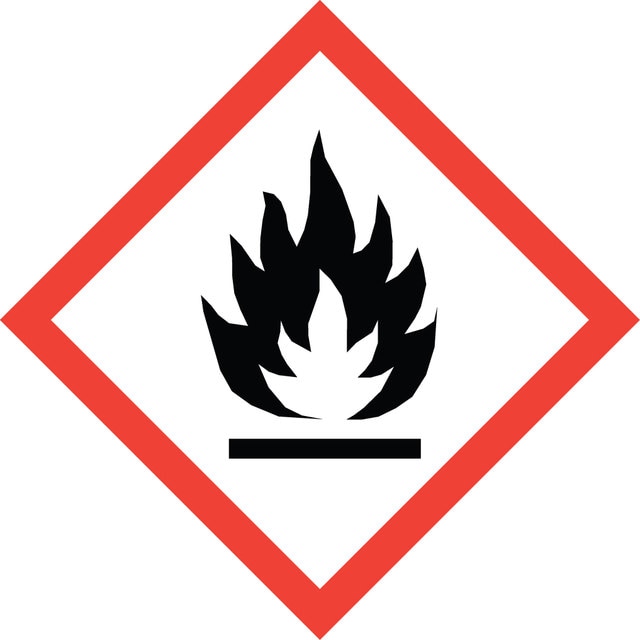
signalword
Danger
hcodes
Hazard Classifications
Flam. Liq. 3 - Repr. 2 - STOT RE 1 - STOT SE 3
target_organs
Central nervous system
Storage Class
3 - Flammable liquids
flash_point_f
73.4 °F - closed cup
flash_point_c
23 °C - closed cup
ppe
Eyeshields, Faceshields, Gloves, type ABEK (EN14387) respirator filter
Choose from one of the most recent versions:
Already Own This Product?
Find documentation for the products that you have recently purchased in the Document Library.
Application of liquid chromatography-mass spectrometry to biomonitoring of exposure to industrial chemicals
Manini P, et al.
Toxicology Letters, 162(2-3), 202-210 (2006)
Handbook of Chemicals and Safety (2016)
Y Lolin
Human toxicology, 8(4), 293-300 (1989-07-01)
1. The main neurological disorders associated with chronic VSA are peripheral neuropathy, cerebellar disease, chronic encephalopathy and dementia. Apart from peripheral neuropathy, the clinical features are non-specific, evidence for solvent-related toxicity is in most cases circumstantial and there is no